• 2 min read
AI may not end humanity, model suggests cycles instead
A 1,000-year civilization model found collapse is not always final. Recovery depends mainly on resource depletion and how much a society can rebuild after crises.
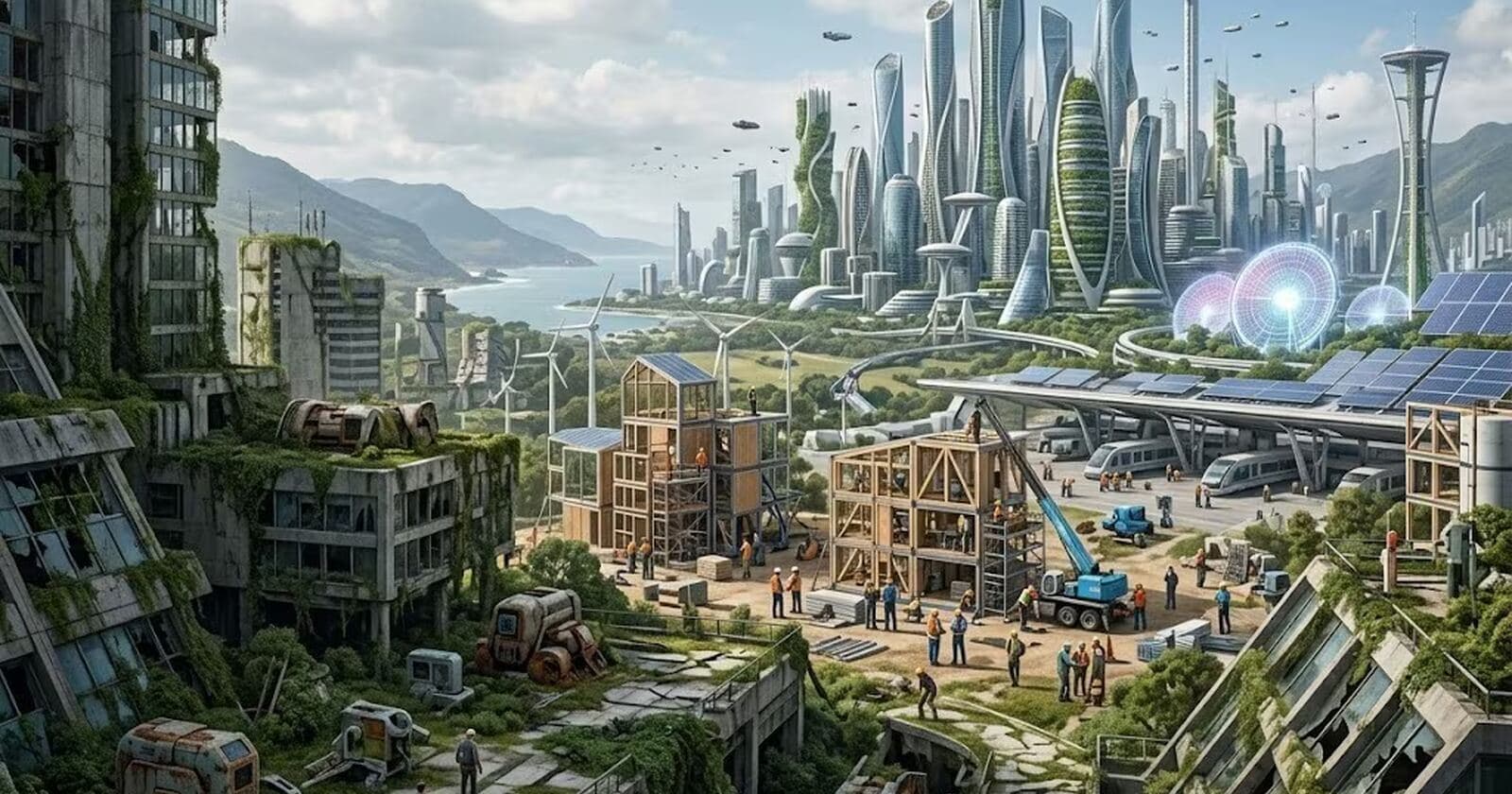
Image: ITzine
Scientists modeled 1,000 years in the life of a technological civilization and came away with a far less apocalyptic view of humanity’s future than the usual end-of-the-world narratives. In their results, the future does not have to move in a straight line — either upward until the end or downward in a single crash. Societies can collapse and later return to a high technological level.
The study’s core point is that long-term survival hinges less on one huge catastrophe and more on how fast a system consumes resources and how well it can rebuild. The authors ran 10 future Earth scenarios through a hybrid model that combined deterministic calculations with noise and random parameter shifts. Each version accounted for technology, resources, crisis risk, and the ability to recover from downturns.
The output was not a single clean curve but a range of different outcomes. In some scenarios, development was barely interrupted. In others, civilization repeatedly fell and then climbed back from the bottom.

Recommended reading
Apollo 11 Code Lives On in a Public GitHub Archive
The main metric was the “activity share” — the fraction of time a civilization remains at a high technological level. Across scenarios, that figure ranged from 0.38 to 1.00. In practice, that means some modeled societies barely slowed down over the millennium, while others spent a large share of it in a state of technological amnesia before recovering.
The model was most sensitive to two variables: the rate of resource depletion and the share of the system that survives and recovers after a crisis. If resources are exhausted too quickly, stability starts to break down before any external shock even arrives. That aligns with earlier collapse models, which also found that internal limits matter more often than meteors, wars, or other science-fiction-style causes.
The researchers argue that moderate consumption may be just as important for survival as efforts to guard against global risks. That is an uncomfortable but useful signal for debates around AI: the resilience of civilization depends not only on how powerful technology becomes, but on whether the broader system can withstand its own appetite.
The model also connects to the search for extraterrestrial life. If technological societies can enter periods of “hibernation” and later return, then the silence of space does not necessarily mean intelligent civilizations are absent. Some may simply not be in a detectable phase.
For astronomy, that has a practical implication: researchers may need to look not just at how long a civilization exists, but at when it is visible through technosignatures. If cyclical decline and recovery are common, the lack of evidence may reflect bad timing rather than an empty universe. For Earth, that leaves a more hopeful possibility: collapse does not have to be the final point.

Frontier Editor
Dan is our resident futurist, covering electric mobility, space exploration, and the smart home. He's interested in atoms just as much as bits. Whether it's a new battery chemistry, a reusable rocket, or a protocol that finally makes IoT devices talk to each other, Dan breaks down the engineering that pushes humanity forward.
via ITzine