• 2 min read
AMD Helios packs 72 GPUs into one rack
AMD’s first rack-scale AI system combines 72 MI455X GPUs, 31TB of HBM4, and 2.9 exaflops of FP4 inference. Samples arrive in H2 2026.
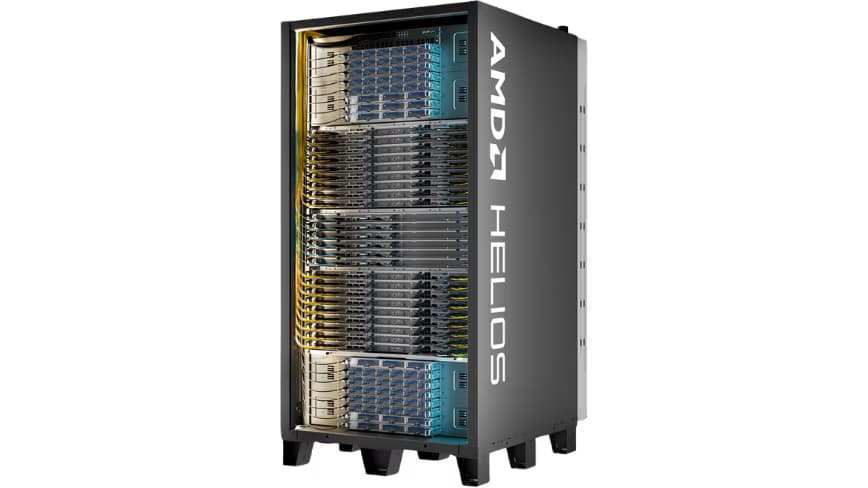
Image: TNW
AMD has unveiled Helios, its first rack-scale AI system, built as a direct rival to Nvidia’s Vera Rubin NVL72. In a single rack, Helios combines 72 Instinct MI455X GPUs, 31TB of HBM4 memory, and 2.9 exaflops of FP4 inference compute.
The system is organized into 18 compute trays, each with four MI455X accelerators based on the new CDNA 5 architecture and one sixth-generation EPYC “Venice” CPU. Engineering samples are due in the second half of 2026, with mass production set for Q2 2027.
AMD is making a clear platform bet on open standards. Helios uses UALink for GPU-to-GPU scale-up interconnect inside the rack, Ultra Ethernet Consortium specifications for networking between racks, and the OCP Open Rack Wide form factor. That contrasts with Nvidia’s proprietary NVLink, giving AMD a pitch aimed at data center operators that want to avoid lock-in to a single vendor’s interconnect.
Memory is a big part of that pitch. Each MI455X GPU includes HBM4 with 19.6 TB/s of bandwidth. Across the full rack, Helios delivers 260 TB/s of scale-up bandwidth and 43 TB/s of scale-out bandwidth. As the source notes, that matters for frontier model training and long-context inference, where memory capacity and data movement are becoming as critical as raw compute.

Recommended reading
World Cup 2026 Is Stress-Testing Supply Chains
The networking is handled by AMD Pensando AI NICs, using programmable hardware and UEC-ready RDMA.
Supermicro showed Helios hardware at Computex in June. AMD also committed billions to UK AI infrastructure at London Tech Week, and according to the source, Helios is the hardware that will run those commitments.
On software, AMD says its ROCm stack supports PyTorch, TensorFlow, and JAX, which in theory lets developers move from Nvidia’s CUDA ecosystem without rewriting code. The hardware numbers are competitive; whether AMD can narrow the software gap with Nvidia is the harder test, and Helios is its clearest attempt yet to force that comparison.

Enterprise Editor
Marcus follows the money. He covers enterprise software, cloud architecture, and the tectonic shifts in Big Tech strategy. He translates dense earnings calls and complex M&A activity into actionable insights about where the industry is actually heading. If a tech giant makes a silent pivot, Marcus is usually the first to notice.
via TNW