• 2 min read
200+ experts urge action on AI’s economic shock
More than 200 economists and AI leaders, including 16 Nobel laureates, warn AI could reshape the economy faster than the Industrial Revolution.
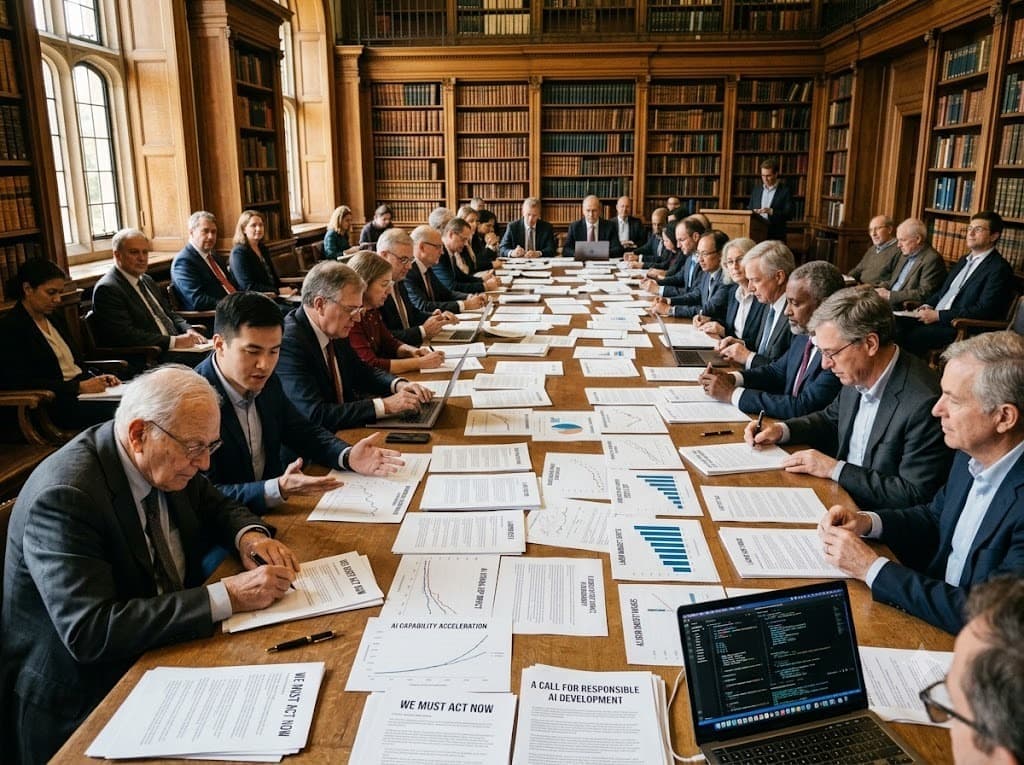
Image: iXBT
More than 200 economists and AI experts, including 16 Nobel laureates, have signed an open letter warning that the economic effects of artificial intelligence could arrive far faster than governments and institutions are prepared for.
The letter, titled “We Must Act Now,” was prepared by Stanford University’s Digital Economy Lab and calls for urgent work on policies that can help economies and public institutions adapt to rapid AI-driven change. Its authors say that within the next 10 years, AI systems could become dramatically more powerful and trigger an economic transformation larger than the Industrial Revolution, but compressed into a much shorter period.
They argue that AI could both raise productivity and improve living standards while also creating a serious risk of large-scale job displacement. Because of that, the letter says, economists, governments, and technology companies need to work together to study AI’s impact and build mechanisms that steer the technology toward broad public benefit rather than narrow gains for a small group of firms or individuals.
The document also says current economic metrics and models are not sufficient to measure AI’s effects on employment, income distribution, and productivity. That gap, the authors say, makes it difficult to produce a detailed response even as the technology moves quickly.

Recommended reading
Google faces publishers' Gemini copyright suit
Erik Brynjolfsson, director of Stanford’s Digital Economy Lab, said AI capabilities are advancing much faster than understanding of their economic consequences. He argued that this gap demands immediate action so the benefits of the technology reach society broadly.
Michael Spence, a Nobel laureate, said the scale, speed, and uncertainty of AI’s effects require “all hands on deck.” Anton Korinek, a University of Virginia professor and Anthropic researcher, drew a contrast with earlier technology waves: society had decades to adapt to steam engines, electricity, and computers, but may have only a few years to adapt to AI.
Among the signatories are Michael Spence (2001 Nobel Prize in Economics), Daron Acemoglu (2024), Joseph Stiglitz (2001), Paul Krugman (2008), and Ben Bernanke (2022). The letter was also backed by leaders from Google, Anthropic, and OpenAI, including Jeff Dean, Jack Clark, Sarah Friar, and Noam Brown.
The warning lands as Google DeepMind CEO Demis Hassabis, who did not sign the letter, has separately said that artificial general intelligence (AG) could arrive within five years. He said its effect on the global economy could amount to “tenfold industrialization at tenfold speed.”

AI Editor
Ava covers the rapidly evolving world of artificial intelligence, from foundational models and research labs to the real-world economics of intelligence. With a background in computational linguistics, she cuts through the hype to find out what actually works. She firmly believes that benchmarks are just marketing until reproduced in the wild.
via iXBT