• 3 min read
New acoustic chip handles 12x more power
HKUST says its new acoustic chip architecture cuts heat by 70% and survives more than 12 times higher power loads for 6G and satellite links.
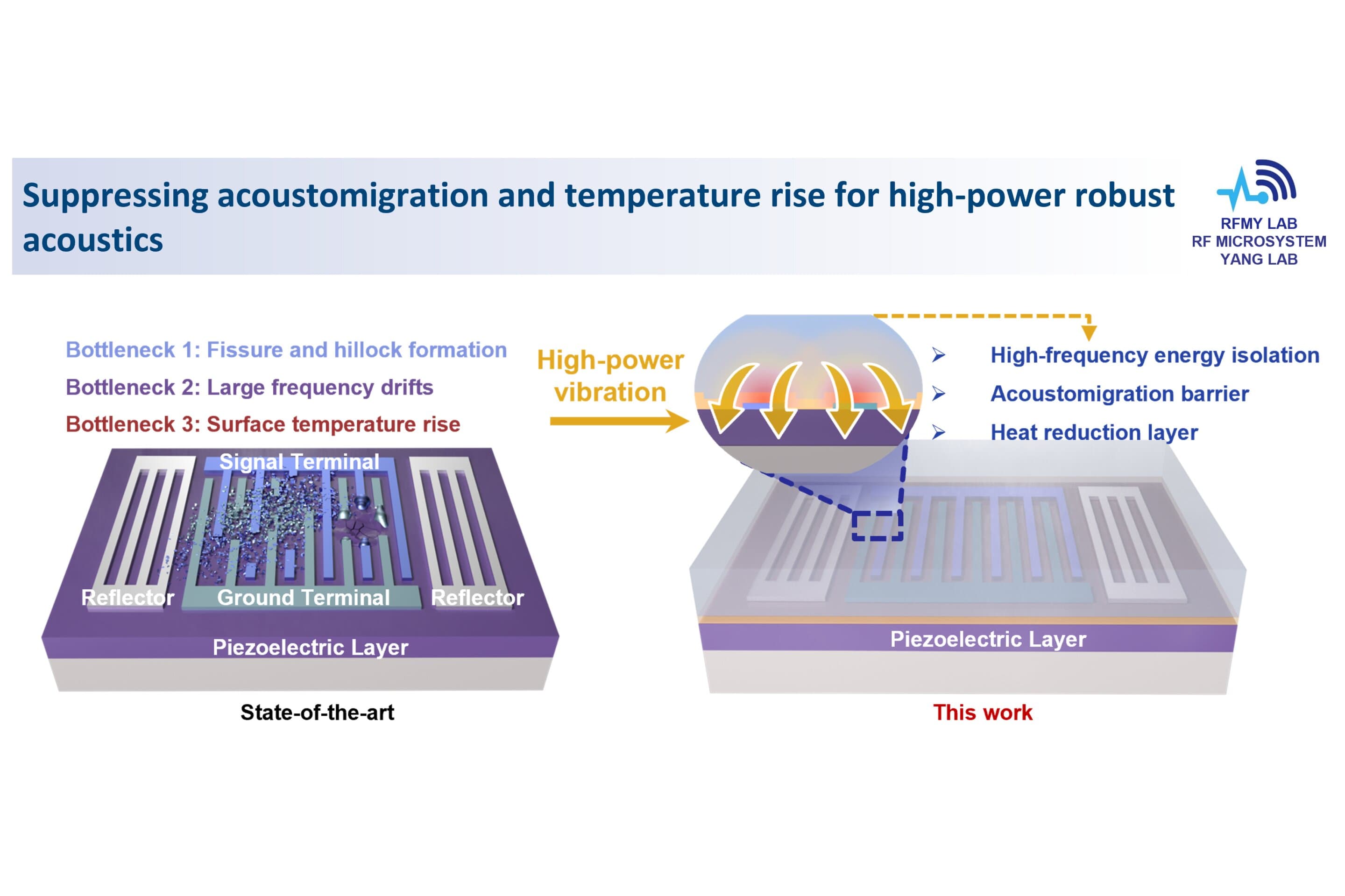
Image: TechXplore
Researchers at The Hong Kong University of Science and Technology (HKUST) say they have broken a long-standing limit in acoustic chip design, creating a structure that can withstand more than 12 times higher power loads while running cooler and more stably. In tests on transducers vibrating at more than 2 billion times per second, the team’s Layered Acoustic Wave (LAW) platform cut temperature rise by 70% and reached a record power-density threshold of 36.4 W/mm².
The work, led by Yansong Yang, assistant professor in HKUST’s Department of Electronic and Computer Engineering, with doctoral student Fangsheng Qian as first author, was published in Nature Communications in a paper titled “Suppressing acoustomigration and temperature rise for high-power robust acoustics.”
Acoustic wave devices are widely used to filter radio-frequency signals in smartphones and mobile base stations. But at high power, they have struggled with three persistent problems: metal atom migration in electrodes, frequency drift caused by heat, and cracking or delamination in the piezoelectric thin film. Existing fixes have largely focused on substrate materials such as silicon carbide or diamond, but the HKUST team argued that approach leaves heat and stress concentrated near the device’s top vibrating surface.
Their LAW design changes that boundary instead. It places the vibrating surface of a lithium niobate thin-film device beneath a stack made of a silicon dioxide isolation layer and a thick amorphous silicon overlayer. According to HKUST, that top stack performs three jobs at once: it redistributes mechanical stress, spreads heat away from hot spots, and compensates for thermal expansion to stabilize frequency.

Recommended reading
Lenovo’s tiny Lecoo AI Mini packs dual Ethernet
The reported gains were substantial. Under identical power levels, the LAW transducer saw a steady-state temperature rise of 5.2°C, versus 17.4°C for a state-of-the-art TF-SAW control device. HKUST said the LAW device endured an injected power density of 45.61 dBm/mm² (36.4 W/mm²), or 12.73 times the TF-SAW threshold, while maintaining a first-order temperature coefficient of frequency of −13 ppm/°C from −150°C to 325°C (−238°F to 617°F).
At −85°C (−121°F), the threshold rose to 49.45 dBm/mm² (88.11 W/mm²), which HKUST said was a 13.85-fold increase over the TF-SAW control threshold, a result the team says could matter for cryogenic quantum acoustic systems.
“For decades, the community accepted two 'givens': that the surface of an acoustic wave device must stay open to the air, and that high-power operation was far out of reach. We have proven that both assumptions can be broken at the same time.”
Yang said the approach could help move acoustic technology beyond small-signal components into applications including direct-to-cell satellite connectivity, 6G networks, and energy conversion. Qian added that the architecture does more than cool the device: it reduces the peak stress driving metal migration to about one-quarter, aiming to address failure at its source.
HKUST says the design principles should apply broadly across acoustic systems based on interdigital transducers, with possible use in next-generation RF filters, quantum acoustic circuits, acousto-optic and microfluidic systems, and miniaturized nonmagnetic power-conversion modules.
The paper’s DOI is 10.1038/s41467-026-72102-7.

Computing Editor
Tomas lives in the terminal. He covers chips, laptops, and operating systems with a focus on performance and efficiency. He reads kernel changelogs the way other people read fiction, and he's always on the hunt for the perfect mechanical keyboard switch. If it processes data, Tomas has an opinion on it.
via TechXplore