• 2 min read
Blue perovskite LEDs get a big stability boost
A Nature study reports blue perovskite LEDs with 16.8% and 22.0% external quantum efficiency, using isomeric hydrogen bonding to improve stability.
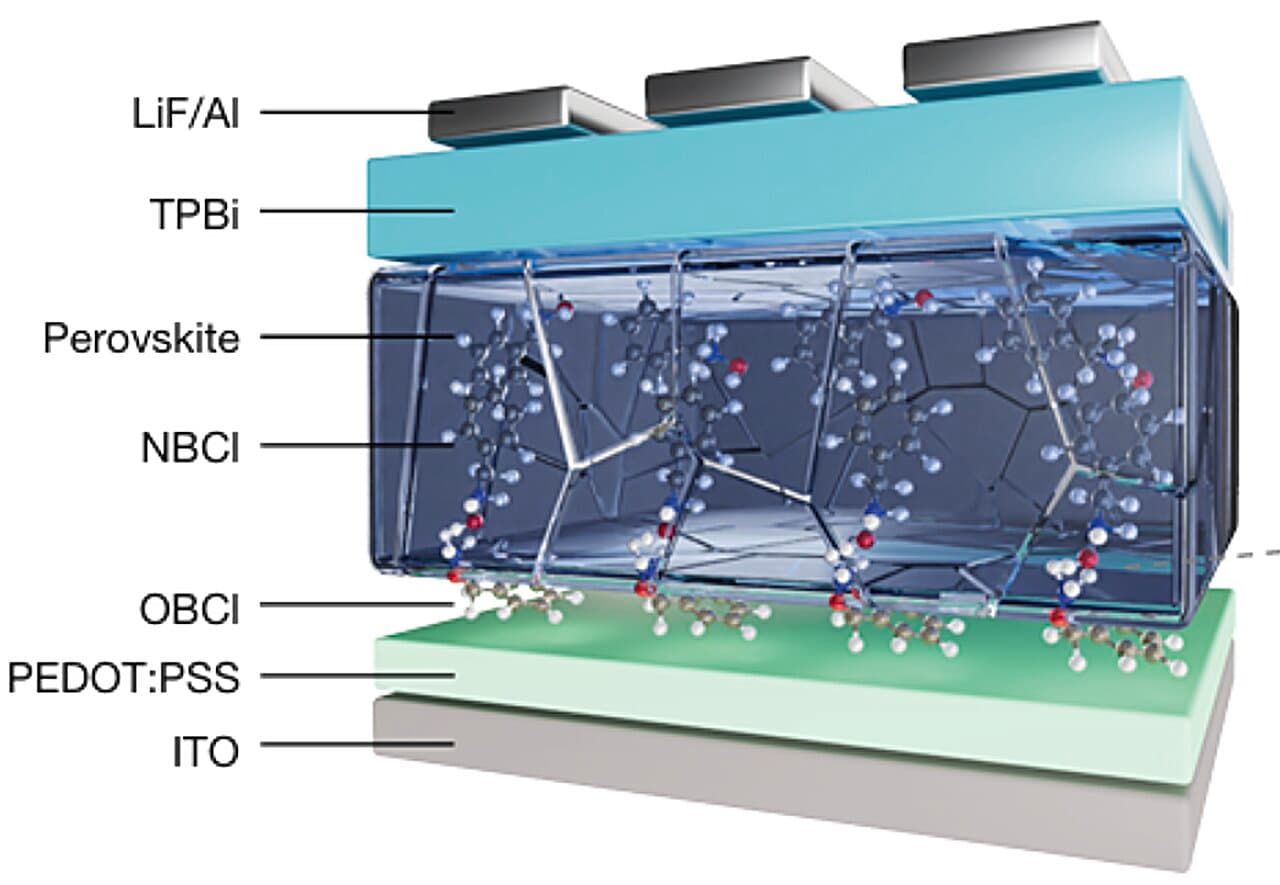
Image: TechXplore
Blue perovskite LEDs have long lagged behind red and green versions, but a team led by Xuyong Yang at Shanghai University says it has cleared a major hurdle. In research published in Nature, the group built perovskite LEDs that produce a vivid, saturated blue while lasting longer than earlier designs.
Perovskites have attracted attention because their crystal structure can be chemically tuned to emit different colors, and the materials can be grown from solution, making them relatively cheap and easier to manufacture at scale. But blue light has been the toughest target. It requires a wider energy gap between electron states, which means higher voltage and more electrical stress inside the device. That stress destabilizes the ion-based crystal lattice, causing blue perovskite LEDs to degrade faster and shine less brightly than red and green ones.
Yang’s team tackled the problem with two isomers—molecules made from the same atoms but arranged differently. One, OBCl, was placed at the interface between the perovskite and the layer that supplies positive charge carriers. The other, NBCl, was mixed directly into the perovskite. According to the researchers, both molecules can donate or accept a hydrogen atom, unlike similar molecules used in earlier designs that could only donate one. That lets them form a denser network of hydrogen bonds, helping stabilize the crystal, improve charge transport, and reduce the energy needed to inject charge carriers.

Recommended reading
Samsung sets up RX unit to speed robot push
The resulting devices reached external quantum efficiencies of 16.8% at a pure-blue wavelength and 22.0% at a slightly longer, deep-blue wavelength. Stability also improved, although the team said the LEDs still run for only a few hundred minutes—better than earlier deep-blue perovskite devices, but still well short of display-grade lifetimes.
Even so, the work points to a clearer route toward full-color perovskite displays. The researchers also say the same hydrogen-bonding approach could be useful in other perovskite-based devices, including solar cells and sensors.
The paper is “Isomeric multi-hydrogen-bonding enables blue perovskite LEDs” by Yuanzhi Wang et al in Nature (2026), DOI: 10.1038/s41586-026-10723-0.

Frontier Editor
Dan is our resident futurist, covering electric mobility, space exploration, and the smart home. He's interested in atoms just as much as bits. Whether it's a new battery chemistry, a reusable rocket, or a protocol that finally makes IoT devices talk to each other, Dan breaks down the engineering that pushes humanity forward.
via TechXplore