• 2 min read
Captains' routes beat conventional AI at ship navigation
Osaka Metropolitan University trained a ship-navigation model on real captain maneuvers, and it outperformed two conventional AI systems in simulation.
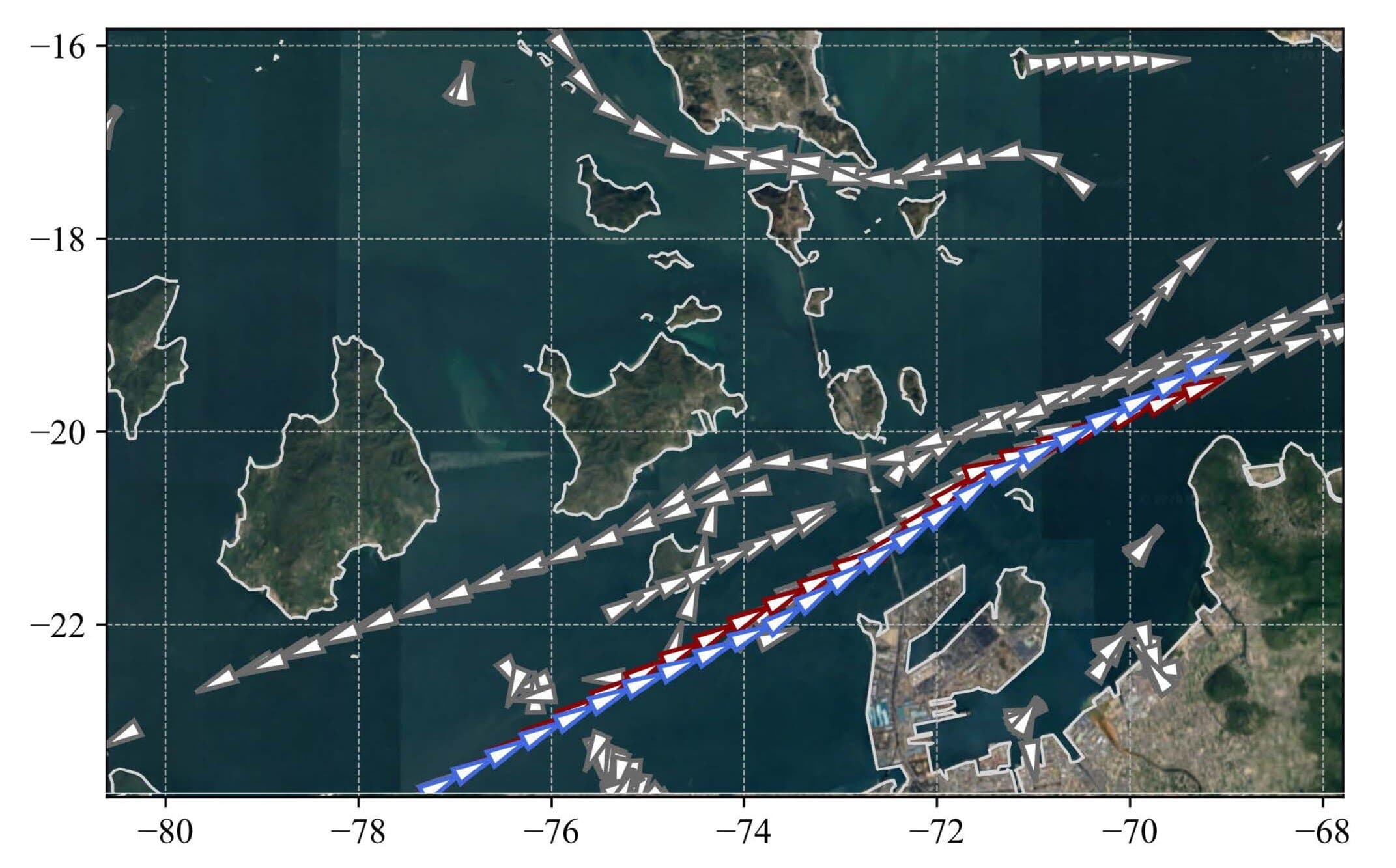
Image: TechXplore
Busy waterways such as Japan’s Seto Inland Sea are a much tougher test for autonomy than roads. Ships have to handle dense traffic, narrow channels, hundreds of islands, changing conditions, and maritime rules all at once. A team led by Assistant Professor Takefumi Higaki at Osaka Metropolitan University says it found a better way to train an autonomous navigation system: learn directly from experienced captains.
The study, published in Ocean Engineering, used maneuver data from Fukae-Maru, a training vessel from Kobe University. Instead of building the model around explicit objectives and rules, the researchers used diffusion AI. Rather than predicting a single best action, the system generates a full trajectory based on the range of actions an experienced human might take.
That matters in crowded waters, where decisions often rely on ambiguity and judgment that are hard to express mathematically. The team compared its model with two leading navigation AIs built with conventional machine-learning methods based on imitation learning. In realistic simulations, the diffusion-based system handled cases that confused the other models, while managing arbitrary numbers of ships, coastlines, narrow waterways, and speed control at the same time.
In ship encounter tests, the model consistently followed international collision-avoidance regulations and kept a safe distance from other vessels. During training, it also began showing behavior that had never been explicitly programmed. One example was the local custom in the Akashi Kaikyo Traffic Route of keeping right within designated traffic lanes; the AI repeatedly moved into the correct lane on its own.
Recommended reading
Google readies Frozen v2 chip for Gemini efficiency leap
“The most distinctive feature of this study is that we did not explicitly balance multiple objectives such as collision avoidance, geographical constraints, navigation efficiency and compliance with maritime traffic rules; however, the AI achieved them.”
“Our approach enables the AI to autonomously learn sophisticated ship-handling skills directly from real-world operational data rather than having researchers manually define what constitutes correct behavior.”
The researchers say broader access to real-world vessel operation data could make autonomous ship navigation more common, much as AI-driven cars have spread. They hope the work will improve safety and help address labor shortages in the maritime industry, especially in Japan.
The paper is titled “Diffusion route planner: Data-driven modeling of human ship navigation that implicitly balances safety, efficiency, and rule compliance under complex geographical constraints” by Takefumi Higaki et al. It carries the DOI 10.1016/j.oceaneng.2026.125656.

AI Editor
Ava covers the rapidly evolving world of artificial intelligence, from foundational models and research labs to the real-world economics of intelligence. With a background in computational linguistics, she cuts through the hype to find out what actually works. She firmly believes that benchmarks are just marketing until reproduced in the wild.
via TechXplore