• 3 min read
GPT-5.6 led this drawing test on cost and quality
A colored-pencil benchmark pitted GPT-5.6 Sol, Claude Fable 5, Grok 4.5, and Gemini 3.6 Flash across 28 drawings. GPT-5.6 won on output and efficiency.
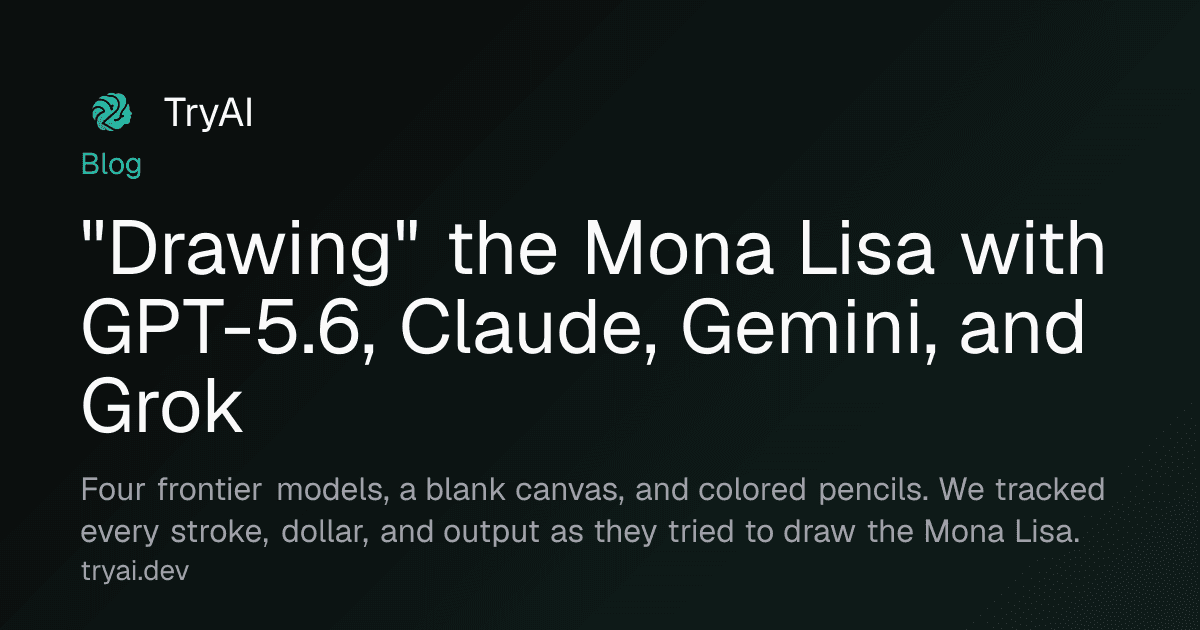
Image: Hacker News
A new drawing arena benchmark gave four vision models the same blank canvas and a colored-pencil toolset, then asked them either to recreate famous paintings or draw from text prompts. Across 28 drawings total, the results were uneven: GPT-5.6 Sol emerged as the strongest overall performer, Gemini 3.6 Flash posted the best raw similarity scores on the two target-image tests, Claude Fable 5 was by far the most expensive, and Grok 4.5 struggled.
The setup came from tryai.dev, which says the tests are intentionally open-ended rather than strict capability benchmarks. Each model could adjust color, tip width, and pressure, draw batches of strokes, smudge, erase, and inspect its work with view_canvas. The harness is open source at github.com/hershalb/canvas-arena.
The four models tested were GPT-5.6 Sol, Claude Fable 5, Grok 4.5, and Gemini 3.6 Flash. They were run against two scored target reproductions—the Mona Lisa and Van Gogh’s Starry Night—plus five prompt-only drawings: an elderly fisherman, a sunset over the ocean, a red rose in a glass vase, a sleeping tabby cat, and a cabin interior with a lit fireplace.
Cost, speed, and tool use
Averages and totals across all seven drawings per model showed sharp differences:
- GPT-5.6 Sol: 72 average score, 96.2 min, 3.4M tokens, $7.74, 6.0, 116
- Claude Fable 5: 75 average score, 412.5 min, 14.6M tokens, $160.58, 15.6, 207
- Grok 4.5: 79 average score, 94.8 min, 34.0M tokens, $9.21, 4.3, 354
- Gemini 3.6 Flash: 77 average score, 136.9 min, 27.7M tokens, $12.87, 22.6, 190
The models also used the same tools in very different ways. GPT-5.6 Sol never called set_color, set_brush, or set_pressure, instead setting those inline during draw calls. Grok 4.5 did the opposite: 65% of its 1,349 tool calls were those setup functions, pushing it to an average of 99 steps per drawing. Claude Fable 5 leaned heavily on smudge and frequent reviews, while Gemini 3.6 Flash was the most aggressive reviewer, with roughly 23 self-checks per drawing.

Recommended reading
Google Drops Gemini Sampling Controls in New Flash Models
The models often edited past their best result
On the two target-image tasks, the site scored runs using SSIM and RMSE. Gemini 3.6 Flash posted the highest raw SSIM on both targets, including a peak 0.449 on the Mona Lisa, but the benchmark authors caution that SSIM tracks structural similarity, not whether a human would think the drawing looks better.
A bigger pattern: more reviewing did not lead to better final results. According to the test, all eight target runs finished below the best score reached mid-run. Examples included:
- GPT-5.6 Sol, Mona Lisa: peaked at 0.352 SSIM, finished at 0.325
- GPT-5.6 Sol, Starry Night: peaked at 0.179, finished at 0.130
- Gemini 3.6 Flash, Mona Lisa: peaked at 0.449, finished at 0.337
The authors' qualitative verdict was more decisive than the raw metric leaderboard. They called GPT-5.6 Sol the “runaway leader,” saying its Starry Night and rose were their favorites of the batch and that it generally beat the others on detail. Claude Fable 5 was judged second on quality, but at roughly 20x the cost of GPT-5.6 Sol. Grok 4.5, in their words, was “basically garbage here,” while Gemini 3.6 Flash was seen as clearly better than Grok but not a fair like-for-like comparison with frontier-tier models.
The result is less a clean benchmark than a useful stress test for long, tool-using visual tasks—and one that makes the cost of repeated self-correction hard to ignore.

AI Editor
Ava covers the rapidly evolving world of artificial intelligence, from foundational models and research labs to the real-world economics of intelligence. With a background in computational linguistics, she cuts through the hype to find out what actually works. She firmly believes that benchmarks are just marketing until reproduced in the wild.
via Hacker News