• 2 min read
Kimi K3 Nearly Matches Fable at a Fraction of the Cost
Fireworks says Kimi K3 and Fable 5 are close on quality across ~1,030 agentic tasks, with routing reaching 93% accuracy at far lower cost.
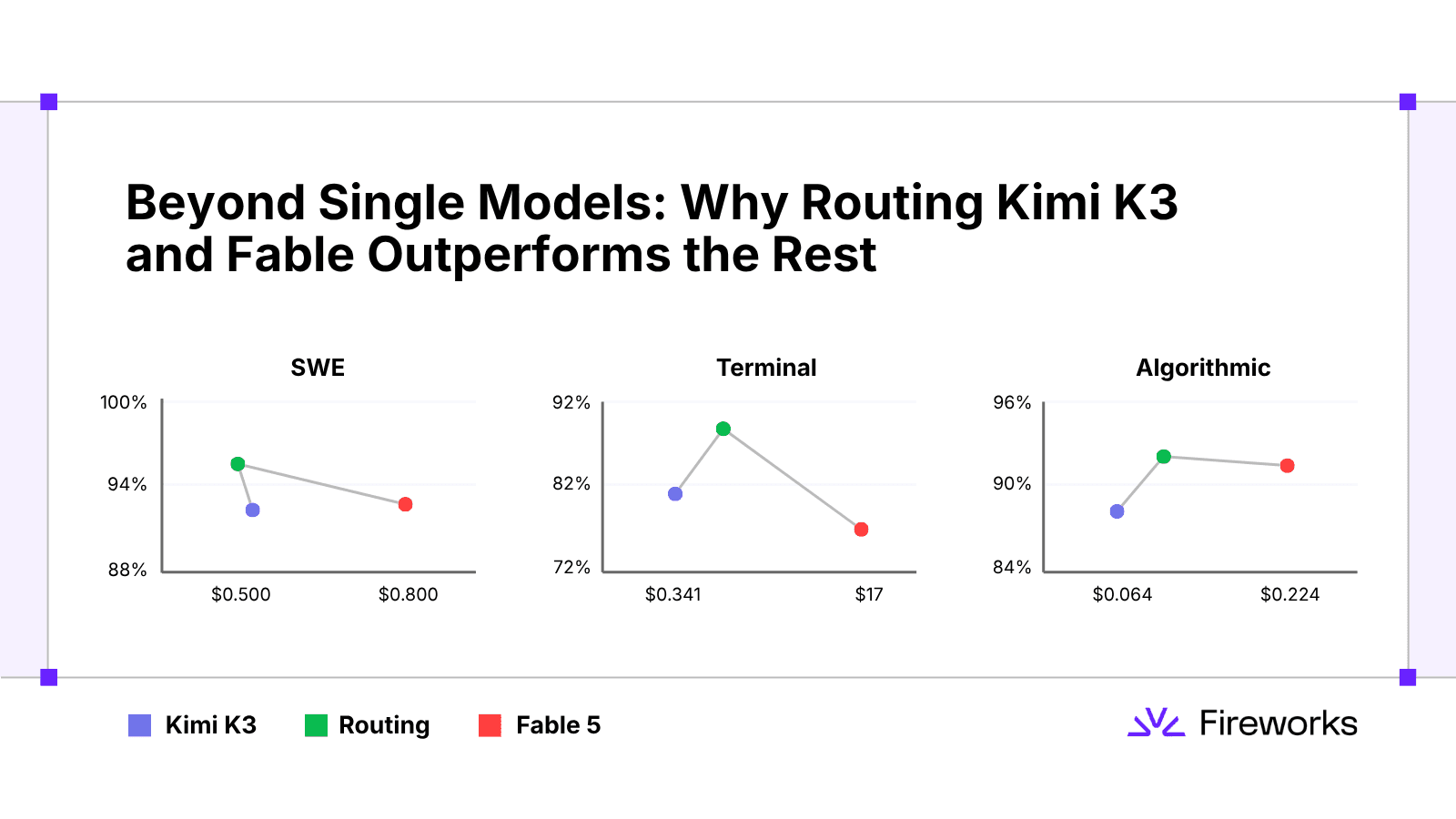
Image: Hacker News
Fireworks says Kimi K3, an open model, comes close to Fable 5 on quality while costing dramatically less on agent-style workloads. In a test run across roughly 1,030 tasks, the company says routing between the two models reached 93% accuracy and delivered results that were up to 50x more cost-effective than using Fable alone on long agentic loops.
The benchmark combined five task families, each run through the same harness in real agent loops:
- SWE: 460 real repo bug-fix tasks
- Terminal: 89 long-horizon security, crypto, reverse engineering, and sysadmin tasks
- Algorithmic: 100 LeetCode- or AtCoder-style problems
- Multi-Language: 225 implementation tasks across six languages
- Legal: 120 lawyer-graded legal-agent tasks
Fireworks also used oracle routing, a theoretical best-case method that runs each task on both models and picks the cheapest correct answer. In that setup, K3 was selected for 72% to 96% of tasks, suggesting that a strong practical router could send most traffic to the cheaper model while preserving quality.
Recommended reading
Google Drops Gemini Sampling Controls in New Flash Models
On raw performance, the two models were often very close. Fireworks says K3 scored 92.4% on SWE, versus 92.6% for Fable 5. Across the five benchmark groups, the gap usually stayed within a few points, though Fable led on broader coding-language coverage in the Multi-Language set.
The bigger finding is that the models appear to specialize in different areas. According to Fireworks, K3 did especially well on symbolic math and developer tooling, while Fable performed better on web and data visualization work. In terminal-based tasks, K3 posted 11 solo wins to Fable’s 7, including wins on security and cryptography problems such as a 7z hash, FEAL cryptanalysis, leaked secrets, a live vulnerability, and runaway async jobs.
Cost is where the split became much clearer. Fireworks says K3 was cheaper across all five task families. On SWE, the company says K3 used about 55 turns and 1.3 million tokens per task, compared with 21 turns and 130,000 tokens for Fable. But on long terminal tasks, Fable was the model that expanded dramatically, reaching 64 turns and 1.5 million tokens, sometimes ending in a timeout. Fireworks attributes K3's cost advantage to token pricing, prompt caching, and differences in how much work each model performs on different tasks.
The company’s main takeaway is simple: don’t pick one model for everything. Fireworks argues that per-task routing beats either model on its own, pushing quality above any single-model setup while keeping cost close to the cheaper option. In its framing, the premium closed model becomes the exception, while the lower-cost open model handles most of the traffic.
That leaves Kimi K3 + Fable as Fireworks' case for a new state of the art: not one model, but a routed mix of specialists.

AI Editor
Ava covers the rapidly evolving world of artificial intelligence, from foundational models and research labs to the real-world economics of intelligence. With a background in computational linguistics, she cuts through the hype to find out what actually works. She firmly believes that benchmarks are just marketing until reproduced in the wild.
via Hacker News