• 2 min read
New graphics methods cut shape costs 10x
ISTA researchers unveiled two SIGGRAPH papers: one keeps deforming textures stable, the other computes shape properties 10 times cheaper.
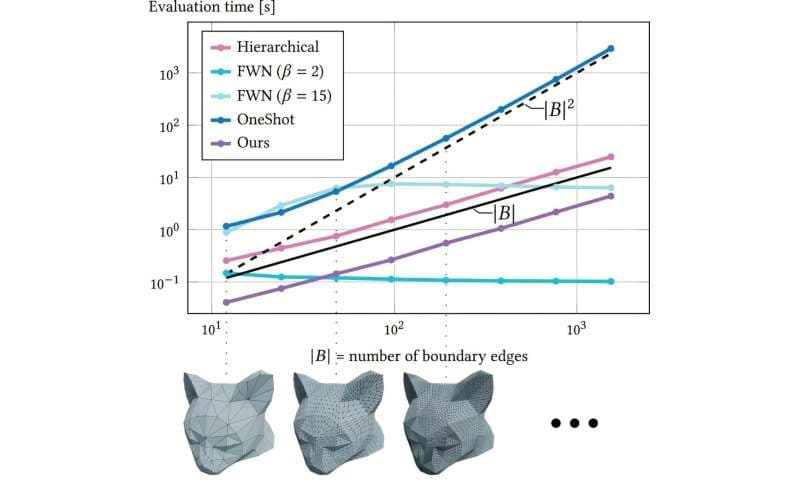
Image: TechXplore
Researchers at the Institute of Science and Technology Austria (ISTA) presented two papers at SIGGRAPH in Los Angeles, both aimed at a familiar graphics tradeoff: improving visual accuracy without driving up compute costs. Published in ACM Transactions on Graphics, the work targets two hard problems in video games, visual effects, and simulation.
One paper, led by doctoral student Aleksei Kalinov from Chris Wojtan’s group, focuses on how to texture extremely deformable surfaces—objects that do not have a clear shape at rest. The team took cues from natural materials such as lava and cake batter.
“If a feature is preserved when natural systems such as lava or cake batter are deformed, we consider that nature 'likes' it and that it’s an 'allowed' texture feature. We then try to come up with nature-inspired rules that are cheap to compute.”
Instead of treating textures as pixels, the researchers modeled them with physical parameters such as frequency and amplitude. Their key idea is that stretching does not truly erase surface detail: high-frequency information is lost and replaced by lower-frequency information, and that process can later be reversed. Compression does the opposite, but if pushed too far it creates frequencies smaller than a pixel, causing aliasing and visible flicker.
Two new algorithms for deformable surfaces
The team built two procedural methods that avoid physics simulations and do not need stored deformation history:
- Spectrum-rescaling algorithm, which restores high-frequency detail consistent with deformation
- Isotropy-preserving method, which works to preserve the original texture against deformation
According to ISTA, both approaches cut computational cost substantially while aiming for flicker-free detail on heavily deformed surfaces.

Recommended reading
Nvidia tweaks DLSS 5, but gamers still aren’t sold
A second paper, led by doctoral student Peiyuan Xie, tackles shape analysis through the winding number, a mathematical quantity used to determine whether a point lies inside or outside a shape. Wojtan likens it to a robot vacuum exploring a room from one point and checking whether the surrounding surfaces form a closed boundary.
The advance is in how the computation scales. Instead of depending on an object’s full surface area, the new method depends only on its boundaries—where surfaces end or connect. Because winding numbers from adjacent surfaces that share a boundary are additive, the researchers can connect an open shape to a simple auxiliary shape, compute an easier closed-form case, then subtract the known result. ISTA says that reduces computation by an order of magnitude while remaining exact.
The papers are:
- Aleksei Kalinov et al., Physics-Inspired Procedural Texturing of Extremely Deformable Surfaces, ACM Transactions on Graphics (2026). DOI: 10.1145/3811353
- Peiyuan Xie et al., Fast and Exact Winding Numbers for Triangle Meshes, ACM Transactions on Graphics (2026). DOI: 10.1145/3811339

Computing Editor
Tomas lives in the terminal. He covers chips, laptops, and operating systems with a focus on performance and efficiency. He reads kernel changelogs the way other people read fiction, and he's always on the hunt for the perfect mechanical keyboard switch. If it processes data, Tomas has an opinion on it.
via TechXplore