• 2 min read
A 10-part map of the modern LLM stack
SeriesA lays out the modern LLM stack across 10 arcs and 80-plus posts, from linear algebra and training to inference and agent protocols.
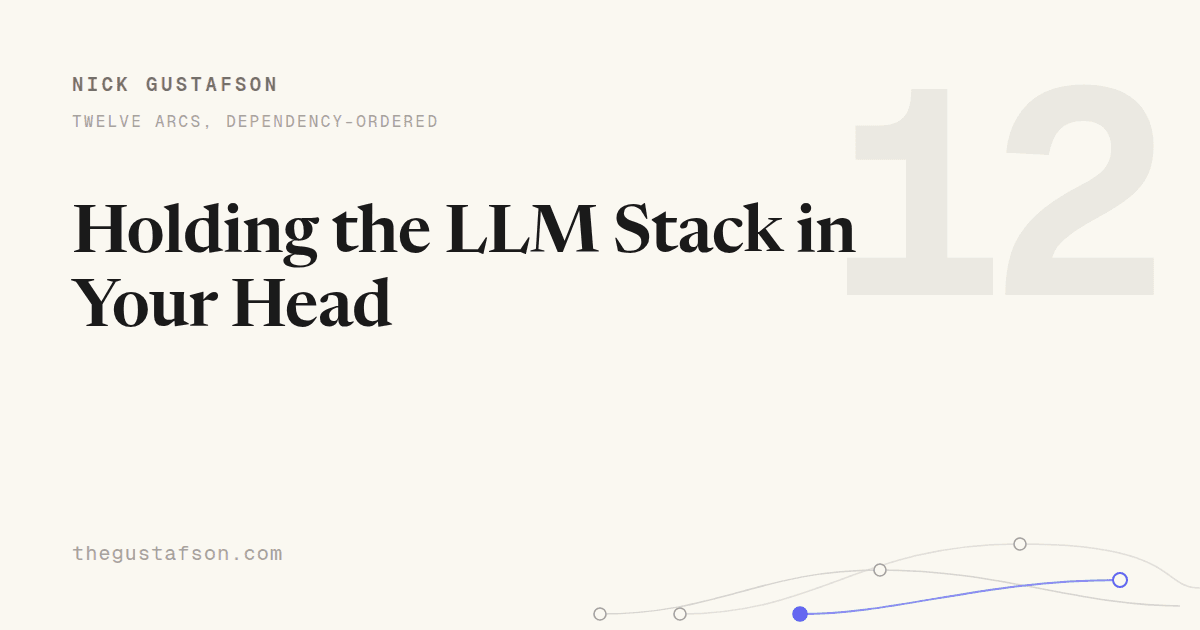
Image: Hacker News
SeriesA is pitching itself as a dependency-ordered guide to the modern LLM stack, spanning 10 arcs and more than 80 posts. The project starts with the math beneath a single attention head, moves through training and inference, and stretches to agent protocols expected to ship in 2026.
The aim, according to the site, is not strict rigor but intuition that holds up against real systems. That makes the series read less like a textbook and more like a structured technical field guide for people trying to keep the whole stack in view.
The first eight arcs currently listed cover:
- Vectors, matrices, and linear maps
- Norms, dot products, and similarity
- Distributions, softmax, and the chain rule of words
- Cross-entropy, KL divergence, and loss functions
- Gradients, backpropagation, and SGD
- Optimizers including momentum, Adam, warmup, and cosine decay
- GPUs, floating point, fp32/fp16/bfloat16, and mixed precision
- A short prehistory of statistical NLP
Each section is framed around practical concepts that show up repeatedly in modern model work, from attention scores and embedding retrieval to perplexity, training dynamics, and GPU parallelism.
The site says the full series is still a first draft, with more polishing, corrections, and occasional rewrites still to come. Readers who spot mistakes are invited to get in touch through the contact information on the site.
Recommended reading
Alibaba touts Qwen3.8 as No. 2—with no proof yet

AI Editor
Ava covers the rapidly evolving world of artificial intelligence, from foundational models and research labs to the real-world economics of intelligence. With a background in computational linguistics, she cuts through the hype to find out what actually works. She firmly believes that benchmarks are just marketing until reproduced in the wild.
via Hacker News