• 3 min read
Samsung’s S95H pushes OLED brightness to new highs
Samsung’s 2026 flagship OLED pairs a bright, color-rich picture with elite gaming features, though its new design and lack of Dolby Vision may divide buyers.
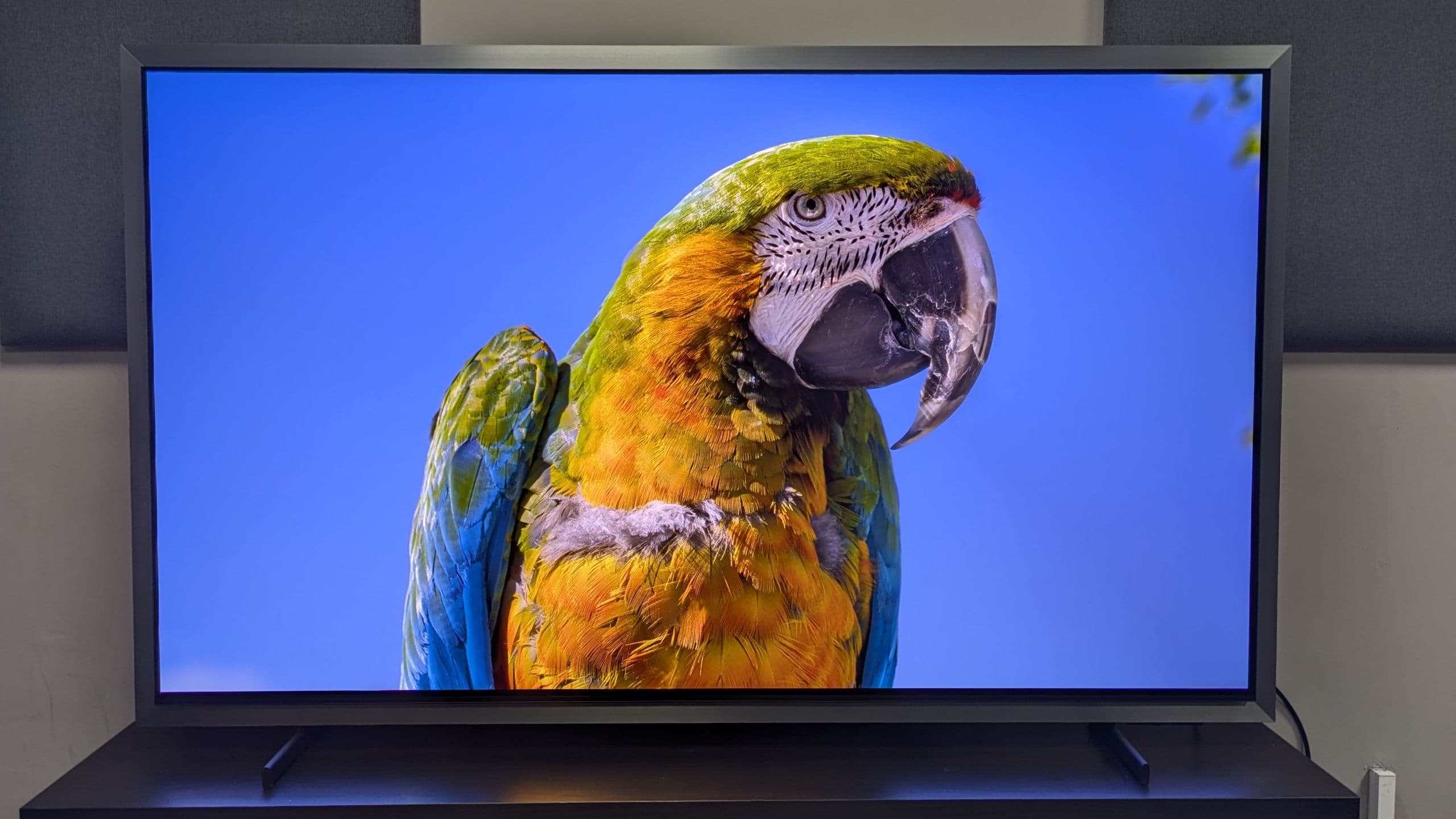
Image: TechRadar
Samsung’s S95H is shaping up as one of the standout TVs of 2026. TechRadar’s review calls it a top-tier flagship OLED, with exceptional brightness, rich color, strong contrast, and a full set of gaming features, even if Samsung’s new FloatLayer Design is likely to split opinion.
At the center of the set is Samsung’s NQ4 AI Gen 3 Processor, which bundles picture tools such as AI Motion Enhancer Pro and AI 4K Upscaling Pro, audio features including Adaptive Sound Pro, and recommendation features under the company’s Vision AI branding. According to the review, the result is a TV that performs especially well in bright rooms thanks to its effective anti-reflection matte screen.
Picture quality is the main draw. TechRadar measured 2,739 nits peak HDR brightness in Filmmaker Mode, with fullscreen HDR brightness at 449 nits. That puts it well above the previous Samsung S95F, which hit 2,132 nits and 390 nits respectively, though still slightly behind the LG G6 on 10% window brightness at 3,004 nits.
Recommended reading
Samsung’s S99H pushes OLED brightness even higher
The S95H launched in June 2026 and sits at the top of Samsung’s OLED range, above the S90H and S85H. Pricing is as follows:
- 55-inch: $2,299 / AU$3,999
- 65-inch: $3,299 / AU$5,299
- 77-inch: $4,299 / AU$7,999
- 83-inch: $6,299 / AU$9,999
TechRadar says some Australian discounts have already appeared, including up to AU$1,500 off the 83-inch model.
On specs, the TV supports up to 165Hz, HDR10+, HDR10, HLG, Dolby Atmos, and 4 x HDMI 2.1 ports. Samsung still skips Dolby Vision, and the built-in tuner is only ATSC 1.0 in the US.
Gaming features and design changes
Gaming is another strong point. The S95H includes four HDMI 2.1 ports with support for 4K 165Hz, VRR, AMD FreeSync Premium Pro, Nvidia G-Sync, HGiG, HDR10+ gaming, and ALLM. TechRadar measured 9.5ms input lag at 60Hz, putting it among the best gaming TVs this year.
The panel in the tested 65-inch model appears, based on TechRadar’s measurements, to be QD-OLED, though Samsung does not officially confirm that. The 83-inch version uses an LG W-OLED panel, since QD-OLED is not available in that size.
Samsung has also made a notable hardware change. The One Connect Box is gone, with ports moved back onto the TV itself. Buyers can optionally add Samsung’s Wireless One Connect Box, which the company says can bring the total to eight HDMI 2.1 ports.
The biggest sticking point may be the industrial design. Samsung has added a wider silver frame it calls FloatLayer Design, making the TV broader overall and replacing the previous central pedestal with two plastic feet. TechRadar found the frame distracting, especially for wall mounting.
Picture performance in bright rooms
The review highlights the TV’s color performance as a particular strength. TechRadar measured 89.2% coverage of the BT.2020 color space and 99.97% of DCI-P3, and said movies such as Speed Racer and La La Land looked bold and accurate.
For darker films, the review found Movie mode better suited than Filmmaker Mode in bright conditions, while Filmmaker Mode worked better in a dark room. Contrast and black levels were praised, though TechRadar noted some black crush in very dark scenes.
Built-in sound from the 4.2.2-channel, 70W speaker system was described as solid, with good precision and punchy bass, but not quite on the level the picture quality deserves. For buyers spending this much, a soundbar still looks like the safer bet.

Computing Editor
Tomas lives in the terminal. He covers chips, laptops, and operating systems with a focus on performance and efficiency. He reads kernel changelogs the way other people read fiction, and he's always on the hunt for the perfect mechanical keyboard switch. If it processes data, Tomas has an opinion on it.
via TechRadar