• 2 min read
A 20 ms window keeps an unstable beam still
NYU Tandon and Stony Brook researchers stabilized a beam by switching between two unstable behaviors in a narrow 218–238 ms timing range.
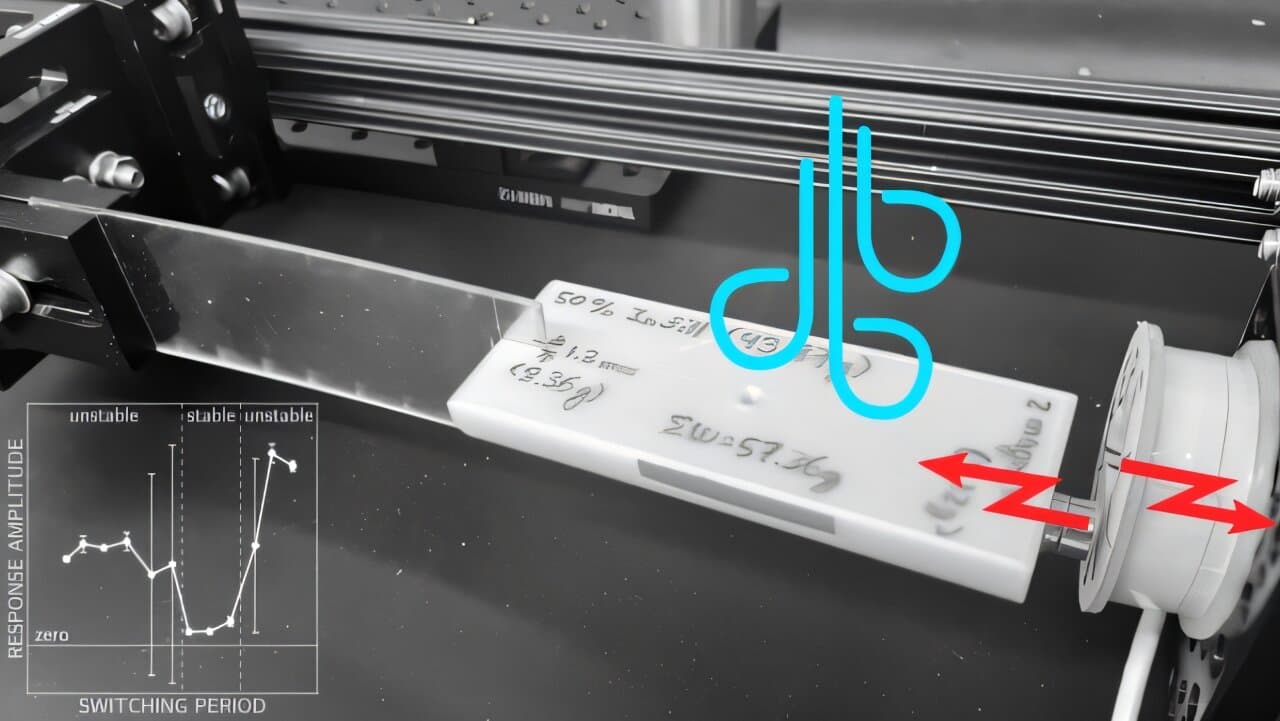
Image: TechXplore
Researchers at NYU Tandon School of Engineering and Stony Brook University have shown that a mechanical system can be stabilized without sensors, feedback software, or continuous correction. Their study, published in Nature Communications, found that a beam can be kept nearly motionless by switching between two unstable behaviors at exactly the right rhythm—even though neither behavior is stable on its own.
The team built what they call the “Frankenstein oscillator”: a thin plastic strip fixed at one end with a small weight on the tip. They then introduced two different forms of instability. A magnetic coil pushed the beam away from its resting position, while a small fan added energy to the motion so its swings grew instead of dying out. When the researchers pulsed those forces on and off with carefully chosen timing, the result was a very narrow stability band.
The beam stayed nearly still only when the switching period was between roughly 218 and 238 milliseconds. Outside that range, the motion quickly grew and the beam swung away.

Recommended reading
40TB of public data became one conservation game
How the stabilization works
The idea extends the physics behind Kapitza’s pendulum, where rapid vibration can keep an inverted pendulum upright. But this case is tougher: there is no stable state to alternate with. Instead, according to the researchers, one instability has a direction where motion shrinks, while the other rotates the motion through different directions. If the timing is right, that rotation steers the system into the shrinking direction before it runs away.
“I have been thinking about the problem of stabilization of unstable systems through switching for over two decades.” “In between ups and downs in the research, I was almost convinced that stabilization of two unstable systems would require some form of nonlinearity or even chaotic dynamics, but that is not the case: A simple, linear mechanical system can do the trick.”
The researchers developed the theory first, then tested it experimentally. They said the narrow stability window seen in the lab closely matched the mathematical model.
“Honestly, I did not believe that we would be able to demonstrate this phenomenon experimentally, as this involved working with a system that is not only unstable, but also features multiple sources of instability.”
The paper is “Dynamic stabilization of a mechanical oscillator in the absence of any stable feature” by David Xiedeng et al., with DOI 10.1038/s41467-026-70493-1. The broader implication is a different engineering strategy: instead of removing instability, designers may sometimes be able to combine unstable parts in ways that become stable through timing alone.

Frontier Editor
Dan is our resident futurist, covering electric mobility, space exploration, and the smart home. He's interested in atoms just as much as bits. Whether it's a new battery chemistry, a reusable rocket, or a protocol that finally makes IoT devices talk to each other, Dan breaks down the engineering that pushes humanity forward.
via TechXplore