• 3 min read
200 Experts Warn as AI Push Speeds Ahead
More than 200 researchers and economists, including 15 Nobel laureates, urged action on AI’s social and economic impact as investment keeps rising.
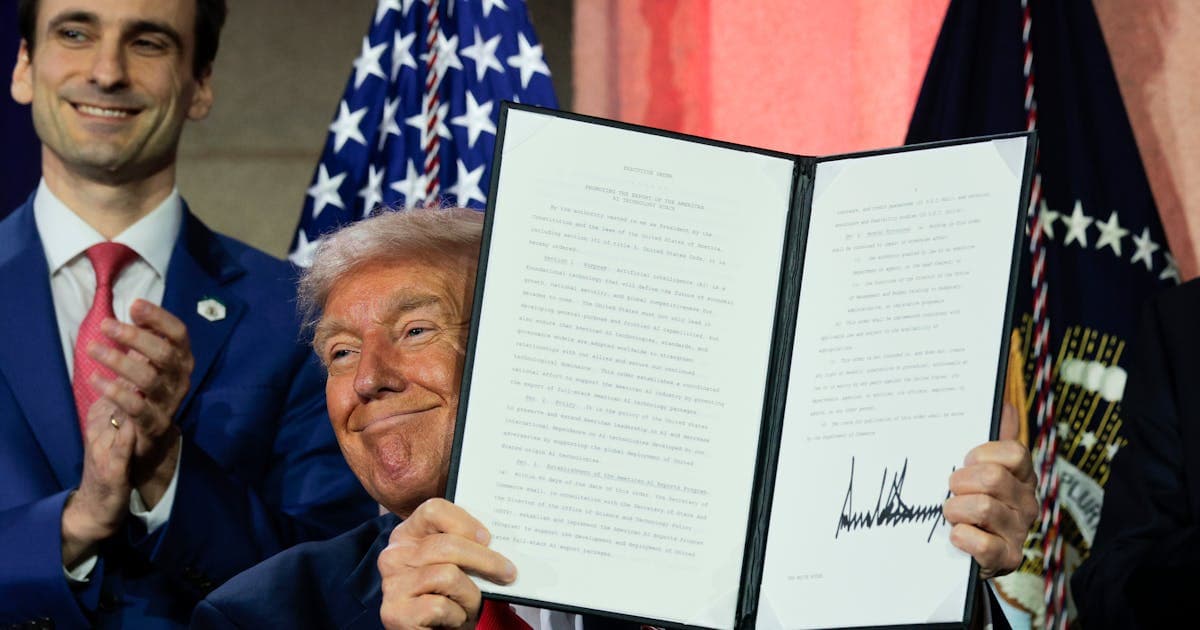
Image: Hacker News
More than 200 researchers and economists, including 15 Nobel laureates, issued a joint statement on Monday urging government and industry to confront the economic and social effects of artificial intelligence, citing fears of broad workforce displacement. The warning lands as companies continue to pour money into the technology: Meta recently expanded a data center project in Louisiana, pushing its cost to $50 billion.
The source article argues that this momentum is badly out of step with public sentiment and with the limits of the technology itself. Drawing a comparison to Kurt Vonnegut’s “Harrison Bergeron,” it frames AI as a tool that can make less-skilled users appear more capable while eroding learning, critical thinking, and originality.
In education, the article points to heavy student adoption. A study released in October 2025 found that 84 percent of high school students use AI to brainstorm, revise essays, or research sources, while 69 percent use ChatGPT for assignments and homework. Among college students, 85 percent use AI for research and brainstorming, 57 percent use it at least weekly for coursework, and 46 percent say it is “extremely important” for understanding complex material, saving time, and improving grades.
The article also cites an MIT study that found students using AI to write showed far less brain activity than students using standard Google search with AI disabled or those using neither tool. Other studies, it says, found lower retention among students who rely on AI, attributing that to “cognitive offloading” and “cognitive surrender.” It also highlights familiar concerns around hallucinated facts and citations.

Recommended reading
Kimi K3 arrives with 2.8T params and pricey tokens
Beyond schools, the piece argues that generative AI is flooding the web with low-quality content. It claims that more than half of new e-books on Amazon are AI-generated, but that these titles draw fewer reviews, generally poor reception, and weak sales. It also says AI now uses 4.4 percent of all energy in the United States, a figure it says is rising quickly, along with up to 90 percent of the total computing power available in the country.
The article further claims that AI systems are increasingly training on AI-generated material, raising the risk of model collapse as outputs become progressively degraded. On policy, it points to the Trump administration’s push to accelerate federal AI adoption, citing the Brookings Institution, and describes broad pressure inside institutions to label work as “AI-informed.” It also references Ford Motor Company, saying it cut hundreds of jobs on the assumption AI would outperform humans, then later rehired after losses mounted.
One of the article’s sharpest claims is that AI’s labor impact remains uneven. It says programming is the field where workers are being replaced most directly, while warning that overreliance on AI coding tools could hollow out the pipeline of future engineers. At the same time, it notes a rare point of agreement across Democratic and Republican voters: opposition to data centers that consume water, generate heat and noise, raise electricity costs, and make computers more expensive.
The piece’s conclusion is blunt: AI may be faster and, at least for now, cheaper, but the tradeoff is lower quality and weaker human capability. Its evidence of widespread student use suggests that dynamic is already becoming entrenched.

AI Editor
Ava covers the rapidly evolving world of artificial intelligence, from foundational models and research labs to the real-world economics of intelligence. With a background in computational linguistics, she cuts through the hype to find out what actually works. She firmly believes that benchmarks are just marketing until reproduced in the wild.
via Hacker News