• 2 min read
Open Book Touch puts open-source reading in your pocket
A **4.26-inch** open-source e-reader built on **ESP32-S3** has passed its **$45,000** Crowd Supply goal, with pledges from **$149** to **$249**.
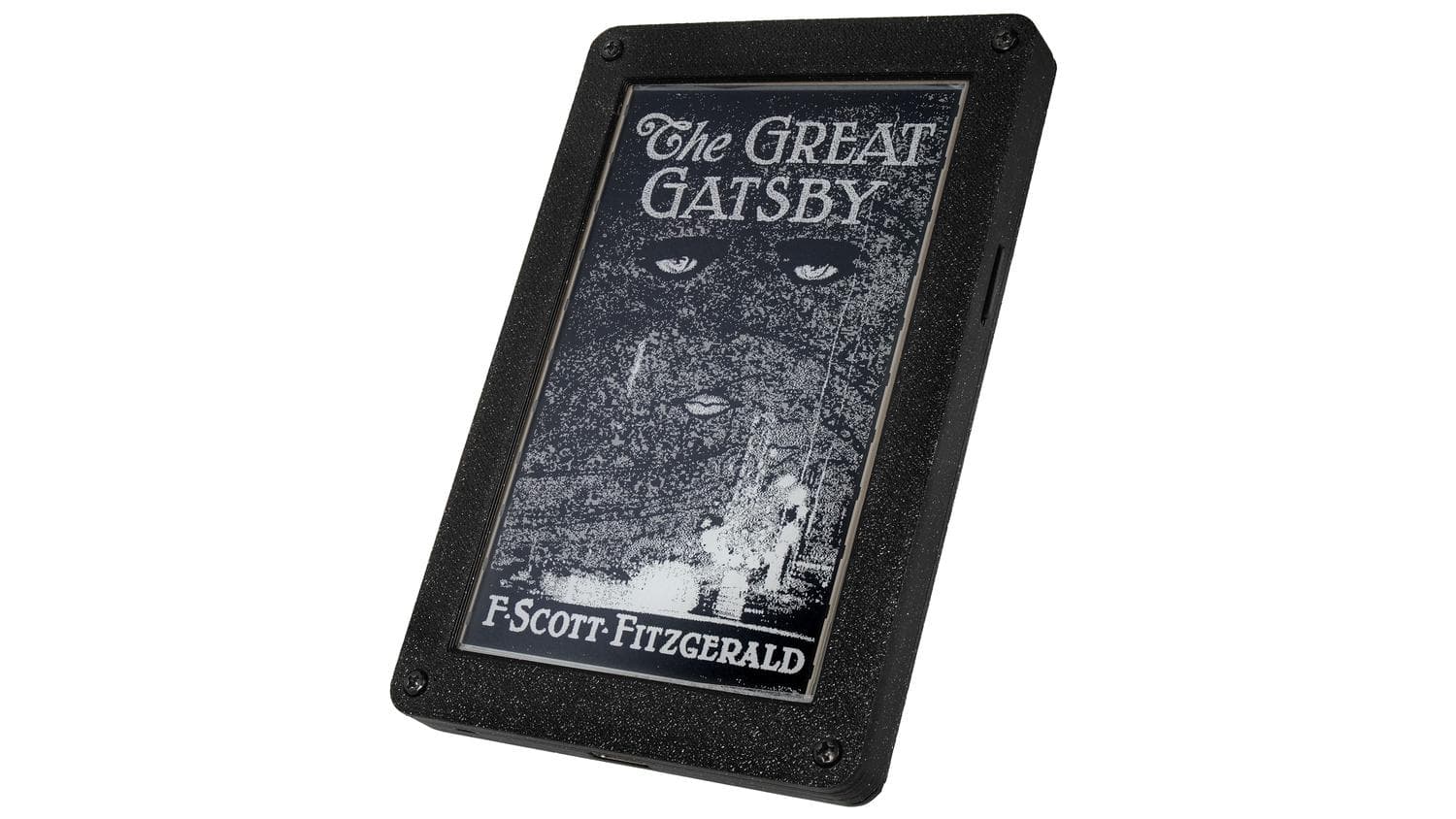
Image: Hacker News
A tiny e-reader with a 4.26-inch front-lit e-paper touchscreen has cleared its $45,000 Crowd Supply goal. Open Book Touch, from Oddly Specific Objects, has raised $45,299 with 34 days left, and funding runs until Aug 20, 2026 at 04:59 PM PDT.
The pitch is straightforward: a one-centimeter-thin, pocketable reader that focuses only on reading. It has no front buttons, no browser, no notifications, and only limited Wi-Fi for syncing time and downloading books. The device runs on an ESP32-S3 microcontroller rather than Linux, boots directly into the current book, and uses ESP-IDF/FreeRTOS with firmware written in readable C++.
It reads EPUB and plain text files from microSD, with a typesetting engine that supports justified text, hyphenation, inline images, highlights, dictionaries, shelves, and resume-to-page behavior. The display packs 480 × 800 pixels into 4.26 inches, with 1-bit and 2-bit grayscale modes, plus a frontlight with five warm and five cool LEDs.
Specs, openness, and language support
Open Book Touch ships with:
Recommended reading
Windows 11 24H2 loses support on Oct. 13, 2026
- 16 MB of flash
- 8 MB of PSRAM
- USB Type-C
- a user-replaceable battery of at least 800 mAh
- Wi-Fi and Bluetooth LE
- dimensions of 78 × 120 × 10 mm
- weight of about 3 oz (85 grams)
The software story is a big part of the appeal. The firmware is MIT-licensed, and the company says schematics, board files, enclosure CAD, and source code will be released when units ship to backers. It is also open-sourcing Focus, its C++ application framework for the device, now.
Language support is unusually broad for a small reader. The device includes GNU Unifont as a fallback with roughly 70,000 glyphs, and the interface is localized into English, Spanish, French, German, Japanese, Arabic, and Hebrew. It also implements the Unicode bidirectional algorithm and Perso-Arabic letter shaping.
Price, battery life, and shipping risks
Pricing runs from $149 to $249. The company estimates about a week of reading with the frontlight off and well over a month of standby. It says it is committing to an 800 mAh battery minimum, but may ship a 1200 mAh cell if supply allows.
Manufacturing is being handled with help from NextPCB’s Launchpad program, while the e-paper panel comes from Good Display. Backer fulfillment will go through Mouser, with first shipments targeted for early 2027.
The main risk is the display. According to the campaign, global supply of e-paper driver chips remains tight, with lead times stretching to eight months at a minimum. Good Display has told the company it will try to reserve about 1,000 units from its next production run, but cannot guarantee that until an order is placed.

Computing Editor
Tomas lives in the terminal. He covers chips, laptops, and operating systems with a focus on performance and efficiency. He reads kernel changelogs the way other people read fiction, and he's always on the hunt for the perfect mechanical keyboard switch. If it processes data, Tomas has an opinion on it.
via Hacker News