• 3 min read
AI agent turns chip rules into verification code
Seoul National University and Samsung AI Center built Rule2DRC to generate and test semiconductor verification scripts at industrial scale.
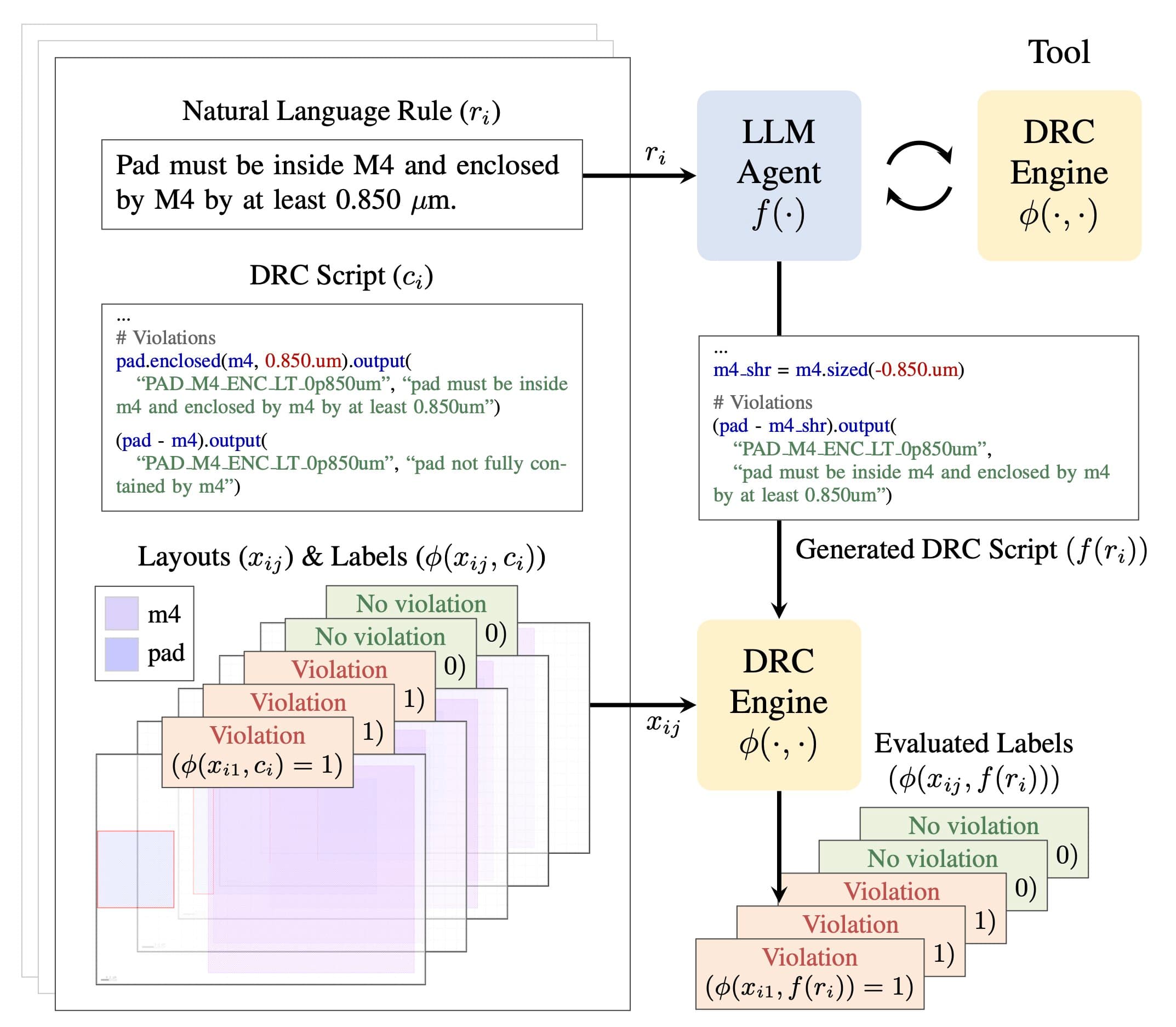
Image: TechXplore
Seoul National University researchers, working with Samsung AI Center, say they have built an AI agent system that can automate a stubborn part of chip development: turning natural-language semiconductor design rules into executable Design Rule Check (DRC) scripts.
The project, called Rule2DRC, was led by Hyun Oh Song, a professor in SNU’s College of Engineering, Department of Computer Science and Engineering. The work was presented at ICML 2026 and also published on arXiv.
Before fabrication, chip designs must be checked against thousands of rules. That usually means expert engineers manually translating written rules into specialized verification languages such as KLayout and SVRF. The team says earlier attempts to automate that workflow were limited by small datasets, code-similarity metrics, and methods that depended on ground-truth test data during generation.

Recommended reading
OVH mass-rebooted hosts to patch Januscape bug
Rule2DRC benchmark and SplitTester
SNU and Samsung built Rule2DRC as a large-scale benchmark for evaluating whether LLM-based systems can generate usable verification code from human-written design rules. The benchmark includes 1,000 design rule–inspection code pairs and 13,921 evaluation chip layouts.
Instead of only comparing generated code with reference code, the system runs the scripts on a real verification engine and checks whether the violation results match ground truth. The researchers also introduced SplitTester, a method that picks the best script from multiple AI-generated candidates based on execution results.
According to the team, that makes the benchmark more useful for real chip design environments, where functional correctness matters more than surface-level code similarity.
Samsung deployment and layout-native workflow
The researchers also built a layout-native AI agent GUI app designed to run inside Samsung’s internal environment. The interface lets engineers view semiconductor layouts and generate inspection code side by side, matching real workflow more closely than text-only tools.
Song said the team worked onsite with Samsung AI Center researchers in secure research environments so the application could operate inside Samsung’s internal systems. Integration with Samsung’s in-house LLM is now underway.
During demos, the agent interpreted natural-language instructions, selected target regions in chip layouts, and automatically modified geometric features such as corners. The researchers describe that as a step toward a layout-native workflow, where an AI system can understand both layout data and verification scripts at the same time.
“This work is meaningful in that it addresses real industrial challenges in semiconductor design verification using AI agents and goes beyond academic contributions by delivering a deployable GUI application for real-world environments. Moving forward, we plan to enhance the system with natural-language feedback-based layout editing and multimodal agent capabilities, quantitatively evaluate productivity gains in industrial settings, and ultimately develop a fully autonomous AI agent.”
Song received the Outstanding Research Award, while researcher Jinuk Kim received the Best Poster Award at the Samsung AI Center NPRC Workshop. Kim, the paper’s first author, will work as a research intern at AWS AI this summer.
The group also reported a separate ICML 2026 result, Identifiable Token Correspondence for World Models, which they say reached state-of-the-art performance on Crafter and Atari 100k.
Publication details listed by the source:
- Jinuk Kim et al, Rule2DRC: Benchmarking LLM Agents for DRC Script Synthesis with Execution-Guided Test Generation, arXiv (2026). DOI: 10.48550/arxiv.2605.15669
- Youngin Kim et al, Identifiable Token Correspondence for World Models, arXiv (2026). DOI: 10.48550/arxiv.2605.16457

Enterprise Editor
Marcus follows the money. He covers enterprise software, cloud architecture, and the tectonic shifts in Big Tech strategy. He translates dense earnings calls and complex M&A activity into actionable insights about where the industry is actually heading. If a tech giant makes a silent pivot, Marcus is usually the first to notice.
via TechXplore