• 3 min read
AI answers are easy, but what do we lose?
A personal essay asks where useful AI assistance ends and the erosion of human judgment begins.
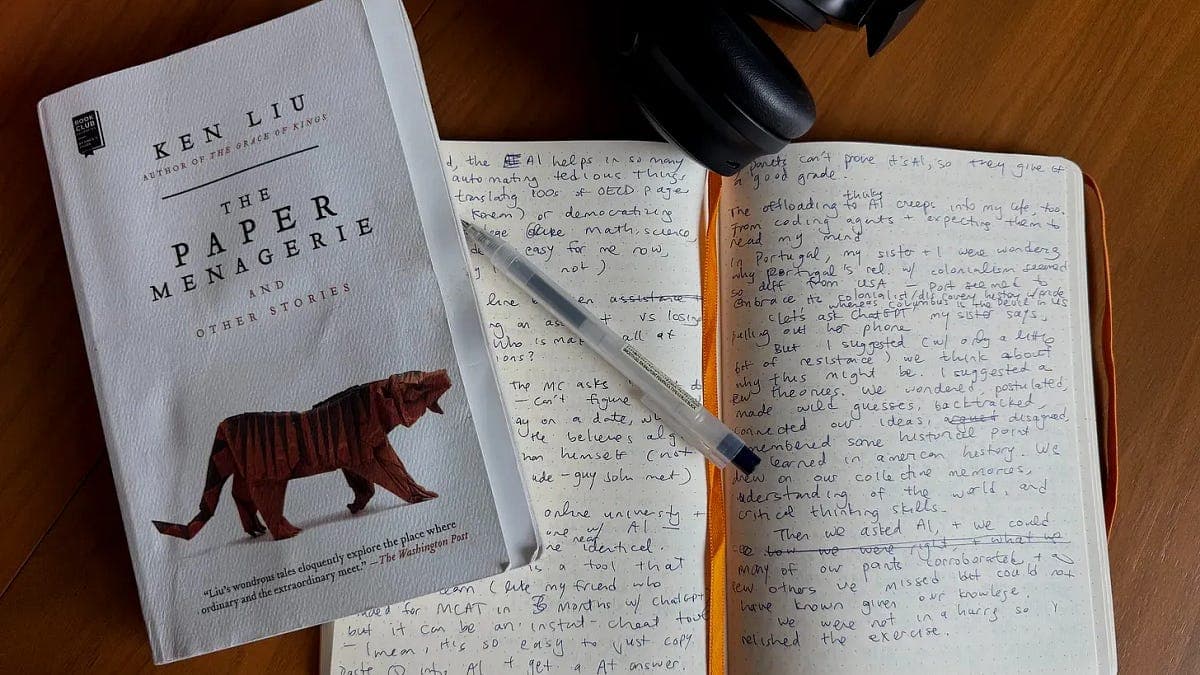
Image: Task-Completion Time Horizons of Frontier AI Models
The convenience of ChatGPT, Claude, and Gemini has made it easier than ever to hand over parts of everyday thinking to software. In an essay for Art Fish Intelligence, the author argues that the real risk is not just automation of routine work, but the gradual outsourcing of judgment itself.
The piece opens with a comparison to Ken Liu’s 2012 short story “The Perfect Match,” where an all-purpose assistant named Tilly chooses everything from breakfast to dating advice. The point, the author suggests, is that this dynamic no longer feels fictional. A friend recently met a man at a San Francisco startup event who wore a microphone on his shirt, recorded all of his conversations, and later used AI to summarize and analyze them.
“I think Claude Fable is smarter than me. It’s better at critical thinking than I am, so I let Fable do all of my thinking these days.”
The author draws a line between older tools like search engines and newer AI systems. Search still required users to break questions apart, assess sources, and synthesize an answer. Newer products such as Google Deep Research and OpenAI Deep Research, the essay notes, increasingly perform those intermediate steps themselves, delivering polished responses to complex questions in minutes.
Where assistance becomes dependence
The essay does not argue that AI use is inherently bad. It points to clear benefits: a cousin using Gemini to translate long official English reports into Korean, colleagues using coding agents to implement research ideas, and a friend using ChatGPT as a personalized tutor while preparing for the MCAT. It also cites the OECD on AI in the workplace and the International Labour Organization report Digital Labour Platforms and the Future of Work.
Recommended reading
A 10-part map of the modern LLM stack
But the author argues that speed can encourage intellectual passivity. One example comes from the author’s mother, who teaches physics at an online university and suspects many students now rely on AI for assignments. Responses often look nearly identical, the essay says, yet remain polished enough to earn high grades.
That gets to the core concern: AI can produce answers without teaching the process needed to reach them.
A Portugal example of thinking first, asking AI later
The essay’s clearest example comes from a trip to Portugal. After visiting the Monument to the Discoveries, the author and her sister discussed why Portuguese attitudes toward colonial-era figures such as Henry the Navigator seemed different from the way the US now treats figures like Christopher Columbus. When her sister suggested asking ChatGPT immediately, the author proposed they first work through their own theories.
They speculated, disagreed, recalled history, and tested each other’s assumptions before eventually turning to AI. The model confirmed some of their ideas, added others, and left out a few explanations they still considered plausible. For the author, that sequence mattered: use AI to extend thought, not replace it.
The essay ends with a pointed distinction. The question is not only what tasks AI can automate, but whether people are starting to automate their own agency along with them.

AI Editor
Ava covers the rapidly evolving world of artificial intelligence, from foundational models and research labs to the real-world economics of intelligence. With a background in computational linguistics, she cuts through the hype to find out what actually works. She firmly believes that benchmarks are just marketing until reproduced in the wild.
via Hacker News