• 2 min read
Seven Bosgame mini PCs run DeepSeek-V3.1 locally
Bosgame linked seven M5 AI mini PCs into a USB4 cluster to run DeepSeek-V3.1 with 671 billion parameters on a desk-sized setup.
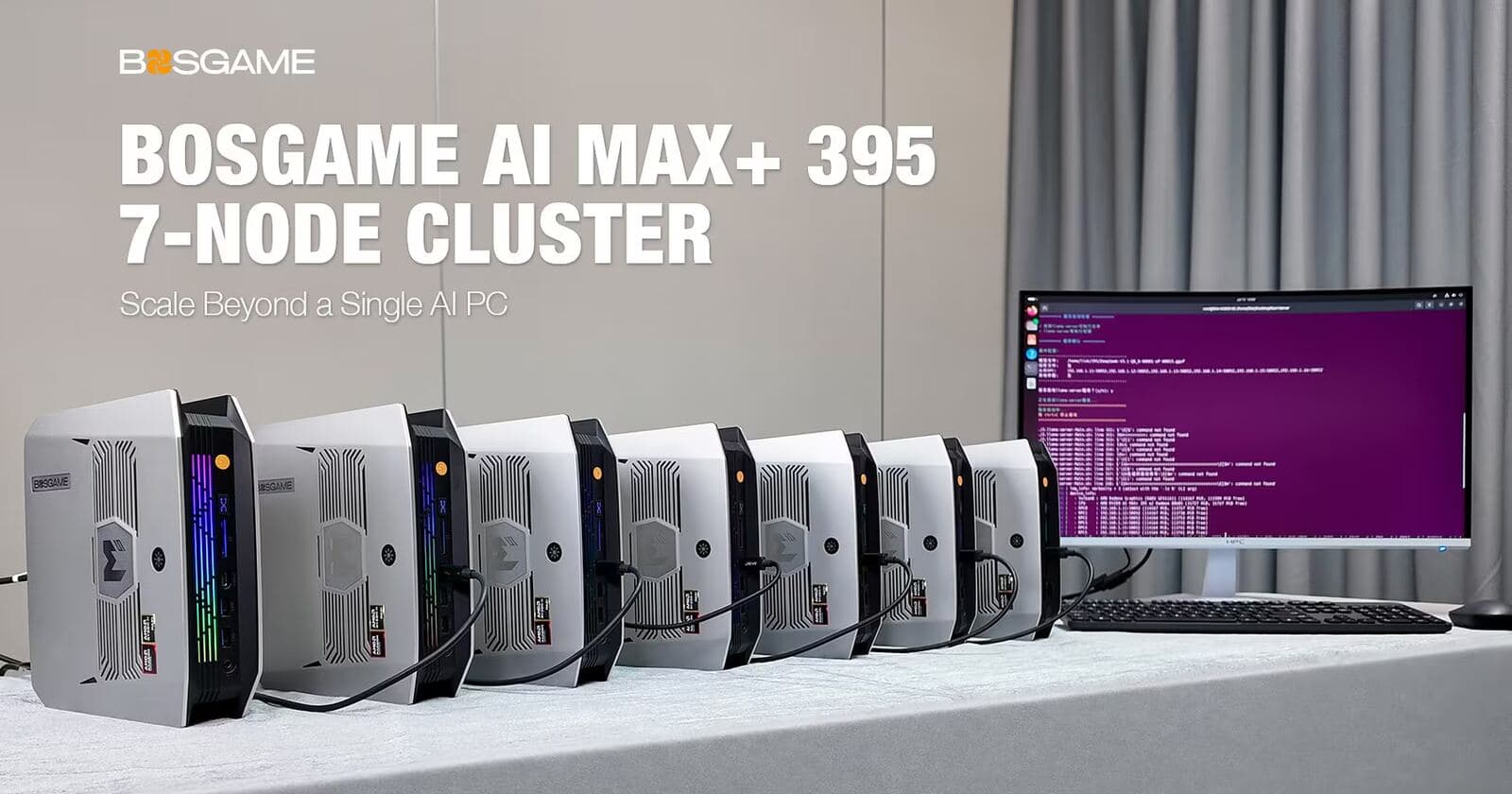
Image: ITzine
Bosgame has shown a cluster of seven M5 AI mini PCs configured to run DeepSeek-V3.1 locally, a model with 671 billion parameters. A single unit cannot handle that workload on its own, so the company’s approach is to scale by linking nodes through a direct USB4 connection.
The system is built around AMD’s Ryzen AI Max+ 395, and the top-end M5 AI configuration includes 128GB of RAM. Put seven of those machines together and the cluster reaches 896GB of unified memory. According to Bosgame, up to 672GB of that can be allocated to GPU tasks.
The pitch is straightforward: add compute without moving to a full server rack and the bulk that comes with it. For a home lab or a small team, that makes the setup closer to a desktop-class system in price and power use than to traditional AI servers, which are usually used for models of this size.

Recommended reading
New solver tackles 10,000-variable optimization problems
Bosgame introduced the M5 AI last year. At the time, it was a fairly standard mini PC for its class, albeit one based on a newer AMD platform with more memory. Now the company is presenting not a single box, but a group of identical machines operating as one compute block.
That lines up with a broader shift in compact workstations. ASUS, Minisforum, and GMKtec also sell mini PCs built on powerful mobile chips, but they usually focus on local workloads with smaller models. Bosgame is aiming at something else: a multi-mini-PC cluster that fits on a desk.
At launch, the top M5 AI configuration cost about $1,700. Bosgame now lists one PC at $2,800. That is still modest next to server hardware for large models, but multiplied across seven nodes, the bill climbs quickly — and that is before adding peripherals and storage.
Whether the modular cluster idea works beyond a staged demo will depend on how easily others can reproduce it in real-world use.

Computing Editor
Tomas lives in the terminal. He covers chips, laptops, and operating systems with a focus on performance and efficiency. He reads kernel changelogs the way other people read fiction, and he's always on the hunt for the perfect mechanical keyboard switch. If it processes data, Tomas has an opinion on it.
via ITzine