• 5 min read
A Canal-Sunk Computer Was Decades Too Early
Linn’s 1988 Rekursiv buried memory safety, garbage collection, and persistence in hardware. Many of those ideas now appear in Arm, CHERI, and domain-specific chips.
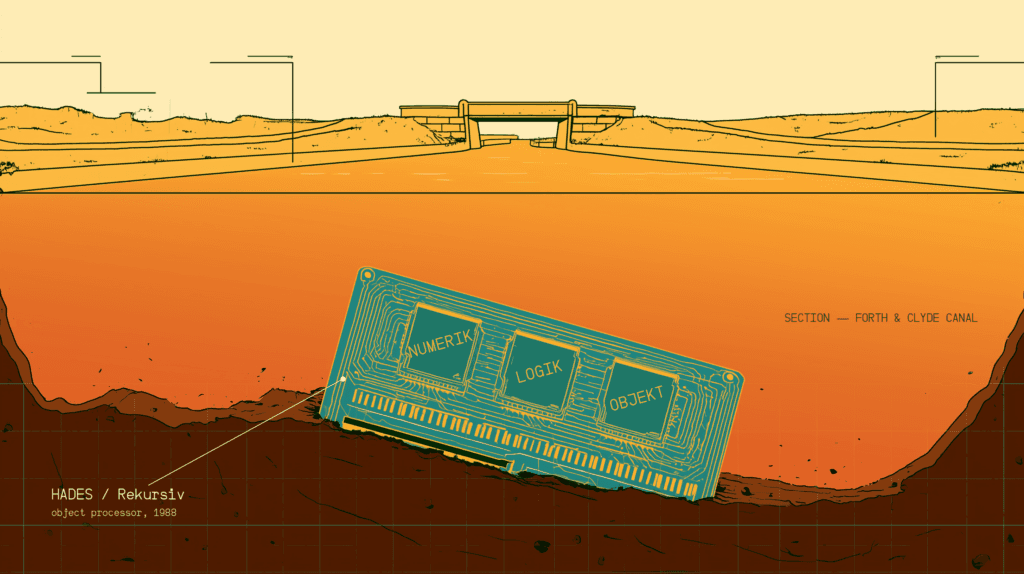
Image: Sondek LP12
Somewhere in the Forth and Clyde Canal lies part of a computer that, in hindsight, got a remarkable amount right. In 1988, Scottish hi-fi maker Linn Products shipped the Rekursiv, a custom processor built around ideas that looked eccentric at the time: hardware-enforced memory safety, garbage collection in silicon, and a persistent object store that blurred the line between RAM and disk.
The machine failed commercially. But nearly 40 years later, many of its core ideas have reappeared in mainstream computing, from Arm security features to the broader shift toward workload-specific silicon.
The Linn Sondek LP12
Recommended reading
Seven Bosgame mini PCs run DeepSeek-V3.1 locally
Linn, founded in 1972 by Ivor Tiefenbrun, was best known for the Sondek LP12 turntable. By the early 1980s, the company was running its factory on VAX-11/750s and 11/780s, but Tiefenbrun disliked the software. He wanted each physical object in the factory to have a corresponding software object tracking its full history.
That led Linn to hire programmers and University of Glasgow lecturer David Harland to build an object-oriented language called LINGO around 1981. When LINGO proved too slow on VAX hardware, Linn chose a more radical answer: build its own machine.
In 1984, Tiefenbrun created Linn Smart Computing, with Marcus Tiefenbrun as managing director and Harland as technical director. The venture was funded with Linn’s money and about £10 million from the Department of Trade and Industry. LSI Logic fabricated four 1.5 micron CMOS gate arrays with 299 pins each: NUMERIK, LOGIK, OBJEKT and KLOK.
What made Rekursiv unusual
The Rekursiv did not just run object-oriented code. It made objects the machine’s fundamental unit. Programs never saw raw addresses. Each object got a 40-bit identifier, while the OBJEKT chip translated that identifier to a physical location and checked type and bounds on every access.
That meant:
- out-of-bounds accesses were blocked in hardware
- forged references were rejected
- objects could move in memory without changing references
- garbage collection could compact live objects transparently
- disk and memory could act as one persistent object store
The machine also had no fixed instruction set. Its microcode was loadable, so the processor could be tailored for different languages. Linn supplied C; James Lothian built a Prolog instruction set; a Manchester group ran Scheme; and Aberdeen ported PS-algol.
Linn’s performance claims were ambitious, including a CONS cell every two microseconds, twenty times the speed of Lisp on a Symbolics workstation, and Prolog unification in a single instruction. But those numbers came from Linn’s own simulations, reported by Byte in November 1988, and were never independently reproduced.
Why it failed — and why it matters now
The Rekursiv arrived just as the industry was moving the other way. Patterson and Ditzel had already made the case for RISC in 1980, arguing that simpler instruction sets and better compilers beat complex hardware. By 1984, Berkeley’s SOAR project had shown that even Smalltalk could run quickly on a relatively simple chip with thirty-five thousand transistors.
Then commodity economics crushed the project. From 1986 to 2003, microprocessors improved by roughly 52% a year, a period Eugene Brooks of Lawrence Livermore called the “attack of the killer micros.” The Rekursiv took four years to design. By the time it appeared, the market had moved on to SPARCstations, 386s, and soon the 486. According to Lothian, it simply could not compete with new workstations.
Only about twenty or thirty boards were built, mostly for universities. There is no record that one ever ran Linn’s production line, the system’s original purpose. One surviving comparison reportedly showed threaded-code LINGO on a Sun-3 running at about twice the speed of the Rekursiv board designed for it.
Its ending was as strange as its design. After Black Monday squeezed Linn’s finances and a rescue venture failed, Harland resigned following a dispute over repairs after a Linn delivery van reversed into his Porsche. On his way out, he threw his own hardware and backup media into the canal. At least one complete board survived and is now in the Jim Austin Computer Collection near York.
The deeper point is that the Rekursiv’s bets no longer look misguided. Hardware memory safety now resembles CHERI, developed by Robert Watson and colleagues at Cambridge and SRI since 2010. Arm shipped Morello prototype boards in 2022 under the UK’s Digital Security by Design programme, and already ships Memory Tagging Extension in Android phones. Microsoft’s security team said in 2020 that CHERI would have deterministically mitigated at least two thirds of the memory-safety vulnerabilities it patched in 2019.
Garbage collection in hardware has echoes in Azul Systems' Vega appliances from the 2000s, while single-level persistent storage lived on through IBM System/38, AS/400, and today’s IBM i. And the Rekursiv’s biggest idea — silicon tuned to a workload instead of everything at once — is now standard industry thinking, visible in chips such as Google’s TPU, Groq’s streaming processor, Cerebras’s wafer-scale engine, and Etched’s transformer ASIC.
The source’s sharpest distinction is between ideas and implementation. IBM kept similar semantics alive by placing them in a virtual instruction set, the Technology Independent Machine Interface (TIMI), which survived hardware changes including a move to PowerPC in 1995. Linn hardwired its approach into four specific chips. The abstraction endured; the gate arrays did not.

Computing Editor
Tomas lives in the terminal. He covers chips, laptops, and operating systems with a focus on performance and efficiency. He reads kernel changelogs the way other people read fiction, and he's always on the hunt for the perfect mechanical keyboard switch. If it processes data, Tomas has an opinion on it.
via Hacker News