• 2 min read
Cooler aluminum 3D printing cuts defects
A University of Manchester study found lower temperatures in molten metal deposition reduced porosity and refined grain structure in aluminum alloy 4043.
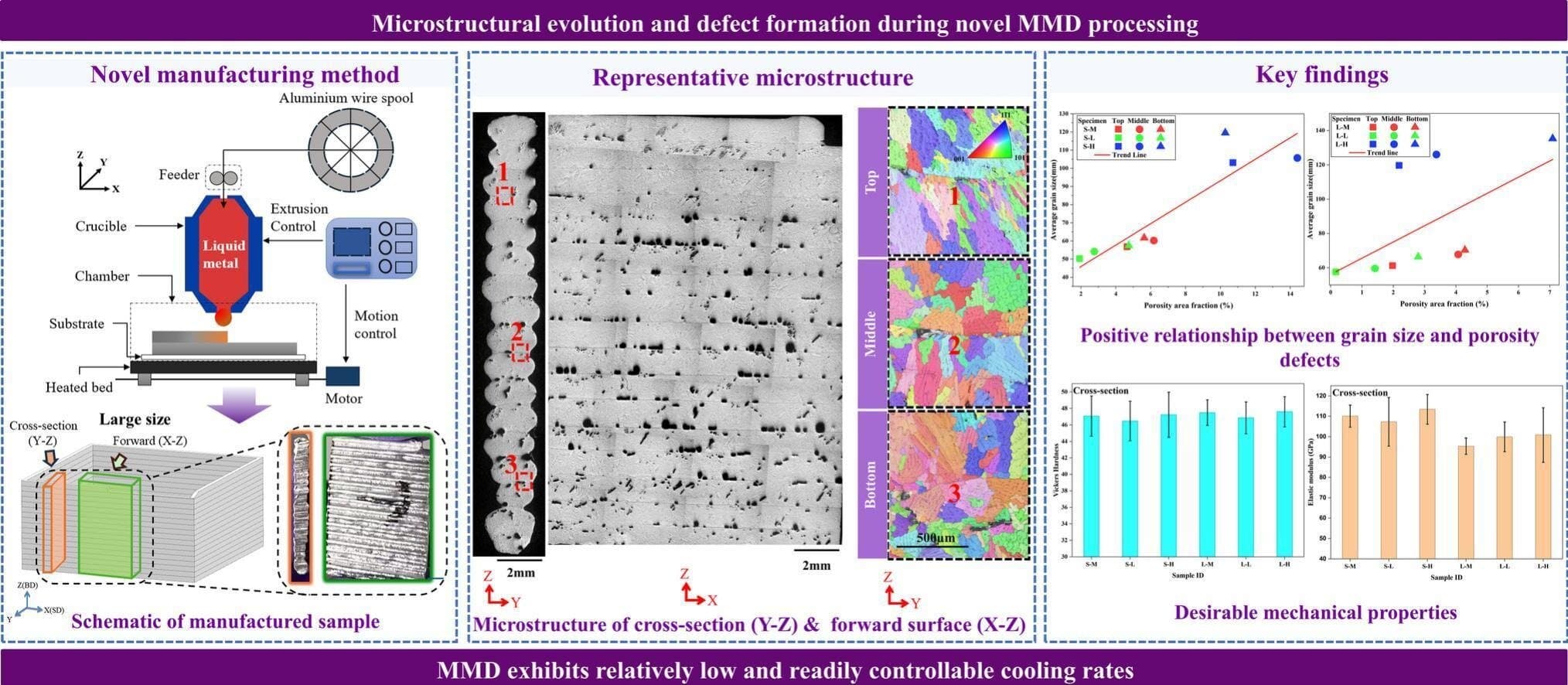
Image: TechXplore
Small temperature changes made a big difference in aluminum 3D printing. In a study published in Materials & Design, researchers at The University of Manchester found that using lower temperatures during molten metal deposition (MMD) reduced microscopic defects and produced a finer internal structure in aluminum alloy 4043.
MMD is an additive manufacturing method that deposits metal after it has already been melted. The researchers say that differs from many established metal 3D-printing techniques, which involve very rapid heating and cooling and can introduce defects, residual stresses, and distortion. Because MMD runs at lower, more controllable temperatures, it could also reduce energy use while making complex parts easier to manufacture.
To test how heat affects part quality, the team printed samples at different nozzle and substrate temperatures. They then used microscopy to examine grain structure, crystallographic orientation, and microscopic pores, and also carried out mechanical testing.

Recommended reading
Libargus brings local LLMs to Java with Panama FFM
The key result: higher nozzle and substrate temperatures slowed cooling, which led to larger grains and more porosity. Lower processing temperatures sped up cooling, producing finer grain structures and fewer defects. The researchers also found that grain size and defect levels generally fell as successive layers were added, suggesting the thermal environment changes throughout the build.
According to co-authors Dr. Fan Wu and Dr. Wajira Mirihanage from the Department of Materials, The University of Manchester, understanding these links is essential if additive manufacturing is to be used more widely in demanding industrial settings.
“Understanding how processing conditions affect the internal structure of a printed component is essential if additive manufacturing technologies are to be used more widely in demanding industrial applications. Our study shows that relatively small adjustments in manufacturing temperatures can have a major impact on defect formation and microstructural development.”
Even with some defects present, the printed parts showed hardness and elastic modulus values within the expected range for aluminum alloy 4043, making them comparable to parts made through conventional manufacturing routes.
The paper is titled “Microstructural evolution and defect formation in aluminium alloy 4043 during molten metal deposition” by Haole Qin et al., published in Materials & Design (2026) with DOI: 10.1016/j.matdes.2026.116508.

Computing Editor
Tomas lives in the terminal. He covers chips, laptops, and operating systems with a focus on performance and efficiency. He reads kernel changelogs the way other people read fiction, and he's always on the hunt for the perfect mechanical keyboard switch. If it processes data, Tomas has an opinion on it.
via TechXplore