• 2 min read
Libargus brings local LLMs to Java with Panama FFM
A new open source runtime uses OpenJDK Panama FFM to run local LLM, speech, and multimodal workloads from Java with low overhead.
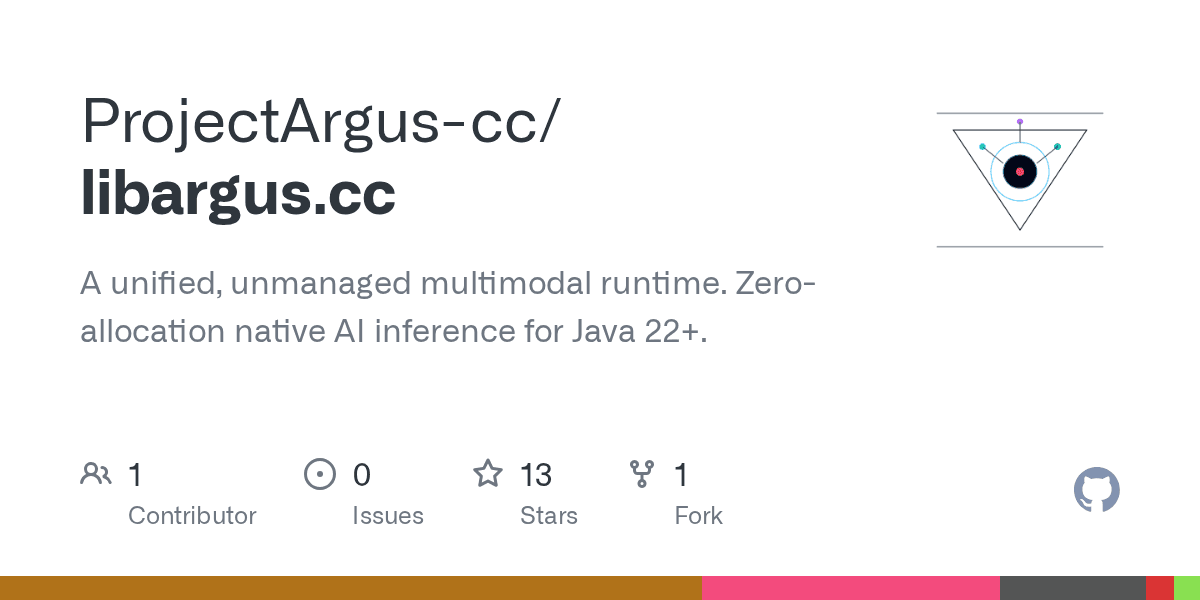
Image: Hacker News
libargus is a new open source local inference runtime aimed squarely at Java 22+ developers using Project Panama Foreign Function & Memory (FFM). Posted to Hacker News as v1.2.0 Stable, the project wraps GGML, llama.cpp, Whisper, and libmtmd behind a single native runtime for LLM text generation, speech-to-text, text-to-speech, embeddings, and multimodal workloads.
The pitch is performance with less JNI-era friction. The project describes itself as an unmanaged, zero-allocation, zero-copy execution layer with a thread-safe C API designed to map cleanly onto Panama FFM. Rather than spinning up separate backends for text, audio, and vision, libargus uses a process-global backend via ggml_backend_load_all() to avoid VRAM fragmentation and multi-context driver conflicts.
A few of the notable architectural choices:
Recommended reading
Apple drops Mac Pro plans and maps out iPad updates
- Model weights and execution contexts are split, so one loaded model can be reused across multiple concurrent sessions.
- Pointers-only C functions replace pass-by-value interfaces to keep the ABI flat and FFM-friendly.
- KV cache quantization supports formats including Q8_0 and Q4_0.
- Native support is included for speculative decoding and Multi-Token Prediction (draft-mtp).
- The runtime exposes GGUF metadata and vocabulary lookups such as BOS, EOS, EOT, and PAD.
The multimodal side is especially ambitious. Through libmtmd, the runtime can ingest raw bitmaps, PCM audio arrays, and video files or streams, then tokenize text and media into a single chunk sequence. It also includes a video pipeline that decodes files frame by frame through internal FFmpeg subprocess pipes, returning either RGB frames or timestamp text like [12m34s] at a target frame rate.
On the Java side, the repository includes a full binding layer under bindings/java/, with classes such as ArgusModel, ArgusContext, ArgusAudioContext, ArgusMultimodalContext, and ArgusVideo. The examples show loading a llama-3-8b.gguf model, configuring a 4096-token context with 8 CPU threads, and enabling Q4_0 KV cache quantization. Another example uses qwen2-vl-7b-it.gguf with its .mmproj adapter for image prompting, while an embeddings example targets jina-embeddings-v3-Q4_K_M.gguf.
Building the shared library is straightforward from the root directory:
''bash cmake -B build -DCMAKE_BUILD_TYPE=Release -DGGML_CUDA=ON cmake --build build --config Release -j $(nproc) ''
The project also ships test hooks for both native and Java integration layers, including ./build/test_libargus and gradle test under bindings/java. For developers who want local model execution from Java without giving up low-level control, libargus is trying to make Panama FFM a first-class path instead of an experiment.

Computing Editor
Tomas lives in the terminal. He covers chips, laptops, and operating systems with a focus on performance and efficiency. He reads kernel changelogs the way other people read fiction, and he's always on the hunt for the perfect mechanical keyboard switch. If it processes data, Tomas has an opinion on it.
via Hacker News