• 2 min read
Deepfake detector hits 95% by tracking facial motion
Researchers say a new self-supervised method detects deepfake videos with over 95% accuracy by comparing speech audio to expected facial movements.
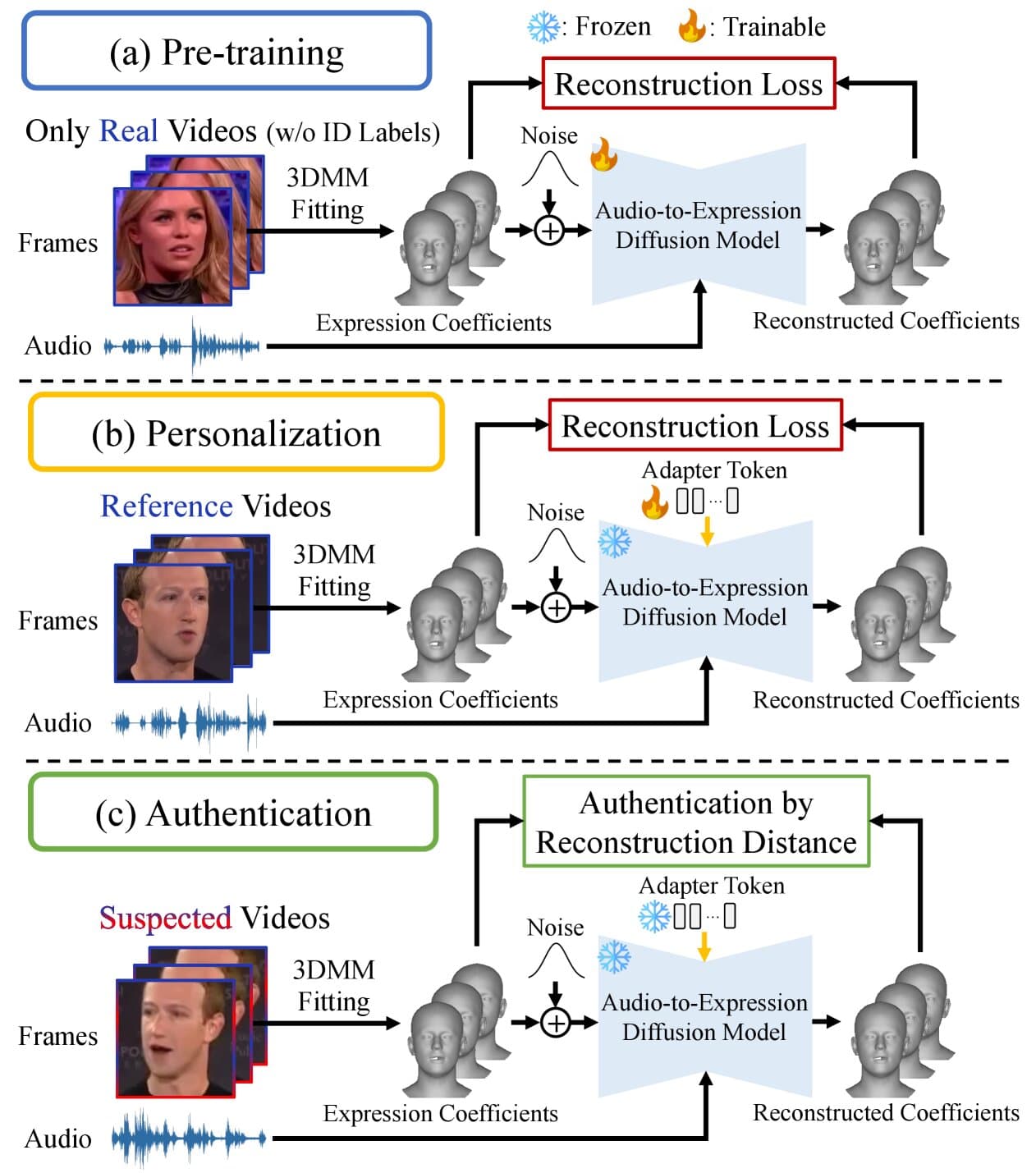
Image: TechXplore
A research team from the University of Tokyo and the Max Planck Institute for Informatics says it has built a deepfake detection system that identifies manipulated videos with more than 95% average accuracy. Instead of looking for visual glitches, the method checks whether a speaker’s facial expressions match the movements that would naturally be expected from the audio.
The work comes from Kaede Shiohara and Toshihiko Yamasaki at the University of Tokyo, together with Vladislav Golyanik, senior researcher and head of the 4D and Quantum Vision group at the Max Planck Institute for Informatics in Saarbrücken, Germany. Their paper, “ExposeAnyone: Personalized Audio-to-Expression Diffusion Models Are Robust Zero-Shot Face Forgery Detectors,” was presented at CVPR 2026.
How the method works
Most top deepfake detectors rely on supervised learning trained on large labeled sets of real and fake videos. That often delivers high accuracy, but it can also make systems too narrowly tuned to known forgery methods. When a new manipulation technique appears, performance can drop sharply.
Recommended reading
AI won’t replace penetration testers just yet
This new approach is self-supervised, meaning it is trained only on authentic video. The researchers say that makes it more resilient to new deepfake techniques while avoiding the accuracy trade-off that has typically hurt earlier self-supervised systems.
The system is built on FLAME, a facial model that represents expressions with 53 parameters. It was pre-trained on more than 450 hours of publicly available video to learn how to predict FLAME facial movements from speech audio. After that, it can be personalized to a specific person using about 60 seconds of reference video.
During detection, the model compares the facial movements seen in a clip with the FLAME parameters it predicts from the accompanying audio. Large mismatches can indicate manipulation.
“The combination of self-supervised learning and FLAME-based facial analysis makes our approach particularly robust against new deepfake generation methods as well as distortions such as image compression or noise.”
Results on benchmark datasets and Sora 2 videos
In tests on established benchmark datasets, the method reached more than 95% average detection accuracy and outperformed prior systems, according to the researchers.
The team also created an additional benchmark using videos generated by OpenAI’s Sora 2. On that dataset, earlier detectors performed only slightly better than chance, but the new system still correctly flagged almost 95 percent of manipulated videos.
The researchers also note clear limits: the system needs extensive pre-training on powerful hardware and is not currently suitable for real-time use.
The paper is available on arXiv with DOI 10.48550/arxiv.2601.02359.

Security Editor
Sophia unpacks the invisible wars happening on our networks. Covering cybersecurity, privacy legislation, and cryptography, she exposes how our data is weaponized and defended. Before joining for(geeks), she spent years as a penetration tester. She's the reason the rest of the team uses physical security keys.
via TechXplore