• 2 min read
Zinc slurry battery runs for 5,128 hours
Researchers at Fudan University and the Chinese Academy of Sciences built a flowing zinc slurry battery with 99.94% Coulombic efficiency.
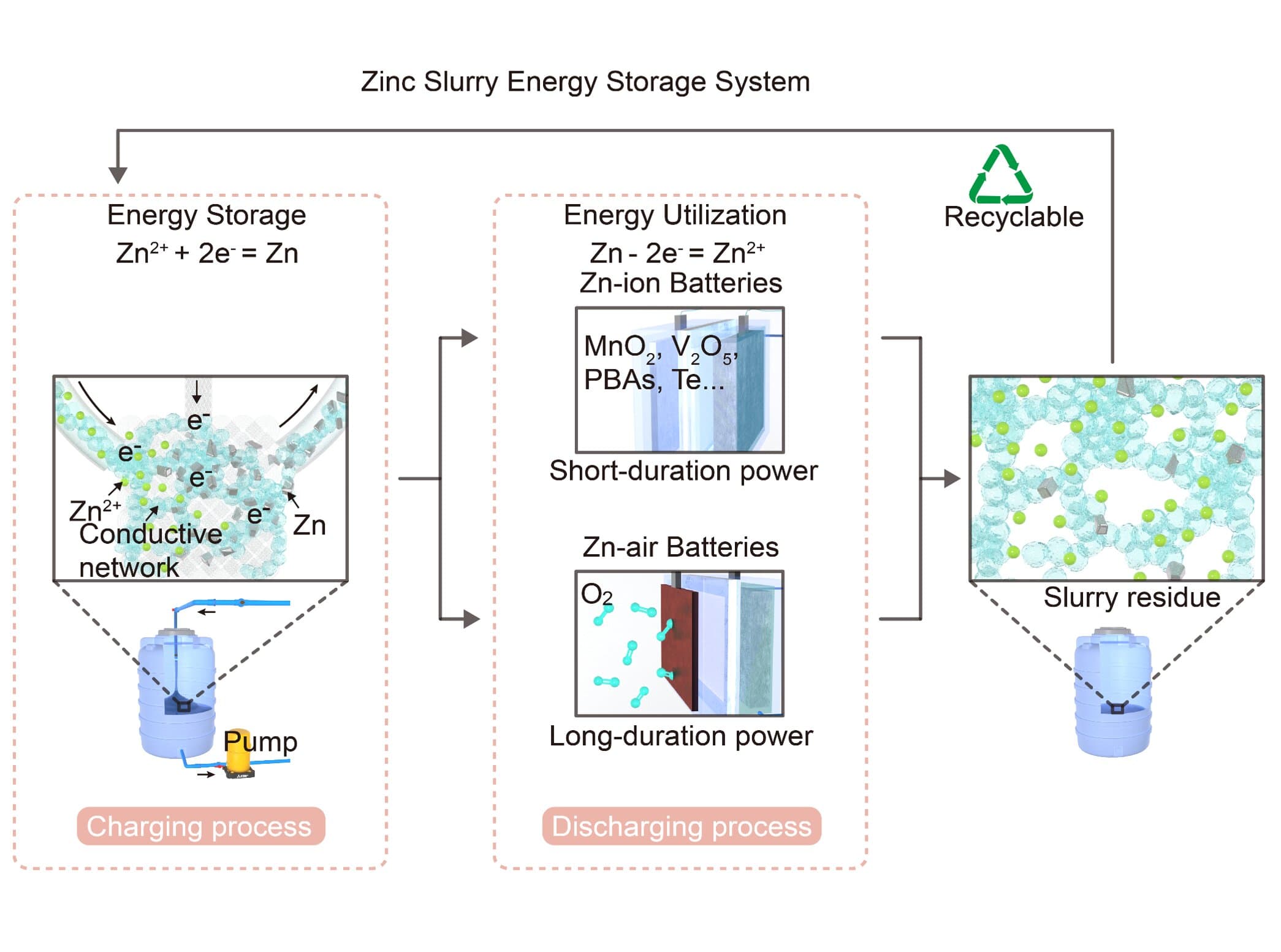
Image: TechXplore
A flowing zinc slurry battery developed by researchers at Fudan University and the Chinese Academy of Sciences could offer a longer-lasting way to store electricity from solar and wind power. Reported in Nature Energy, the design replaces the usual fixed zinc electrode with zinc nanoparticles suspended in a conductive liquid, allowing the active material to circulate through the system.
According to senior author Fei Wang, the idea grew out of work on improving the reversibility of zinc metal electrodes, which often degrade at the interface during repeated cycling. He told Tech Xplore that a visit to a zinc electrowinning plant helped inspire the concept of using the Zn2+ to metallic Zn conversion process directly for energy storage.
The battery combines three main components:
- nanoscale Zn particles as the active storage material
- a hollow carbon network to maintain electronic pathways and keep particles dispersed
- a ligand-controlled electrolyte environment to stabilize the interface
Wang said this setup helps preserve reversible Zn/Zn2+ cycling while limiting particle aggregation and unwanted side reactions. The flow architecture also separates energy storage from power delivery, which is useful for long-duration storage systems.
In early tests, the battery reached a Coulombic efficiency of 99.94%. The team also demonstrated continuous operation of symmetric flowing zinc slurry battery cells for 5,128 hours. In addition, zinc-manganese dioxide batteries based on the design retained 81.1% of their original energy capacity after 5,500 charge-discharge cycles.
Recommended reading
Magnesium oxide could shield fragile solid-state batteries
“Rather than relying on a fixed Zn surface that gradually degrades during cycling, our approach enables continuous circulation of Zn slurry while maintaining reversible Zn/Zn2+ conversion.”
The researchers said the concept could be scaled by increasing the amount of slurry stored in the system. Their next steps include building larger devices, improving integration, and testing long-term performance under more realistic operating conditions, including pumping and slurry management.
The paper is “Flowing zinc slurry for long-duration energy storage” by Wenyong Chen et al, published in Nature Energy (2026) with DOI 10.1038/s41560-026-02091-w.

Frontier Editor
Dan is our resident futurist, covering electric mobility, space exploration, and the smart home. He's interested in atoms just as much as bits. Whether it's a new battery chemistry, a reusable rocket, or a protocol that finally makes IoT devices talk to each other, Dan breaks down the engineering that pushes humanity forward.
via TechXplore