• 2 min read
Google boosts Fitbit with better sleep tracking and AI health advice
Google is rolling out a slew of upgrades to its Fitbit app, sharpening sleep tracking accuracy, launching AI-powered health consultations, and opening the door to medical data integration. These enhancements build on the
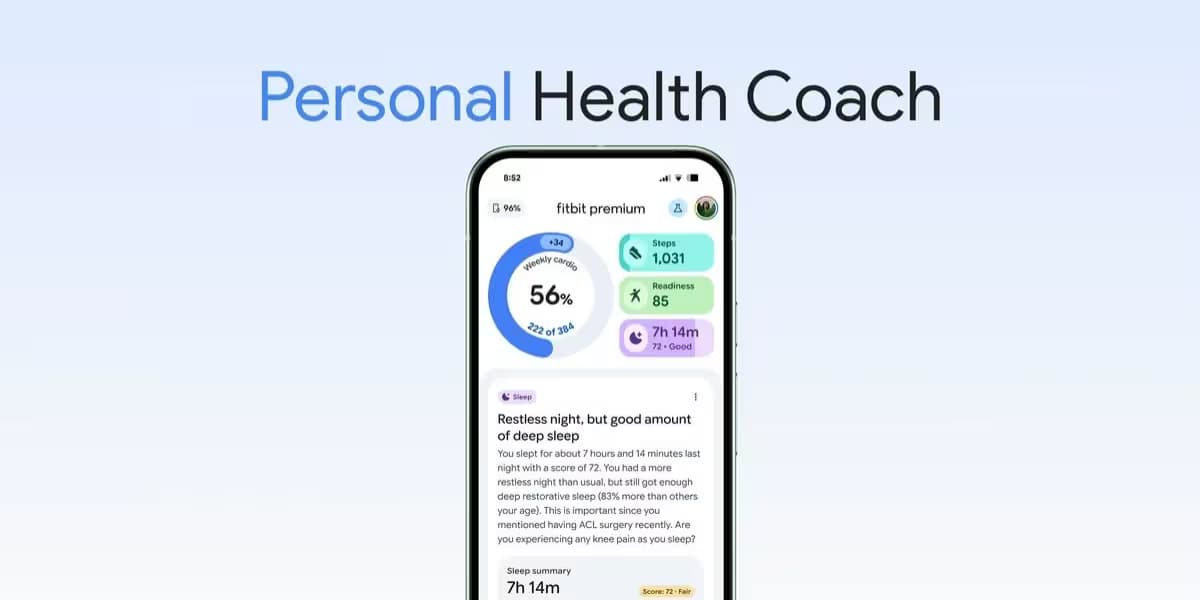
Image: NotebookCheck
Google is rolling out a slew of upgrades to its Fitbit app, sharpening sleep tracking accuracy, launching AI-powered health consultations, and opening the door to medical data integration. These enhancements build on the “personal health assistant” feature Google introduced in late 2025, which has been in public beta for Fitbit Premium subscribers in the US.
One major improvement is a 15% jump in the accuracy of sleep phase detection on Fitbit devices. They can now more precisely distinguish between awake times, light and deep sleep, spot naps, and identify sleep disruptions. This boost feeds into the Sleep Score metric and helps fine-tune personalized tips for better rest. These sleep-focused updates will reach US public preview users in the coming weeks.
Google also announced a new Fitbit Lab research program called “Get care now,” developed in partnership with Included Health, a telemedicine provider. The initiative will test how well conversational AI performs within virtual medical consultations, exploring how these AI interactions might support users' healthcare needs.
Another new feature will let users link continuous glucose monitors (CGMs) to Fitbit via Google’s Health Connect platform, enabling real-time blood sugar tracking directly in the app. This capability is slated for public testing in the US starting April 2026.
Additionally, Fitbit will soon allow users to attach their medical records to the app through partnerships with services like b.well and CLEAR. To safeguard privacy, the process includes identity verification via selfies and official documents. This feature is also scheduled to launch in April 2026.

Recommended reading
xAI Sues Grok User Over Child Abuse Images
Earlier in February 2026, Fitbit’s personal health assistant expanded beyond the US, becoming available to Premium subscribers in the UK, Canada, Australia, New Zealand, and Singapore. However, Google has yet to reveal when these latest updates will reach users outside the US beta group.
Google’s push to integrate AI and medical data into Fitbit follows broader trends among wearable makers. Apple Health already offers medical records syncing with several institutions, and Samsung has deepened its health platform with AI coaching. Google’s advances could help Fitbit stay relevant amid fierce competition, especially by broadening data integration and virtual care.
The coming months will be key to seeing how users adopt these smarter health tools and whether Google can match the seamlessness offered by Apple and Samsung.

AI Editor
Ava covers the rapidly evolving world of artificial intelligence, from foundational models and research labs to the real-world economics of intelligence. With a background in computational linguistics, she cuts through the hype to find out what actually works. She firmly believes that benchmarks are just marketing until reproduced in the wild.
via NotebookCheck