• 2 min read
Green hydrogen study finds hidden pH losses in PEC cells
HZB researchers used 2D imaging and particle velocimetry to track ion and gas flow in PEC electrolyzers, finding buffer concentration is key to limiting pH losses.
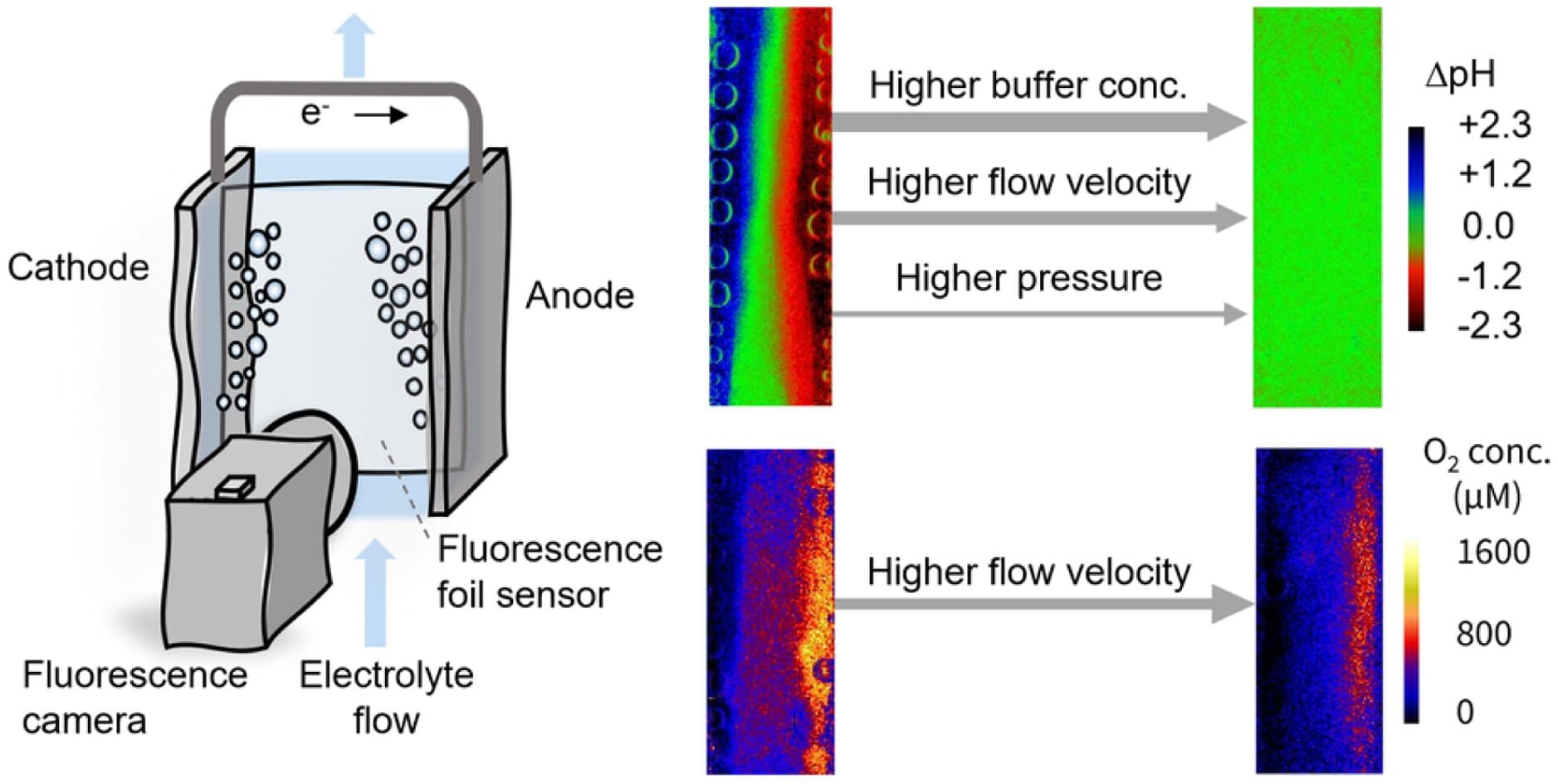
Image: TechXplore
One of the big hurdles for photoelectrochemical (PEC) electrolyzers is that performance can fall sharply when devices move beyond the lab. Researchers at the HZB Institute for Solar Fuels now say they have pinned down part of the problem: large pH gradients can form inside the electrolyte volume, creating overpotential losses that hurt efficiency.
The team, publishing in EES Solar, used 2D fluorescence imaging and particle image velocimetry (PIV) to watch how ions and dissolved gases move through the electrolyte during electrolysis. The goal was to better understand the transport processes that become more problematic as PEC systems scale up, especially when larger volumes allow convective flows and pH gradients that can also contribute to electrode degradation.
Professor Roel van de Krol said the group developed visualization techniques at HZB specifically to map those effects. The fluorescence method let the researchers track local pH and its changes over time, while also measuring dissolved oxygen concentration. PIV, meanwhile, was used to follow the movement of individual particles in the electrolyte.
Recommended reading
Scientists built a thermal cloak that hides objects in IR
The experiments produced a result the team did not expect: a continuously flowing electrolyte in a pH-neutral electrolyte solution was not enough to stop large pH gradients from forming. According to van de Krol, the gradients could only be avoided by also increasing the concentration of buffer ions.
“To avoid such gradients, we also had to increase the concentration of buffer ions.”
Another surprise was where those gradients appeared. Rather than forming right at the electrode surfaces, the measurements showed they developed within the electrolyte volume. That runs against computer simulations from other groups, which had predicted the gradients would occur very close to surfaces.
“This shows that computer simulations are not (yet) capable of truly capturing all physical relationships; the experiment remains the gold standard.”
The paper is “In situ measurement of mass transport in (photo)electrochemical water splitting at device scale” by Feng Liang et al, published in EES Solar (2026) with DOI: 10.1039/d6el00057f.

Frontier Editor
Dan is our resident futurist, covering electric mobility, space exploration, and the smart home. He's interested in atoms just as much as bits. Whether it's a new battery chemistry, a reusable rocket, or a protocol that finally makes IoT devices talk to each other, Dan breaks down the engineering that pushes humanity forward.
via TechXplore