• 2 min read
Scientists built a thermal cloak that hides objects in IR
A new 3D metamaterial cloak bends heat around objects, making them nearly invisible to infrared cameras while keeping the interior temperature stable.
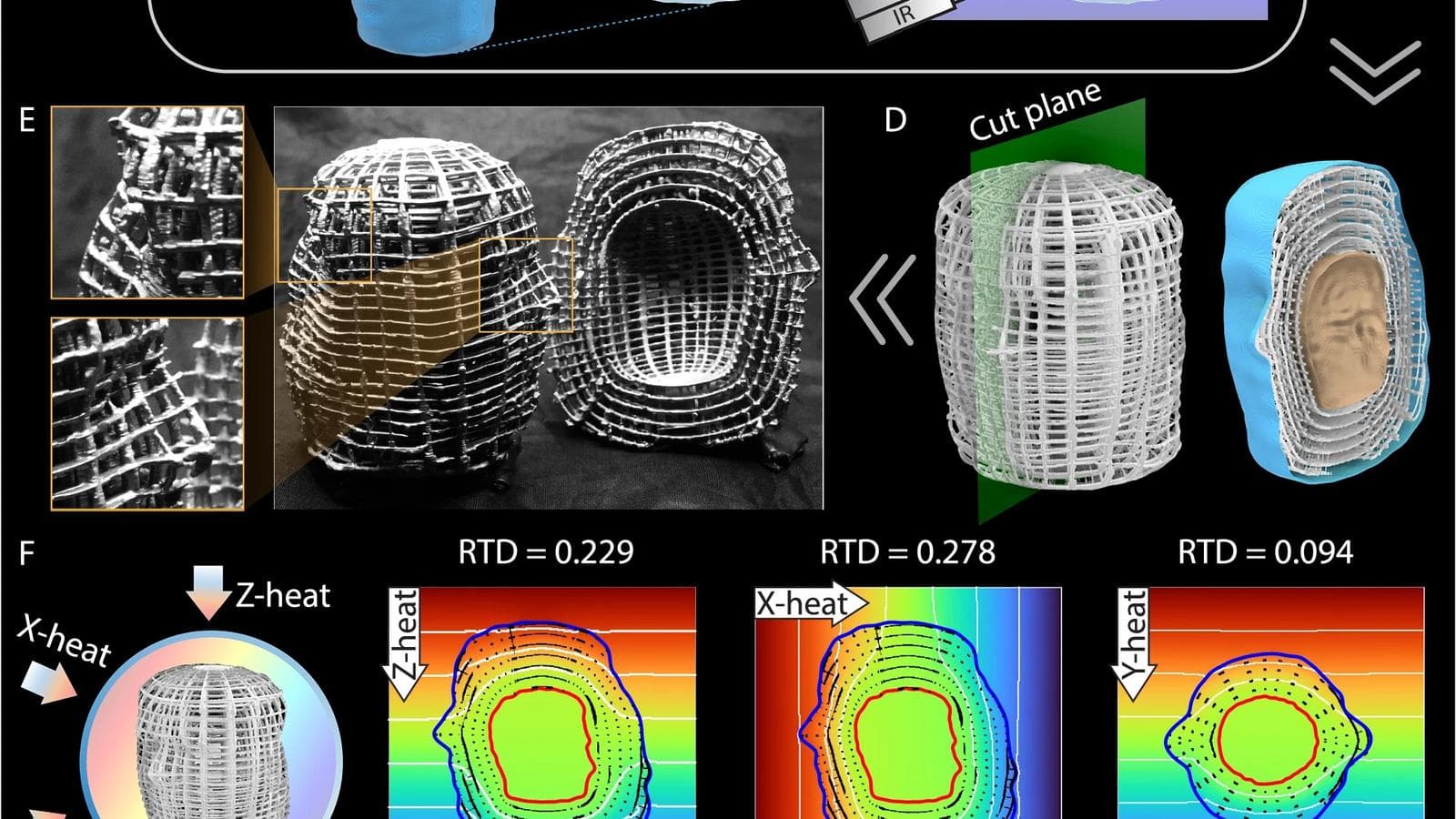
Image: iXBT
Scientists have developed a 3D thermal cloak that can hide objects from infrared cameras while also shielding them from high temperatures. Unlike earlier systems that worked only in 2D or under heating from a single direction, the new design controls heat flow across all three dimensions.
Instead of simply blocking heat transfer, the device redirects heat around the concealed object so the outside temperature pattern looks almost as if nothing is there. Through an infrared camera, the object becomes nearly invisible, while the temperature inside the protected region stays stable.
To build it, the researchers created a lattice material with tunable thermal properties. The structure combines a 3D-printed aluminum framework, which conducts heat well, with a molded polymer that has low thermal conductivity and acts as an insulator. Together, those components let the team precisely steer heat through different parts of the cloak.
Recommended reading
Too Much Power Could Make Electricity Prices Go Negative
In lab tests, the device was placed between hot and cold zones. Heat flowed around the hidden object, producing an external temperature field that was almost indistinguishable from one with no object inside. The protected area, meanwhile, remained at a nearly constant temperature despite a large temperature difference around it.
The team also tested the system on complex 3D shapes, including head models with detailed geometry. According to the researchers, those trials showed higher performance than earlier versions of thermal cloaks.
The work could be useful anywhere precise heat control or protection from infrared detection matters, including:
- shielding sensitive electronics and microchips from overheating
- improving thermal management in computing systems
- reducing the visibility of objects to infrared sensors
The next step is to build more advanced versions that can also conceal heat-emitting objects. The source cites the underlying paper as Li, W., Wang, Y., Sigmund, O. et al. _Free-form thermal cloaks in three dimensions_. Nat Commun 17, 5739 (2026), published at https://doi.org/10.1038/s41467-026-73167-0.

Frontier Editor
Dan is our resident futurist, covering electric mobility, space exploration, and the smart home. He's interested in atoms just as much as bits. Whether it's a new battery chemistry, a reusable rocket, or a protocol that finally makes IoT devices talk to each other, Dan breaks down the engineering that pushes humanity forward.
via iXBT