• 2 min read
Hubble and Webb spot black hole with a 94-year orbit
Astronomers found the first stellar-mass black hole in Omega Centauri, using 20 years of Hubble data and Webb follow-up.
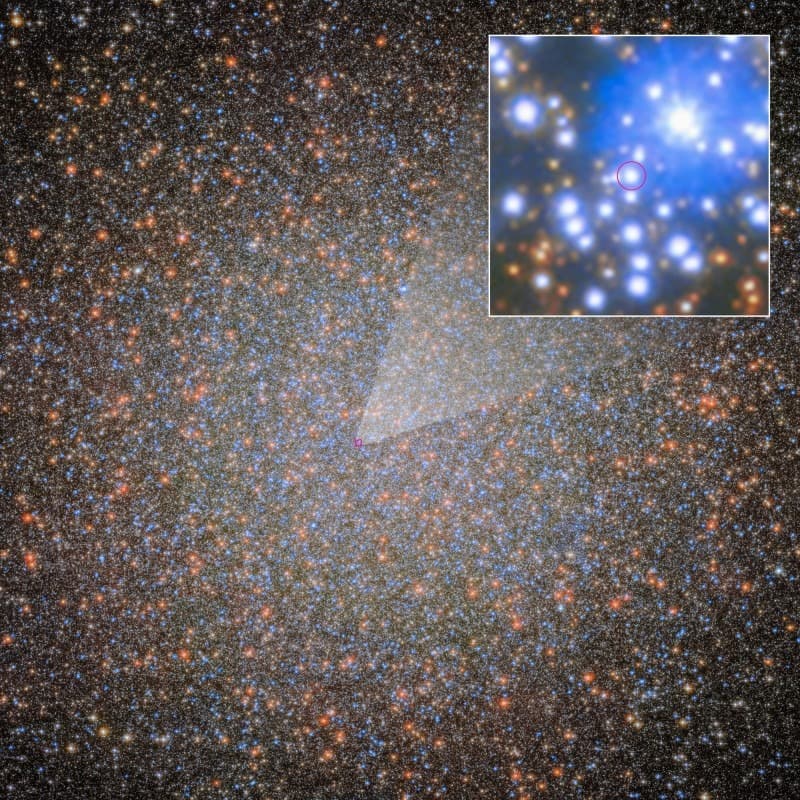
Image: iXBT
Astronomers have identified the first stellar-mass black hole in Omega Centauri, one of the Milky Way’s largest and densest globular clusters, after 20 years of searching for the cluster’s long-predicted population of such objects. The discovery, published in The Astrophysical Journal Letters, relied on more than two decades of archival NASA Hubble Space Telescope data, refined with observations from the James Webb Space Telescope.
Omega Centauri contains roughly 10 million stars bound by gravity. Earlier Hubble studies had hinted at a possible intermediate-mass black hole in the cluster’s center, while models also predicted about 10,000 smaller stellar-mass black holes left behind by massive stars that ended their lives as supernovae.
Previous searches came up empty. Those efforts mainly tracked stars' line-of-sight velocities or looked for X-ray and radio emission from matter falling into a black hole.
The newly identified object, oMEGACat BH-2, was found through astrometry, which measures tiny shifts in a star’s position over long periods. Researchers tracked a visible companion star about 18,000 light-years from Earth and found that it orbits an unseen massive object. The motion rules out ordinary explanations, pointing to a black hole.
Recommended reading
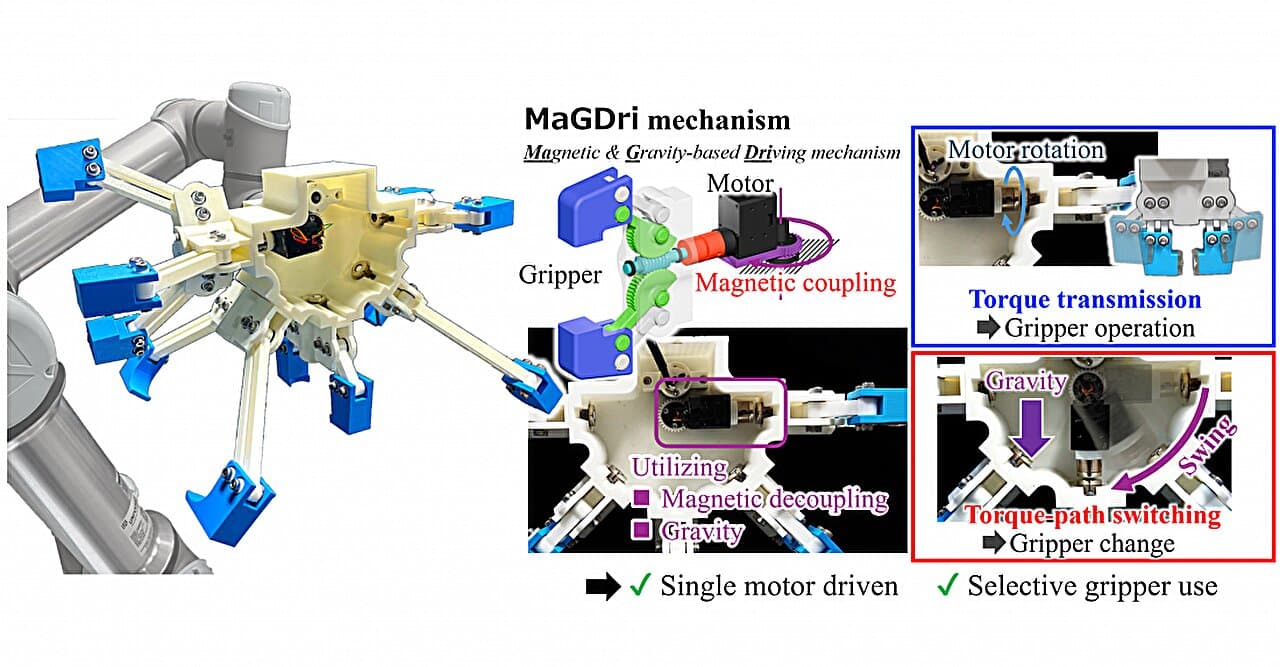
One motor powers this robotic hand’s multiple grippers
Using Hubble images from 2002 to 2023 plus Webb’s infrared data, the team refined the system’s mass estimates. The visible star has about 0.78 solar masses, while its unseen companion comes in at 4.46 solar masses. That is too massive to be a neutron star, but still lighter than expected for Omega Centauri’s low-heavy-element environment.
Orbit and formation
What stands out most is the orbit: the star takes 94 years to complete one revolution around the black hole, the longest known orbital period for a black hole binary system. According to the researchers, the pair likely did not form together. Instead, the black hole and star may have encountered each other later inside the dense cluster through dynamical interactions with other stars.
The team says studying systems like this could sharpen models of black hole formation and the creation of binary systems that may later become sources of gravitational waves when they merge. Researchers now plan to keep searching for similar objects in Omega Centauri and other globular clusters, with future observations from the Nancy Grace Roman Space Telescope expected to help through regular, high-resolution imaging of dense regions of the galaxy.

Frontier Editor
Dan is our resident futurist, covering electric mobility, space exploration, and the smart home. He's interested in atoms just as much as bits. Whether it's a new battery chemistry, a reusable rocket, or a protocol that finally makes IoT devices talk to each other, Dan breaks down the engineering that pushes humanity forward.
via iXBT