• 2 min read
KAIST’s XR comics put webtoons into your room
KAIST has released ComiXR, an open-source XR platform that turns comics into room-scale 3D scenes with eye tracking, haptics, and spatial audio.
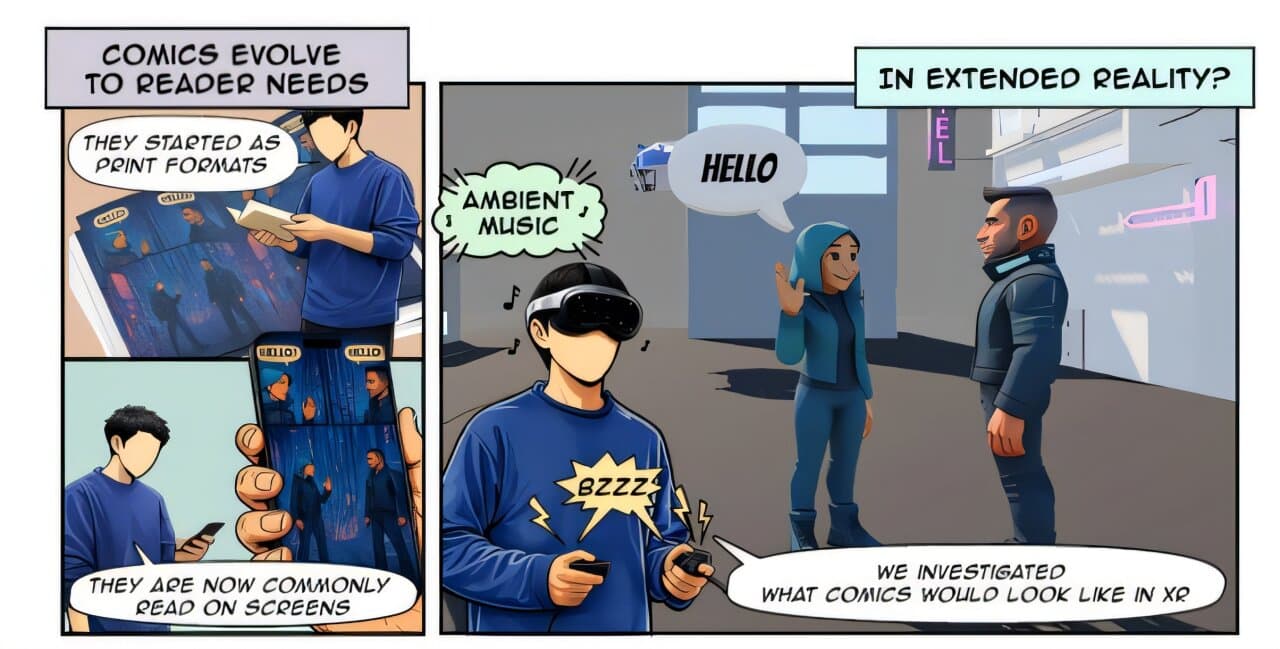
Image: TechXplore
KAIST researchers have built an open-source platform that turns webtoons into 3D XR comics readers can place and explore in real rooms. The project, called ComiXR, was presented at ACM DIS 2026 and is positioned as a new step in the evolution of comics beyond print, smartphones, and vertical-scrolling webtoons.
Led by Professor Ian Oakley of KAIST’s School of Electrical Engineering, the team ran a user study with 15 participants, including HCI experts, professional webtoon creators, and readers. Using a Meta Quest Pro headset, participants converted a conventional print comic into an XR comic and tested combinations of visual, auditory, haptic, and interactive features.
The study found that readers preferred comics that made active use of physical depth instead of simply placing flat pages in a virtual space. Immersion increased when characters, backgrounds, and speech bubbles were separated into different layers. One especially effective feature used eye tracking to reveal the next line of dialogue only when a reader looked at a specific character, helping avoid spoilers.
ComiXR also adds storytelling tools unavailable in conventional comics. According to the study, facial expression triggers can activate special effects, while haptic feedback can simulate sensations such as a character’s heartbeat or the impact of an onomatopoeic effect.
XR comic design concepts
Based on the research, the team proposed four design concepts for XR comics:

Recommended reading
SIHOO’s Doro C300 Pro V2 drops to about $404
- The Panel Gallery: room walls become a gallery for comic panels
- The Pop-Up: comics appear like pop-up books on desks or walls
- Around Comic: 3D characters and comic elements are placed in outdoor spaces
- Inclusive ComiX: accessibility-focused designs for a broader range of readers
The researchers say XR comics are meant to complement, not replace, smartphone-based webtoons. They also point to uses in special exhibitions, education, and wider access to cultural content.
Ammar Al-Taie, a postdoctoral researcher at the KAIST Information and Electronics Research Institute, is the paper’s first author, with Hyunyoung Han, a doctoral student in the School of Electrical Engineering, listed as co-author. The paper is titled “ComiXR: Exploring Comic Layouts in eXtended Reality” and has the DOI 10.1145/3800645.3812857.

Design & UX Editor
Yuki believes that a great product is defined by how it feels. She critiques software interfaces, hardware ergonomics, and the philosophy of design in tech. With a background in industrial design, she analyzes the subtle decisions that make tools intuitive or infuriating. She advocates for accessible, human-centric technology.
via TechXplore