• 2 min read
China switches on major heavy-ion accelerator
China has begun trial operations of HIAF, a next-generation heavy-ion accelerator built over 16 years with domestically developed core technology.
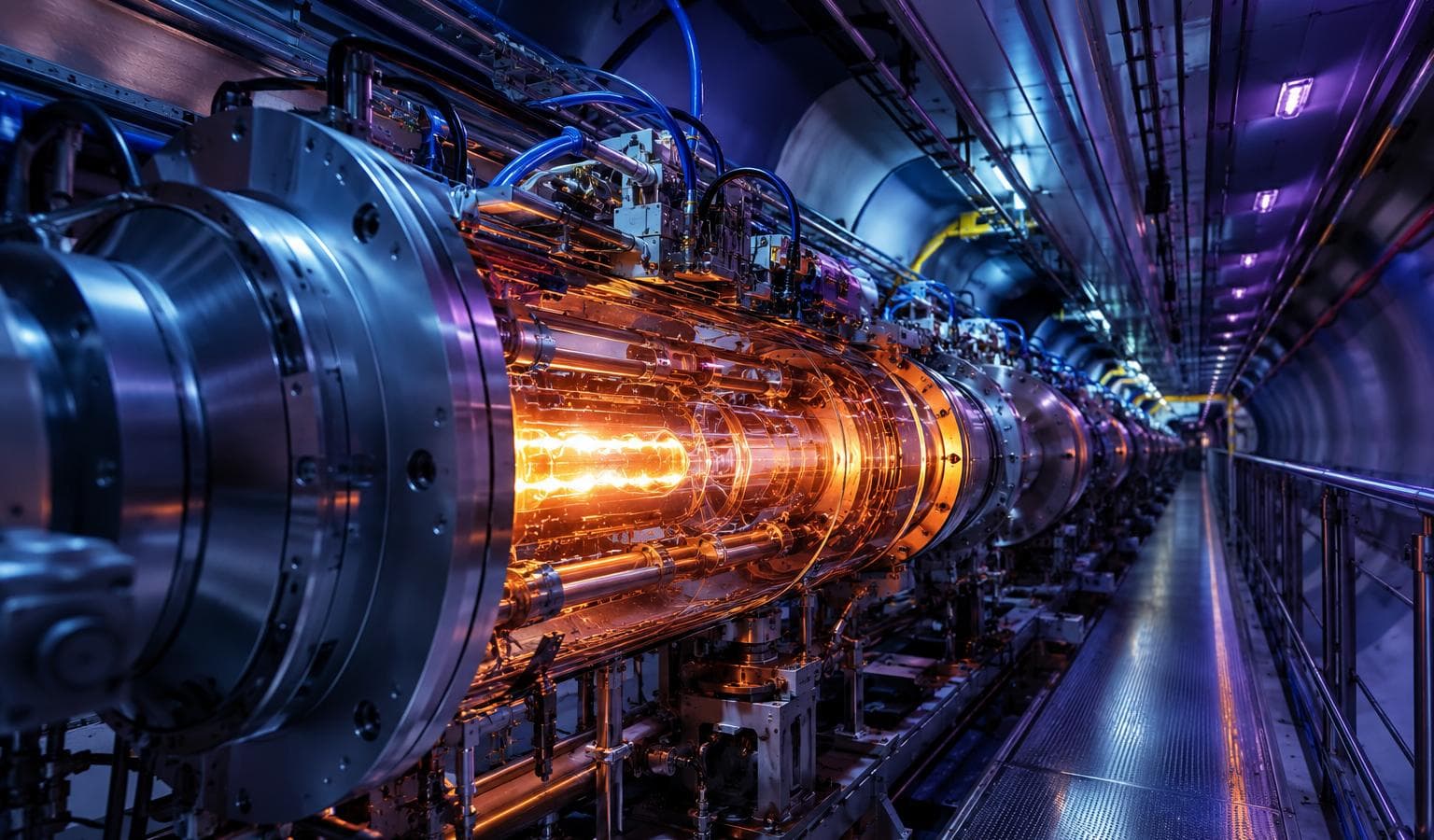
Image: iXBT
China has officially started trial operations of HIAF (High Intensity Heavy Ion Accelerator Facility), a next-generation heavy-ion accelerator that the country says ranks among the most powerful in its class. After passing technical acceptance, the complex became the first fully completed research center in the world to combine a superconducting linear accelerator, synchrotron, and storage ring into a single system.
HIAF is located in Huizhou, Guangdong province, and is described as one of China’s largest scientific projects. The facility took 16 years to go from concept to operation. It was developed by the Institute of Modern Physics at the Chinese Academy of Sciences.
The accelerator complex stretches roughly two kilometers and includes the accelerator itself, experimental stations, supporting infrastructure, about 6,000 pieces of equipment, 5 million components, and roughly 1.5 million meters of engineering utilities.
According to the developers, HIAF can generate the world’s most intense pulsed heavy-ion beams, making it one of the strongest accelerators of its kind. A major part of the project was reducing dependence on foreign suppliers. Early in construction, Chinese researchers ran into restrictions around critical technologies, including magnetic-alloy RF cavities, whose technical parameters were not disclosed by overseas manufacturers.

Recommended reading
NASA’s $2.1B Mars craft bets on nuclear power
Engineers ultimately built domestic replacements. The key hardware and software were developed in China, and reliance on foreign components was almost entirely removed. During the project, researchers also created several new technologies, including an ultra-thin vacuum chamber and a magnetic-alloy RF system with a record voltage gradient for the low-frequency range.
The facility is aimed at both basic research and practical applications. Scientists plan to use it to study:
- the structure of atomic nuclei
- the origin of chemical elements
- processes taking place in the universe
- the behavior of matter under extreme conditions
China also expects industrial spillover. Over the next two years, the country plans to launch a new generation of heavy-ion cancer therapy systems, equipment for producing nuclear membranes, and production lines for medical radioisotopes.

Frontier Editor
Dan is our resident futurist, covering electric mobility, space exploration, and the smart home. He's interested in atoms just as much as bits. Whether it's a new battery chemistry, a reusable rocket, or a protocol that finally makes IoT devices talk to each other, Dan breaks down the engineering that pushes humanity forward.
via iXBT