• 3 min read
Kimi K3 arrives as the first open 3T-class model
Moonshot says Kimi K3 is a 2.8T-parameter open model with vision, a 1 million-token context window, and weights due by July 27, 2026.
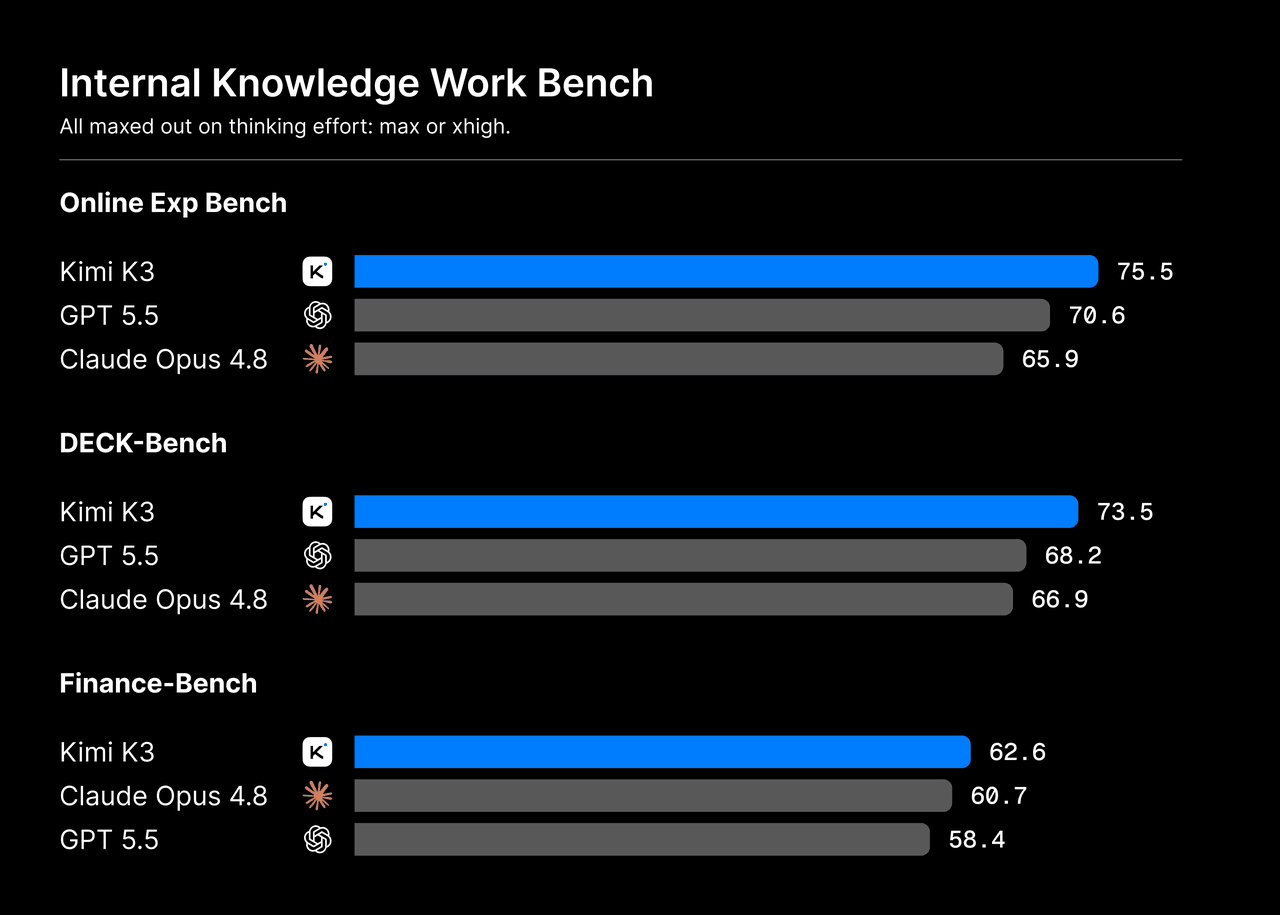
Image: Hacker News
Moonshot has unveiled Kimi K3, a 2.8 trillion-parameter model the company calls the world’s first open 3T-class model. It ships with native vision, a 1 million-token context window, and support across Kimi.com, Kimi Work, Kimi Code, and the Kimi API. Full model weights are scheduled for release by July 27, 2026.
The company says K3 is its most capable model so far, built on Kimi Delta Attention (KDA) and Attention Residuals (AttnRes). It also uses a Mixture of Experts design that activates 16 of 896 experts under a Stable LatentMoE framework. According to Moonshot, those changes deliver about a 2.5x scaling-efficiency improvement over Kimi K2.
Moonshot positions K3 as strong on long-running coding, reasoning, and knowledge-work tasks, while acknowledging that it still trails the top proprietary models overall, specifically Claude Fable 5 and GPT 5.6 Sol. In its own benchmark table, K3 posts competitive results across software engineering, agentic workflows, vision, and reasoning, often ahead of other tested models.
Coding, research, and multimodal work
The blog highlights several showcase projects. In coding, Moonshot says K3 can sustain long engineering sessions, work across large repositories, and use screenshots and other visuals in tasks like frontend work, game development, and CAD. In one test, the company says K3 performed competitively with Fable 5 on GPU kernel optimization, while beating Opus 4.8, GPT 5.6 Sol, and GPT 5.5.
Moonshot also says K3 built MiniTriton, a compact Triton-like GPU compiler with its own MLIR-based IR, optimization passes, and PTX code-generation pipeline. The company claims MiniTriton matched or exceeded Triton and torch.compile on supported roofline benchmarks and sustained end-to-end nanoGPT training.
Recommended reading
Hassabis says STEM makes you 10x better at AI
Other examples are broader:
- a procedural browser-based 3D exploration game built with Three.js WebGPU
- a chip designed in a single 48-hour autonomous run using open-source EDA tools on the Nangate 45nm library
- an astrophysics workflow reproducing I–Love–Q universal relations after reviewing 20+ papers, evaluating 300+ equations of state, and generating 3,000+ lines of Python
For knowledge work, Moonshot says K3 can generate interactive research outputs in finance and science, including a 42-year AI ASIC industry report built through 120+ rounds of recursive self-improvement, using 2.8k+ web searches and fetches, 1.1k+ terminal data pulls, and 11k+ pages across 87 quarterly reports and 99 PDFs.
The company is also adding Widgets and Dashboard to Kimi Work, aimed at making K3's outputs more visual and persistent inside chats.
Pricing and rollout
At launch, max reasoning effort is the default. Low- and high-effort modes will come later, according to the company. Moonshot says it is working with inference partners and open-source maintainers ahead of a broader rollout and plans to publish a technical report covering architecture, training, and evaluations.
API pricing is set at:
- $0.30/MTok for cache-hit input
- $3.00/MTok for cache-miss input
- $15.00/MTok for output
Moonshot says the official API, powered by Mooncake’s disaggregated inference architecture, achieves a cache hit rate above 90% in coding workloads.

AI Editor
Ava covers the rapidly evolving world of artificial intelligence, from foundational models and research labs to the real-world economics of intelligence. With a background in computational linguistics, she cuts through the hype to find out what actually works. She firmly believes that benchmarks are just marketing until reproduced in the wild.
via Hacker News