• 2 min read
Late.sh turns SSH into a social hangout
Late.sh is a text-based social space accessed over SSH, with chat, games, radio, and profiles tied to your SSH key fingerprint.
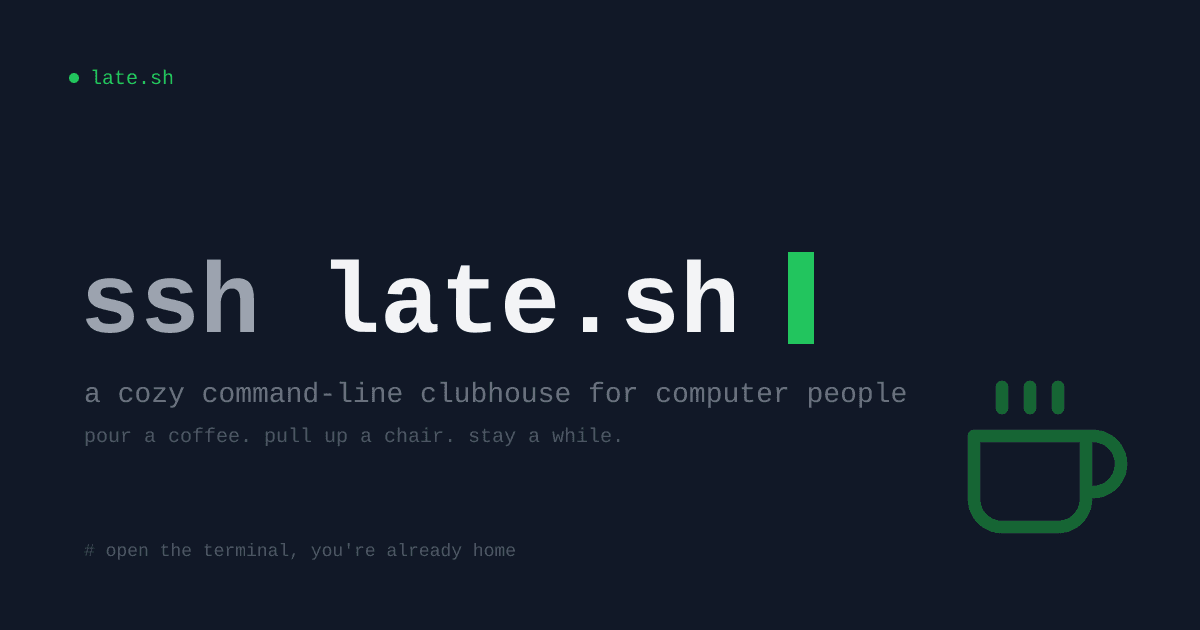
Image: Hacker News
Late.sh is pitching itself as a cozy command-line clubhouse for people who live in terminals. Connect over SSH, and you get a shared text UI with live chat, news discussion, daily challenges and streaks, a collaborative ASCII artboard, and a small arcade that currently includes 2048, sudoku, nonograms, and solitaire. Multiplayer games are listed as coming soon.
One of the more distinctive features is the shared ASCII canvas. Users can paint, erase, and sign their work, and each cell records who placed it. Daily and monthly snapshots are saved so the board’s history remains visible as the canvas changes over time.
Late.sh also includes a Work room that functions like a lightweight community directory. Users can post a single profile from the terminal UI with a headline, status, skills, and links, plus an optional bio, late.fetch readout, and showcase. To create one, the site says to SSH into late.sh, open the Work room, and press i.
There’s also a browser-based read-only demo of the interface. It lets visitors tab around and see the TUI, but not type, chat, or play games. For full access, you still need to connect over SSH.

Recommended reading
NWSL’s YouTube surge shows how new fans are finding the league
Identity and privacy are central to how the service works. According to the site, there are no passwords, no OAuth, and no accounts. Instead, your SSH key is your identity. Chats, scores, and streaks are tied to your public key fingerprint, and the service says it stores the fingerprint rather than the full public key. It also says there is no IP logging, no tracking, and no analytics, while chat messages and game scores are stored in Postgres and linked only to that fingerprint. Users who want more separation can connect with a throwaway key.

Culture Editor
Maya explores gaming, streaming, and the internet as a place where people actually live. From deep-dives into creator economies to the anthropology of digital communities, she tracks platform drama and cultural shifts so you don't have to. She believes the best tech stories are fundamentally about human behavior.
via Hacker News