• 2 min read
LONGi claims 35.5% solar cell efficiency record
Chinese solar company LONGi says its new tandem cell reached 35.5% efficiency, well above the roughly 25% seen in commercial panels.
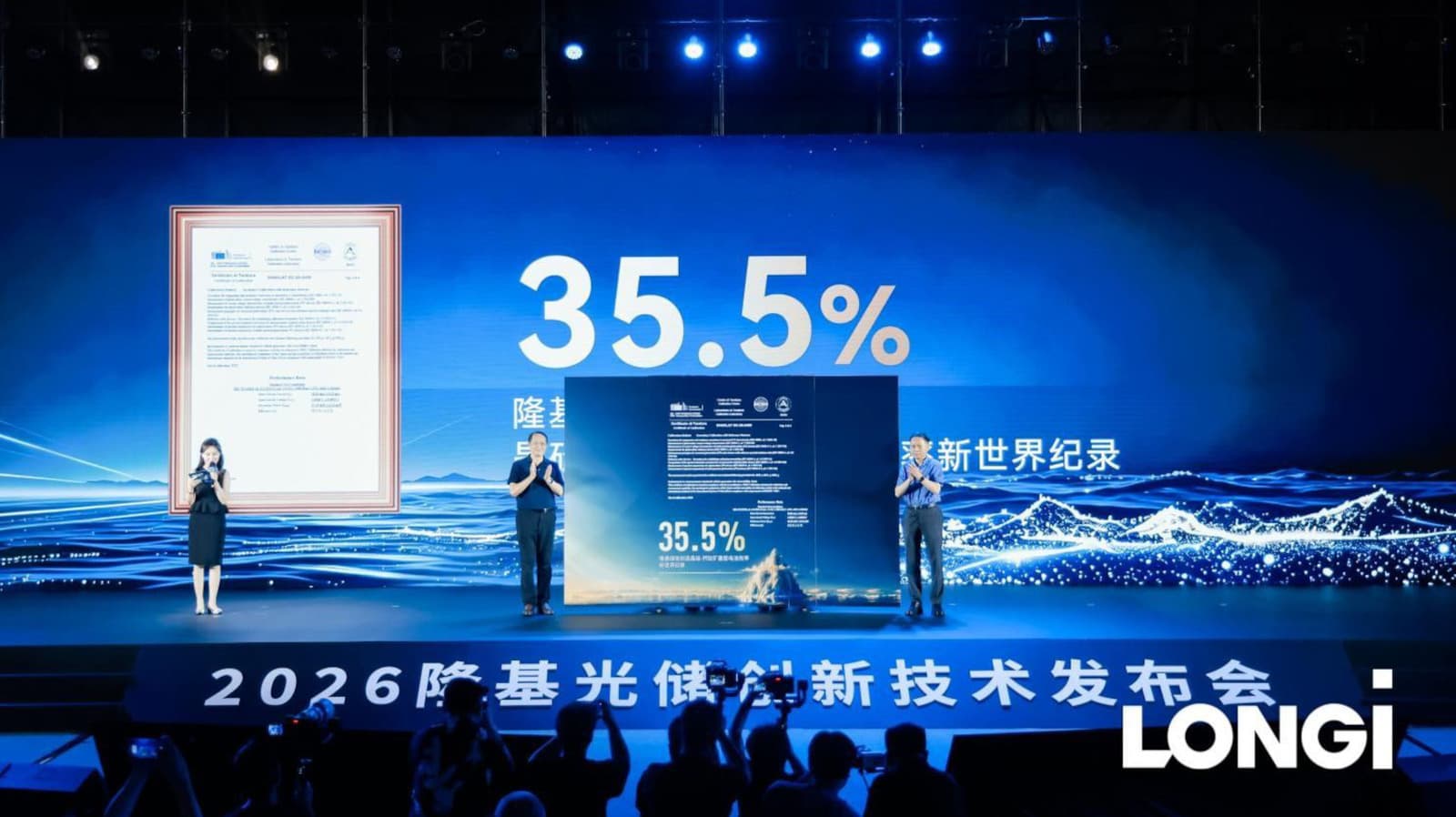
Image: Engadget
LONGi says it has built a solar cell with 35.5 percent conversion efficiency, a notable jump from the roughly 25 percent efficiency now seen in commercially available panels, according to the US Energy Information Administration.
The Chinese company said the result was verified by the European Solar Test Installation, a reference laboratory for calibrating photovoltaic devices. The cell uses crystalline silicon-perovskite tandem technology, an emerging approach that LONGi argues represents the future of solar power.
The company says this type of cell has a theoretical efficiency ceiling of 43 percent. LONGi previously reported 33.9 percent efficiency in November 2023 and 34.6 percent in June 2024, before a series of smaller gains led to the new 35.5 percent claim.
Recommended reading
MIT’s 3D-printed bridge exposes concrete’s real bottleneck
LONGi says that gives it the world record for this specific photovoltaic technology. Still, record claims depend on the category. The US Department of Energy’s National Renewable Energy Laboratory built a solar cell with 39.5 percent efficiency in 2022, though the source notes that very high-efficiency cells can be limited to niche applications such as satellites.
The bigger challenge is not just setting laboratory marks, but turning them into products at scale. For the solar industry, the real milestone will be mass-producing and commercializing cells with efficiencies this high.

Frontier Editor
Dan is our resident futurist, covering electric mobility, space exploration, and the smart home. He's interested in atoms just as much as bits. Whether it's a new battery chemistry, a reusable rocket, or a protocol that finally makes IoT devices talk to each other, Dan breaks down the engineering that pushes humanity forward.
via Engadget