• 3 min read
MIT’s 3D-printed bridge exposes concrete’s real bottleneck
MIT researchers designed and printed a 2.3-meter concrete bridge in 30 minutes, showing printer limits—not concrete strength—drive material use.
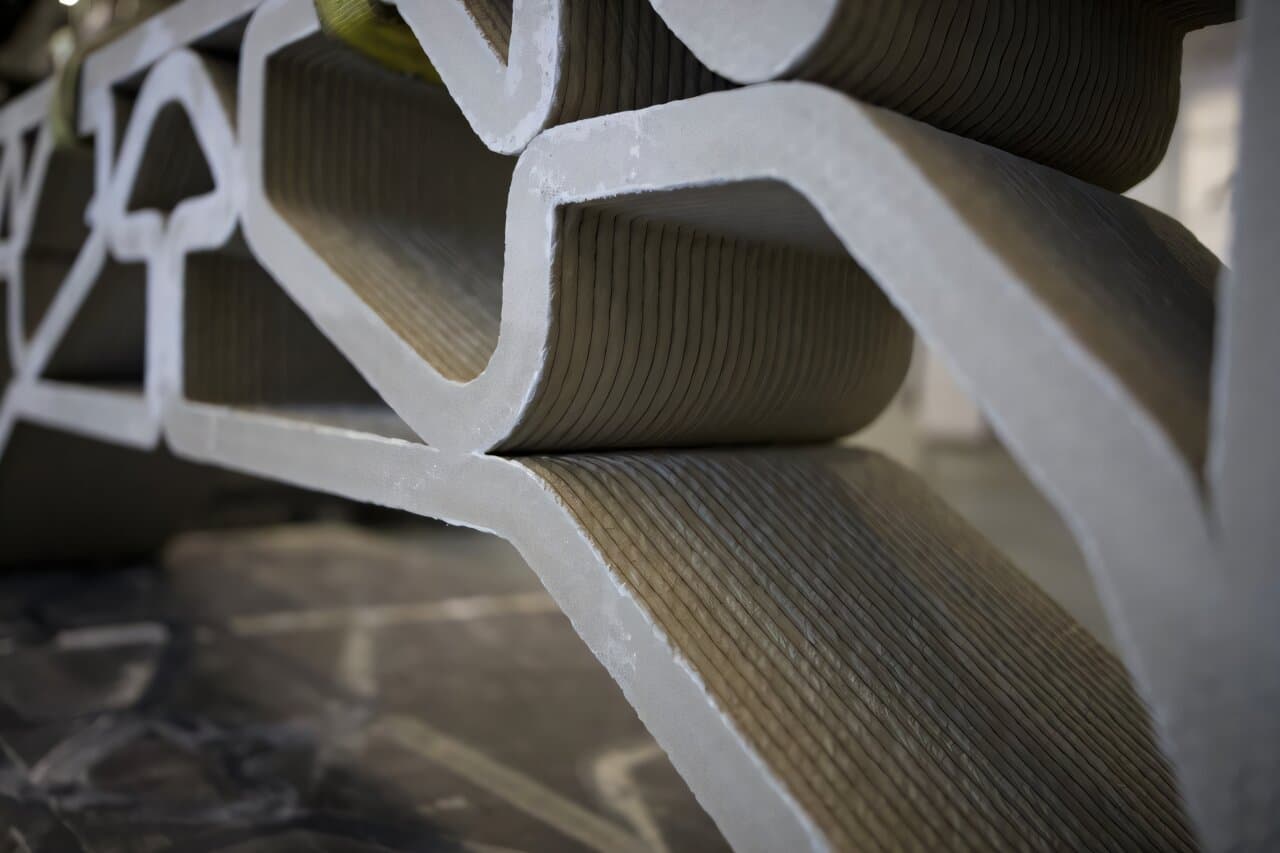
Image: TechXplore
Concrete is the most widely used building material on Earth, and one of the biggest single sources of carbon emissions. A team at MIT says 3D printing could help cut that footprint, but only if engineers stop designing shapes that today’s printers cannot actually build.
In a paper published in Additive Manufacturing, the researchers describe a framework that folds real-world printer limits directly into topology optimization—the process engineers use to find the strongest structure with the least material. Instead of producing mathematically elegant but unprintable shapes, the system generates designs that can be fabricated with little or no manual redesign.
The team demonstrated the approach with a 2.3-meter-long (7.5-foot-long) concrete bridge. According to Hajin Kim-Tackowiak, co-first author and a postdoctoral researcher in MIT’s Department of Civil and Environmental Engineering, the gap between ideal designs and printable ones has been severe.

Recommended reading
LONGi claims 35.5% solar cell efficiency record
“We were finding a lot of cracks you can fall through when it comes to translating these super-optimal designs into manufacturable designs. Those cracks were like chasms.”
Working with operators at Autodesk’s large-scale printing facility in Boston, the researchers identified three key constraints:
- Bead thickness
- How sharply the nozzle can turn
- The need to print in one continuous line
They encoded those limits into the optimization itself. Kim-Tackowiak said conventional methods often require “a massive amount of post-processing” and can take days, while the new framework produced printable designs in about two minutes on a laptop. When the bridge had to be slightly resized on the day of printing, the team reran the optimization and got an updated design in 5–10 minutes.
What the bridge test showed
The bridge was printed in about 30 minutes using off-the-shelf mortar, said senior author Josephine Carstensen, the Gilbert W. Winslow (1937) Career Development Professor in Civil Engineering. The roughly 900-pound (410-kilogram) structure held more than 2,000 pounds (910 kilograms) spread across it with virtually no measurable bending, closely matching simulations.
But the bigger finding was that the design was heavily shaped by printer constraints rather than concrete strength.
“What we found was our result was super over-engineered. From zero to 200,000 pounds (91,000 kilograms), your design is entirely driven by these 'can I build it or not' constraints. And then, after 200,000 pounds, you can start to think about the physics.”
Because the framework seeks a global optimum using mixed-integer optimization, the team could also estimate how much each hardware limit affects material use. The biggest factor was bead width. The bridge used a 4-centimeter bead, and the researchers found that a printer capable of laying a 1 cm bead could reduce material use by as much as 76 percent while staying “well within safety margins,” Carstensen said.
The bridge was designed so every part stayed in compression, where concrete performs well. That became obvious after testing: it supported more than 2,000 pounds (910 kilograms) without moving, but broke when a worker lifted one corner a few inches to sweep under it, putting parts of the structure into tension.
The next step is reinforced concrete, though Kim-Tackowiak said figuring out how to feed rebar into a printed concrete structure remains a challenge.
The study is: Hajin Kim-Tackowiak et al, Effect of fabrication restrictions on topology optimized 3D printed concrete structures, Additive Manufacturing (2026). DOI: 10.1016/j.addma.2026.105283

Frontier Editor
Dan is our resident futurist, covering electric mobility, space exploration, and the smart home. He's interested in atoms just as much as bits. Whether it's a new battery chemistry, a reusable rocket, or a protocol that finally makes IoT devices talk to each other, Dan breaks down the engineering that pushes humanity forward.
via TechXplore