• 2 min read
Memristor chip brings brain modeling under 10ms
A Peking University-led team says its memristor chip can match brain-speed processing, with up to 478.18× faster cortical reconstruction than an NVIDIA A100.
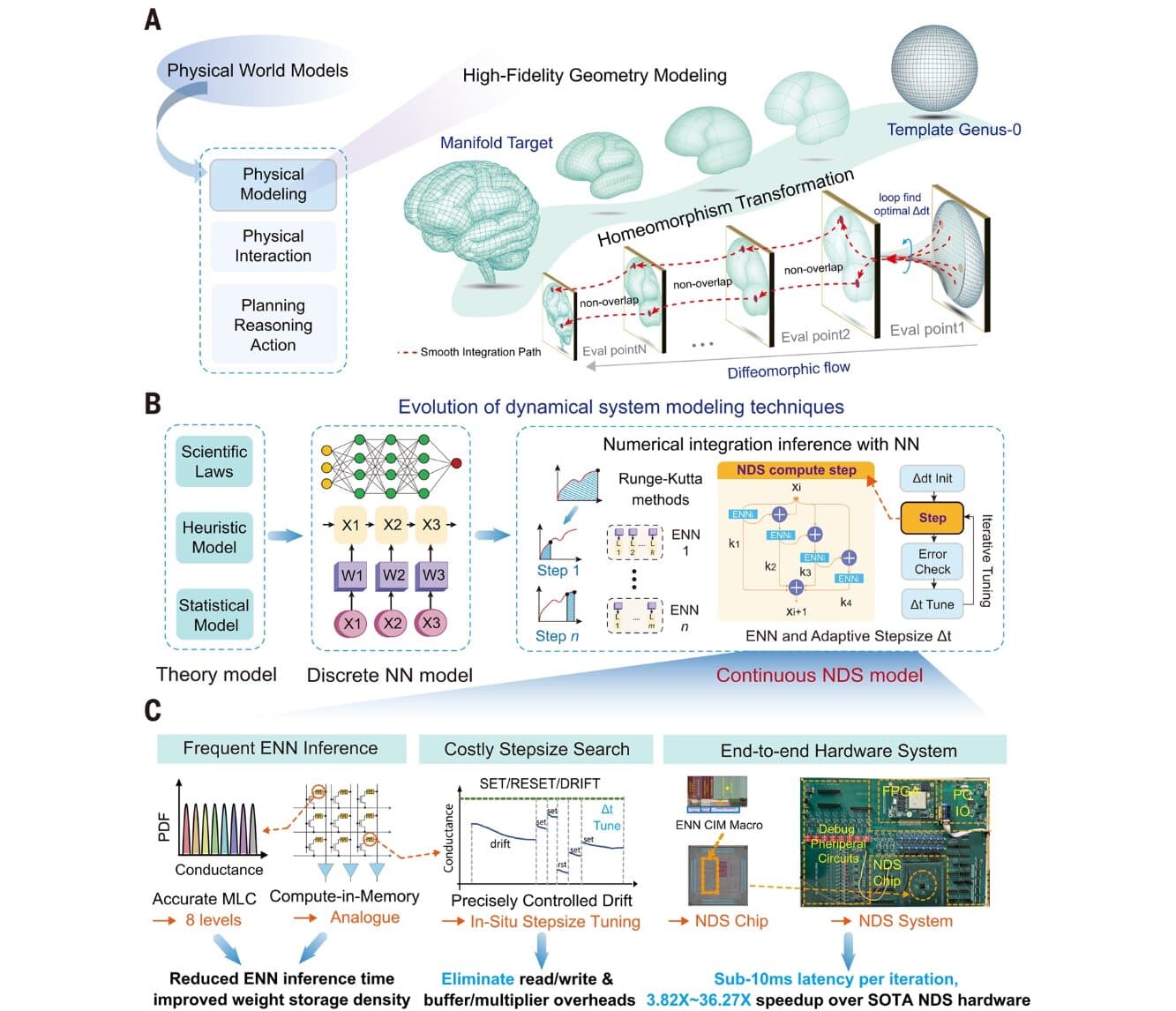
Image: TechXplore
A Peking University-led team says it has built the world’s first chip that matches the operating speed of the human brain, cutting neural dynamical system processing to under 10 milliseconds. The work, published in Science as “A sub–10-millisecond neural dynamical system based on phase-change memristors,” was led by Professor Yang Yuchao with researchers from the Shanghai Institute of Microsystem and Information Technology, Chinese Academy of Sciences.
Neural dynamical systems combine neural networks with mathematical equations that describe how complex systems evolve over time. They are used in physical modeling, medical imaging, and 3D brain reconstruction, but they are computationally expensive because they require repeated calculations, error checks, and adjustments to each calculation step. On conventional hardware, constant data transfers between memory and processors add further delays and energy costs.
The new chip tackles that bottleneck by performing key operations directly in memory. Built on a 40-nm process, its in-memory computing and conductance-drift arrays occupy 0.28 square millimeters. It runs at 50 MHz and uses nine pipeline stages for each integration step.
According to the researchers, the hardware delivers:

Recommended reading
Adobe Firefly keeps prices low and editing sharp
- 3.82×–36.27× faster neural dynamics calculations than state-of-the-art ASICs
- 11.75×–24.73× lower power use than those ASICs
- Up to 478.18× faster performance in cortical surface reconstruction than an NVIDIA A100 GPU
In testing, the team used the chip to reconstruct the brain’s white and gray matter surfaces and generate 3D manifold-based surface meshes in real time. The system produced smooth, closed, and topologically consistent cortical surfaces while preserving complex brain folds, and it performed well on average symmetric surface distance and Hausdorff distance measurements.
The researchers say the chip could help shift advanced brain modeling from slow offline workflows to millisecond-scale operation, with potential uses in brain–computer interfaces, digital brain twins, real-time surgical navigation, brain-surface reconstruction, and research on Alzheimer’s and Parkinson’s.
The paper is authored by Lei Cai et al. and carries the DOI 10.1126/science.aee6277.

Computing Editor
Tomas lives in the terminal. He covers chips, laptops, and operating systems with a focus on performance and efficiency. He reads kernel changelogs the way other people read fiction, and he's always on the hunt for the perfect mechanical keyboard switch. If it processes data, Tomas has an opinion on it.
via TechXplore