• 4 min read
Moonshot’s Kimi K3 packs 2.8T parameters
Moonshot AI unveiled Kimi K3, a 2.8 trillion-parameter open model with a 1 million-token context window and API pricing starting at $3 per million input tokens.
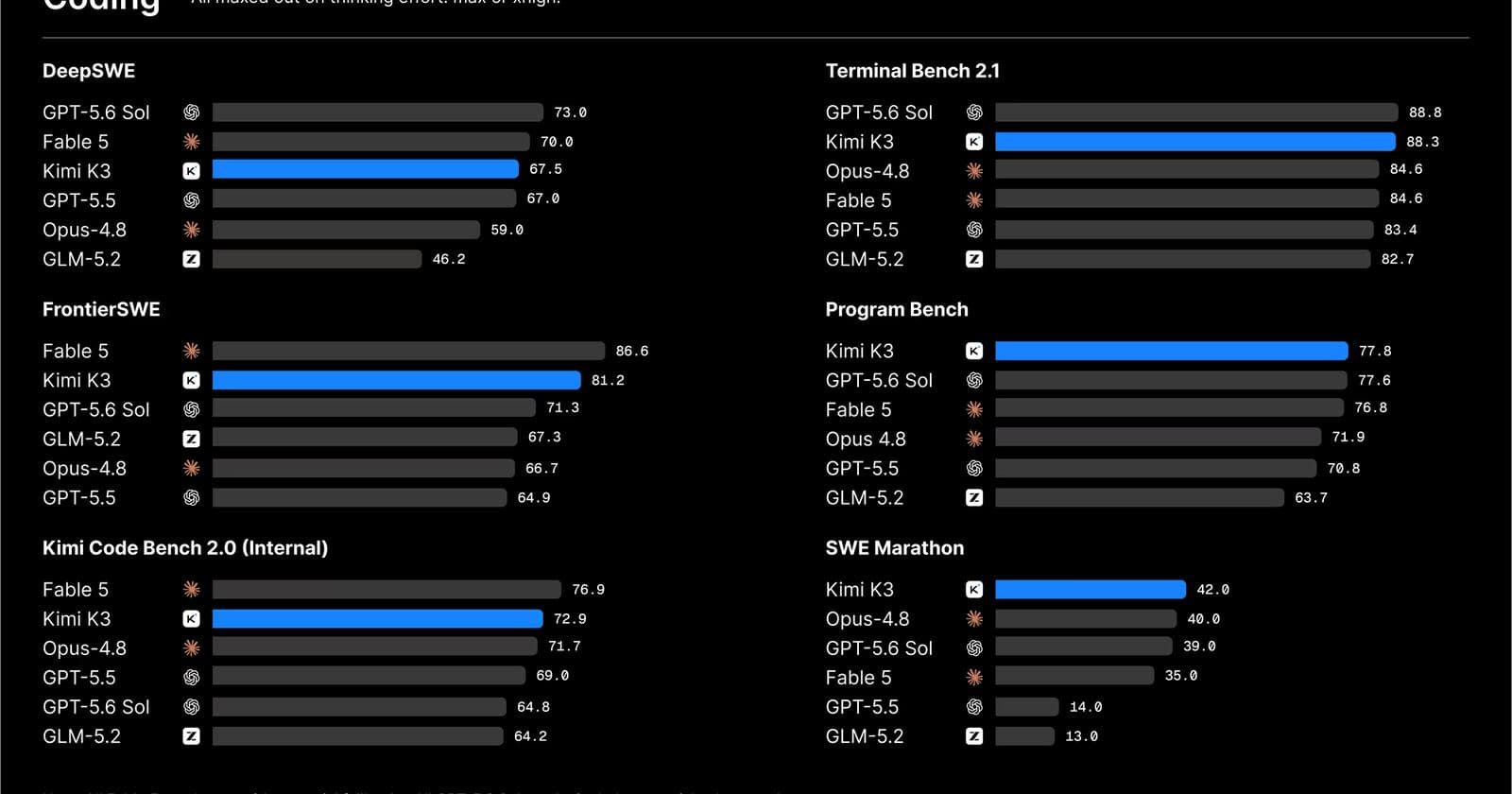
Image: kod
Moonshot AI has unveiled Kimi K3, positioning it as the world’s largest open language model with 2.8 trillion parameters. The company is pitching the release less as a headline-grabbing size milestone and more as a model built for practical heavy-duty work: coding, long-document processing, and tasks that require keeping a massive amount of context in memory.
The model is already running across Moonshot’s own services, including Kimi, Kimi Code, Kimi Work, and via API. Full weights are scheduled to be released on July 27. According to Moonshot, Kimi K3 supports a context window of up to 1 million tokens and offers native multimodality, meaning it can handle both text and images.
That makes it nearly three times larger than Kimi K2. Among open Chinese models, the gap is also notable: DeepSeek had previously announced 1.6 trillion parameters, while Xiaomi was at roughly 1.02 trillion.
Recommended reading
Hassabis says STEM makes you 10x better at AI
Moonshot describes K3 as a system for long-horizon tasks — scenarios such as digesting large batches of documents, maintaining coherent reasoning across extended exchanges, or writing code from specifications spanning dozens of pages. That is also where competition has tightened in 2026, as OpenAI and Anthropic keep pushing closed models forward while open-model developers try to catch up on capability, not just price.
By Moonshot’s own account, Kimi K3 still trails Anthropic’s Claude Fable 5 and OpenAI’s GPT-5.6 Sol in overall performance. But the company says the model shows a strong lead over many rivals in programming and reasoning benchmarks. Some of those results have also been reflected on outside platforms: in blind Arena tests, developers reportedly preferred Kimi over leading US models on frontend development tasks, and in the overall text ranking, K3 surpassed the standard version of Claude Opus 4.8 and reached the level of GPT-5.6 Sol.
Pricing and benchmark trade-offs
API pricing is set at $3 per million input tokens and $15 per million output tokens. For an open model, that is no longer the near-free pricing Chinese labs had accustomed the market to in 2024 and 2025. The pricing is also notably higher than K3's predecessor and now sits closer to midrange Western models.
That shift matters. Chinese labs spent much of the last two years arguing that open models could be both powerful and extremely cheap. As models get larger and infrastructure requirements rise, that argument is getting harder to sustain.
At the same time, scale appears to have brought a drawback. According to Artificial Analysis, K3 shows a higher tendency to hallucinate than the previous version. That trade-off is familiar: as companies push model size and reasoning behavior harder, maintaining accuracy over long answers often becomes more difficult. In enterprise use cases centered on documents and code, that can quickly translate into extra verification work.
WAIC launch and Moonshot’s funding push
The announcement was made at WAIC in Shanghai, a venue that has become a showcase for Chinese companies making global ambitions explicit rather than simply demoing lab prototypes. In that context, Kimi K3 looks less like a routine product refresh and more like Moonshot’s bid to secure a place at the core of the open-model ecosystem alongside DeepSeek and other fast-rising players.
Moonshot was founded in 2023, and Alibaba has been named among its investors and partners. In May, the company raised about $2 billion at a $20 billion valuation, and Chinese media reported a new round at a valuation above $30 billion. That level of funding is typically about more than one splashy release — it is about compute infrastructure and winning over developers deciding which open model to build on.
The next test will come quickly. Once the weights are published on July 27, developers will begin running Kimi K3 on their own clusters, comparing it with DeepSeek, and tuning it for local workloads. If independent testing backs up the current results, Moonshot may end up with more than just a size record.

AI Editor
Ava covers the rapidly evolving world of artificial intelligence, from foundational models and research labs to the real-world economics of intelligence. With a background in computational linguistics, she cuts through the hype to find out what actually works. She firmly believes that benchmarks are just marketing until reproduced in the wild.
via ITzine