• 2 min read
NASA’s 100PB climate archive moves to Swiss supercomputer
ETH Zurich copied roughly 100 petabytes of open NASA climate data to the Alps supercomputer to preserve it and train faster weather models.
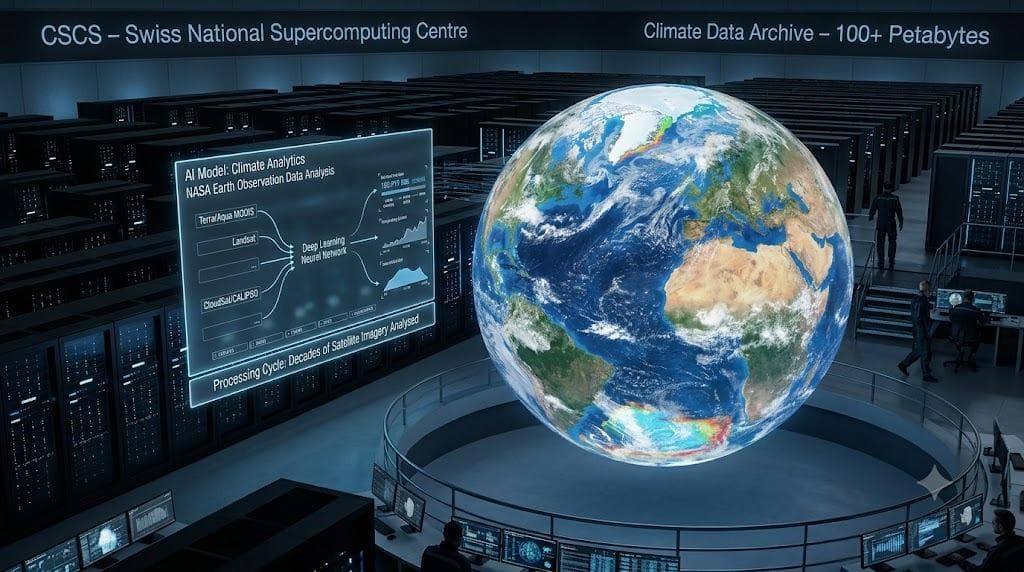
Image: iXBT
ETH Zurich has copied roughly 100 petabytes of open NASA data — about 6 billion files — to the Swiss National Supercomputing Centre (CSCS) in Lugano, placing a vast Earth climate archive next to one of the world’s most powerful supercomputers, Alps.
The transfer took about a year. The archive includes long-running observations of Earth’s climate system, including data on greenhouse gas concentrations, cloud cover, precipitation, ice sheets, and other atmospheric and ocean processes. Researchers also plan to copy large datasets from the US National Oceanic and Atmospheric Administration (NOAA).
The project’s main goal is to use the data to train AI models that can forecast weather, climate change, and natural disasters. According to the researchers, newer machine learning models can already produce some forecasts much faster than traditional systems based on physical equations.
For example, instead of taking hours to compute a global weather forecast several days ahead, AI models can handle a similar task in about a minute. That could speed up warnings for dangerous events including floods, storms, and droughts that affect agriculture and energy systems.

Recommended reading
China Launches AI-Equipped Hyperspectral Satellite
The data move is also tied to concern over shrinking US climate research funding. ETH Zurich researchers said all of the copied material was publicly available and not secret, but they still wanted an additional copy because scientific infrastructure depends on long-term political decisions.
The NASA archive now sits alongside Alps, where researchers hope to combine the observational record with large-scale compute to uncover climate patterns that were previously hard to detect.

Frontier Editor
Dan is our resident futurist, covering electric mobility, space exploration, and the smart home. He's interested in atoms just as much as bits. Whether it's a new battery chemistry, a reusable rocket, or a protocol that finally makes IoT devices talk to each other, Dan breaks down the engineering that pushes humanity forward.
via iXBT