• 2 min read
NVIDIA DLSS 5 brings photorealistic AI-driven visuals this fall
NVIDIA is pushing the envelope of gaming visuals again with DLSS 5, its latest AI-powered upscaling technology set to launch this fall. Following closely on DLSS 4.5's heels, this new version promises to enhance image qu
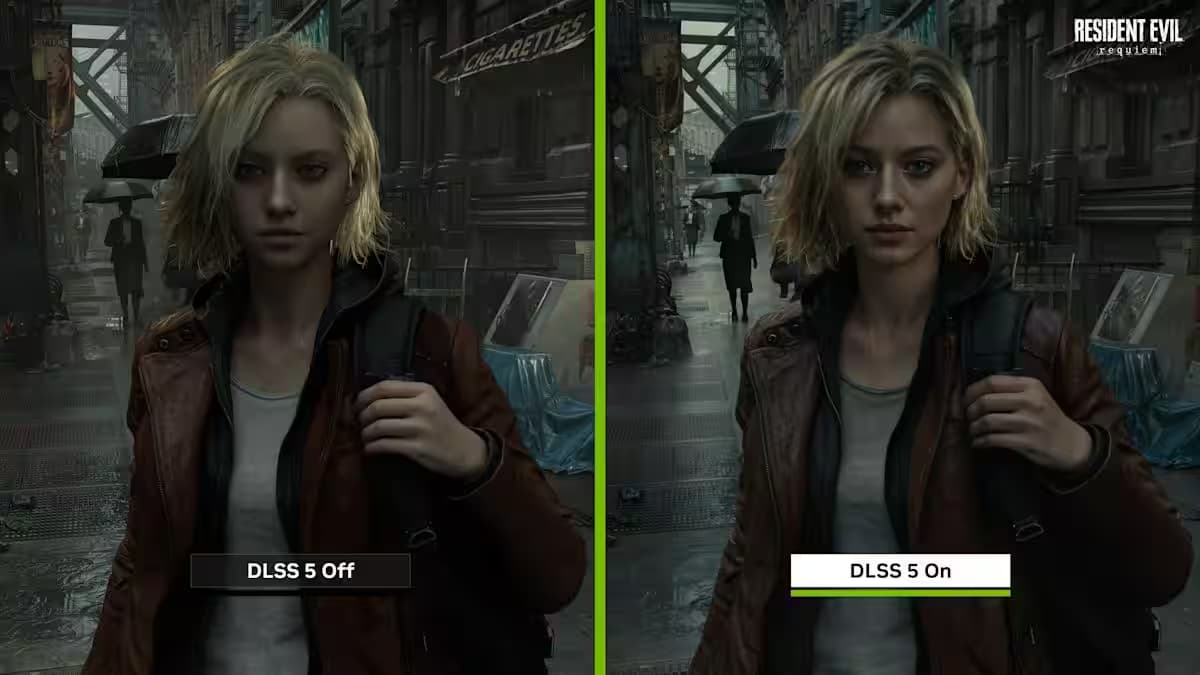
Image: Engadget
NVIDIA is pushing the envelope of gaming visuals again with DLSS 5, its latest AI-powered upscaling technology set to launch this fall. Following closely on DLSS 4.5's heels, this new version promises to enhance image quality to a photorealistic level by applying real-time neural rendering that adds lifelike lighting and material details directly tied to the game’s 3D models. Presented at NVIDIA’s GTC 2026 keynote, CEO Jensen Huang highlighted how DLSS 5 brings out finer nuances in characters' hair and skin tones in games like Resident Evil: Requiem, Hogwarts Legacy, and Starfield, dramatically improving fidelity without compromising performance.
How DLSS 5 delivers photorealistic image quality
Unlike previous iterations that focused mainly on resolution scaling and temporal reconstruction, DLSS 5 taps into game color data and motion vectors on a per-frame basis. This approach enables the AI model to generate consistent, frame-to-frame photorealistic lighting effects, elevating in-game scenes to near-cinematic quality in real time. NVIDIA demonstrated the technology running on a twin RTX 5090 GPU setup, but the company expects it to eventually run on a single high-end GPU capable of handling the significant computational load.

Recommended reading
xAI Sues Grok User Over Child Abuse Images
The evolution from ray tracing to AI-driven rendering
This iteration feels like a natural evolution from real-time ray tracing, which NVIDIA considers the biggest graphics breakthrough in recent years. DLSS 5 aims to reduce the massive GPU horsepower studios usually require for Hollywood-style rendering without sacrificing image quality. However, the practical benefits for gamers still need to be demonstrated. Ray tracing itself has seen slow adoption due to performance costs and inconsistent implementation across titles.
Potential impact of AI-generated photorealistic graphics
NVIDIA’s ambition to infuse AI-generated pixels with physically accurate lighting and materials suggests a shift toward more intelligent, AI-driven graphics pipelines. This technology could offer developers new levels of control over visual quality, approaching real-time generative visual effects crafted on demand rather than relying solely on static rendering or pre-baked assets. Whether DLSS 5 becomes a standard feature or remains a niche technology for high-end rigs will be clearer once it launches later this year.

AI Editor
Ava covers the rapidly evolving world of artificial intelligence, from foundational models and research labs to the real-world economics of intelligence. With a background in computational linguistics, she cuts through the hype to find out what actually works. She firmly believes that benchmarks are just marketing until reproduced in the wild.
via Engadget