• 3 min read
Magnesium oxide could shield fragile solid-state batteries
Argonne researchers say a 1-nanometer magnesium oxide coating improved stability in sulfide solid electrolytes and outperformed some more stable materials.
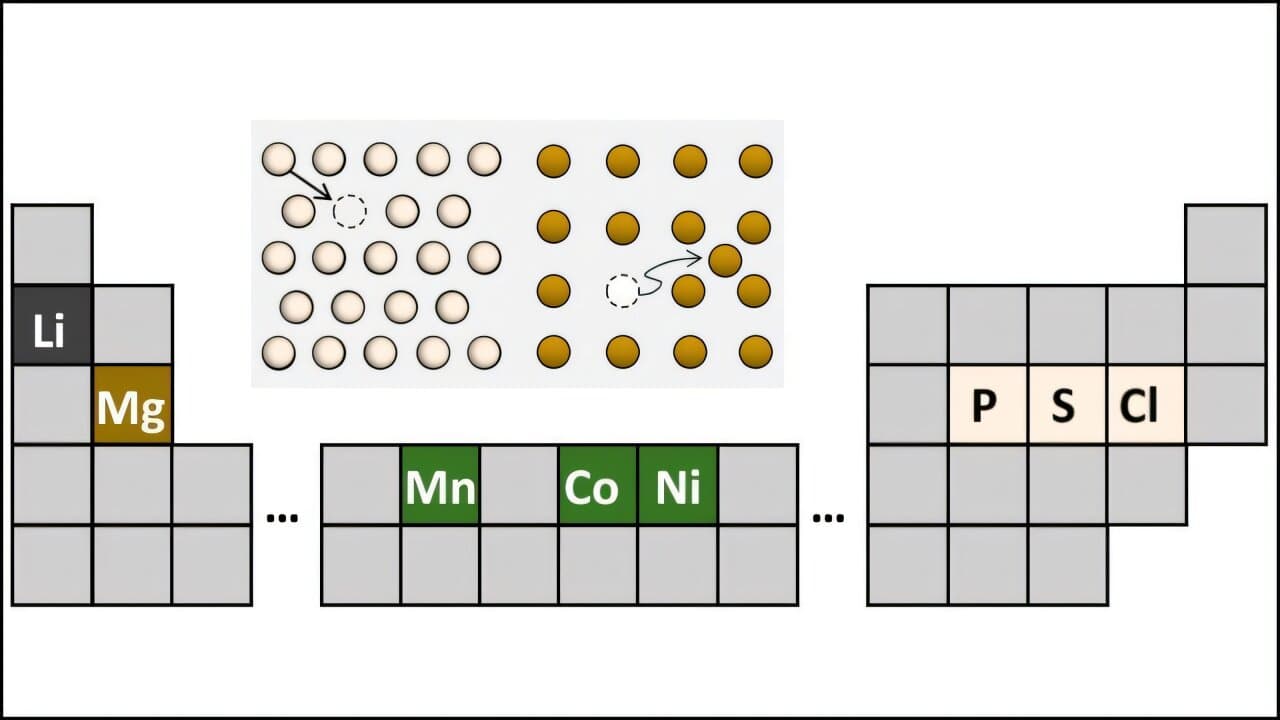
Image: TechXplore
A 1-nanometer coating may help solve one of the biggest problems in solid-state batteries. Researchers at the U.S. Department of Energy’s Argonne National Laboratory say magnesium oxide is a promising protective layer for sulfide-based solid electrolytes, a class of materials that could boost energy storage and safety compared with today’s lithium-ion batteries.
The work, published in Advanced Science, focused on lithium phosphorus sulfur chloride (LPSCl), a sulfide solid electrolyte that can react at critical battery interfaces, especially where it touches lithium metal. Those reactions can reduce performance and shorten battery life.
To find better coatings, the team combined computation and lab testing. Using density functional theory, the researchers screened a wide range of oxide coatings that can be applied with atomic layer deposition (ALD), which creates ultrathin, uniform films with near-atomic precision. They modeled how coatings would behave where they contact the electrolyte, lithium metal, and cathode materials.
What mattered most was not simply whether a coating was reactive, but which reaction products formed. The best coatings produced compounds that still allowed lithium ions to move while limiting electron flow.
“This work focused on using computation to guide that search,” said Justin Connell, an Argonne materials scientist and University of Chicago Consortium for Advanced Science and Engineering (CASE) scientist. “We can’t experimentally explore the full range of possible materials in any reasonable way. That would take forever, and it’s just not possible.”
What magnesium oxide did better
Argonne then tested several candidates by coating LPSCl powder with ALD. Magnesium oxide stood out: it improved stability in contact with lithium metal, reduced interface resistance, and improved performance. The researchers also found it blocked electron flow while still allowing lithium ions to move efficiently.

Recommended reading
MS-21 plant removes a key production bottleneck
By comparison, zirconium oxide was highly stable on its own but performed poorly because it formed unfavorable reaction products. Zinc oxide, despite being predicted to be more reactive overall, still showed useful transport behavior because of the compounds it created at the interface.
“Atomic layer deposition gives us a unique way to apply uniform coatings that are only about a nanometer thick, even on complex powder surfaces,” said Jeffrey Elam, senior chemist and Argonne Distinguished Fellow. “That level of control lets us test new coating chemistries efficiently and connect computational predictions to real materials.”
The team used scanning transmission electron microscopy and energy dispersive X-ray spectroscopy at Argonne’s Center for Nanoscale Materials to confirm the coatings were uniformly distributed on powder surfaces.
The broader value of the study may be the search method itself. Peter Zapol, the Argonne physicist who led the calculations and computational screening, said the approach offers a more predictive way to evaluate coatings instead of relying on trial and error. Connell said the same framework could now be used to study other systems, including sulfides, fluorides, binary chemistries, ternary coating chemistries, and combinations of materials.
The paper is “Computationally‐Guided Development of Sulfide Solid Electrolyte Powder Coatings for Enhanced Stability and Performance of Solid‐State Batteries” by Aditya Sundar et al, published in Advanced Science (2025). DOI: 10.1002/advs.202513191.

Frontier Editor
Dan is our resident futurist, covering electric mobility, space exploration, and the smart home. He's interested in atoms just as much as bits. Whether it's a new battery chemistry, a reusable rocket, or a protocol that finally makes IoT devices talk to each other, Dan breaks down the engineering that pushes humanity forward.
via TechXplore