• 2 min read
This drone spins itself nearly out of sight
Northwestern University engineers built a drone that spins at 25 times per second, making it about 10 times harder to spot than a quadcopter.
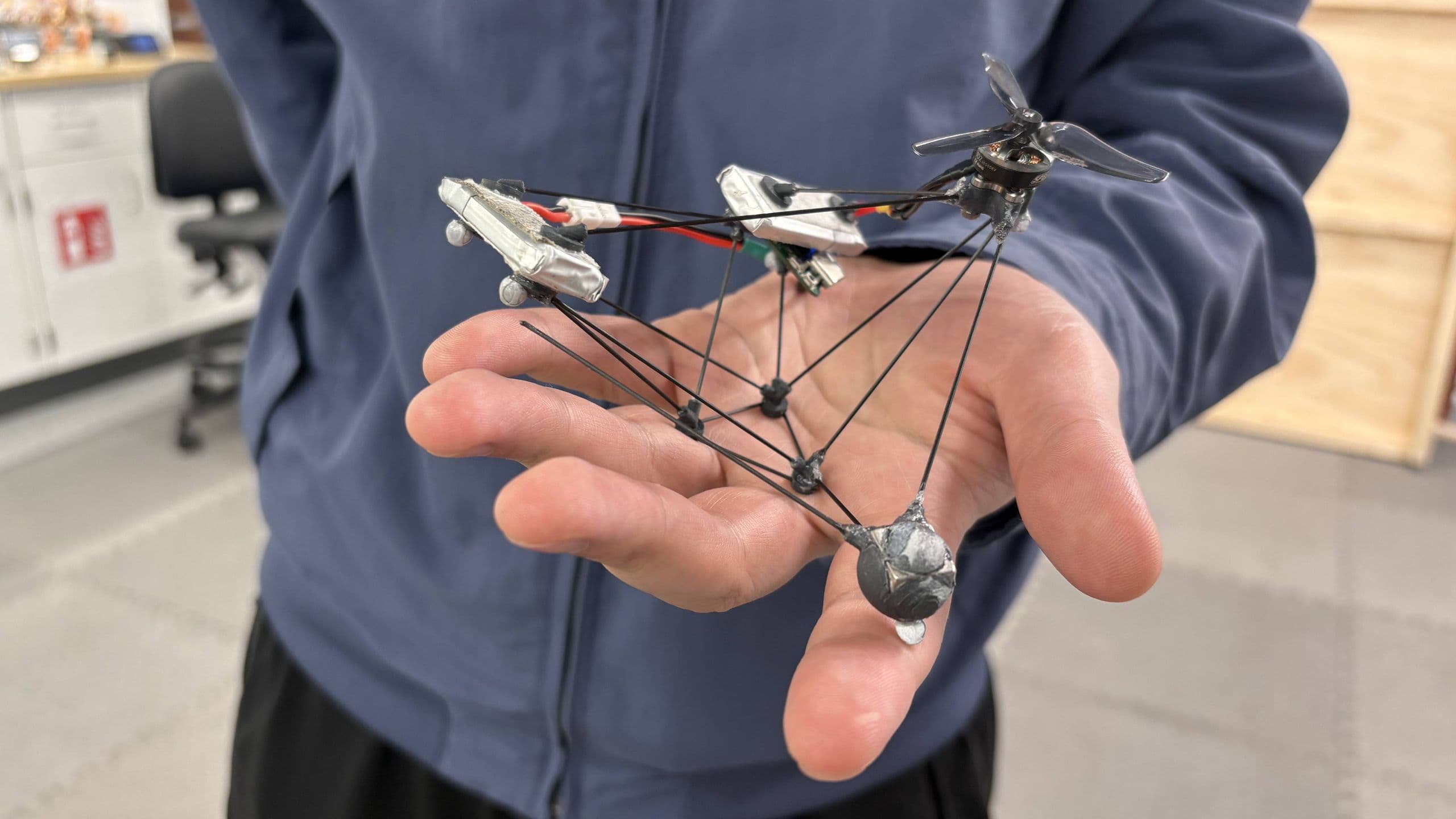
Image: TechRadar
A research drone from Northwestern University takes a very different route to near-invisibility: it doesn’t use camouflage, it spins its entire body so fast that the human eye struggles to track it.
The prototype, called Phantom Twist, rotates up to 25 times per second. According to the team, that turns the aircraft into a faint, semi-transparent blur rather than a clearly defined object, making it roughly 10 times harder to spot than a conventional quadcopter.
A standard quadcopter leaves its frame stationary while its rotors spin, which makes the body easy for the eye to lock onto. Phantom Twist removes that visual anchor. It uses one motor and one propeller, with the propeller spinning in one direction and the rest of the airframe spinning in the other.
How Phantom Twist was designed
Getting a drone to fly stably while spinning that quickly is not straightforward, so the researchers used an AI design pipeline. They generated around 20,000 possible layouts and tested each for stable flight.

Recommended reading
Robot labs are training machines on internet video
From there, optimization algorithms repeatedly adjusted the position of major components including:
- motor
- propeller
- circuit board
- battery
- counterweights
The goal was to keep those parts from visually overlapping as the drone spun. Each candidate was then simulated against 100 real-world photo backgrounds and scored using a model meant to approximate human vision. The 500 lowest-scoring designs moved on to further optimization before the final version was built.
The finished design spreads components across different heights and angles, so their motion blends into a soft haze in flight.
What the prototype can and can’t do yet
This is still a university research prototype, not a commercial product, and there is no release date or price. The current build also has obvious limitations. The propeller is still audible, and the drone carries no camera or imaging payload despite the team’s interest in wildlife monitoring and infrastructure inspection.
That leaves a major open question: how a drone spinning 25 times per second could capture usable footage without some kind of image stabilization or de-rotation system. The team has not explained how, or if, it plans to address that.
The project was funded by the National Science Foundation. For now, it remains a lab experiment focused on reducing disturbance to wildlife rather than a sign that spinning-body drones are about to reach the consumer market.

Frontier Editor
Dan is our resident futurist, covering electric mobility, space exploration, and the smart home. He's interested in atoms just as much as bits. Whether it's a new battery chemistry, a reusable rocket, or a protocol that finally makes IoT devices talk to each other, Dan breaks down the engineering that pushes humanity forward.
via TechRadar