• 2 min read
Plastic additive boosts stretchable OLEDs to near 100% efficiency
University of Chicago researchers used a common plasticizer to make stretchable OLED films brighter and far more elastic, with gains across multiple polymers.
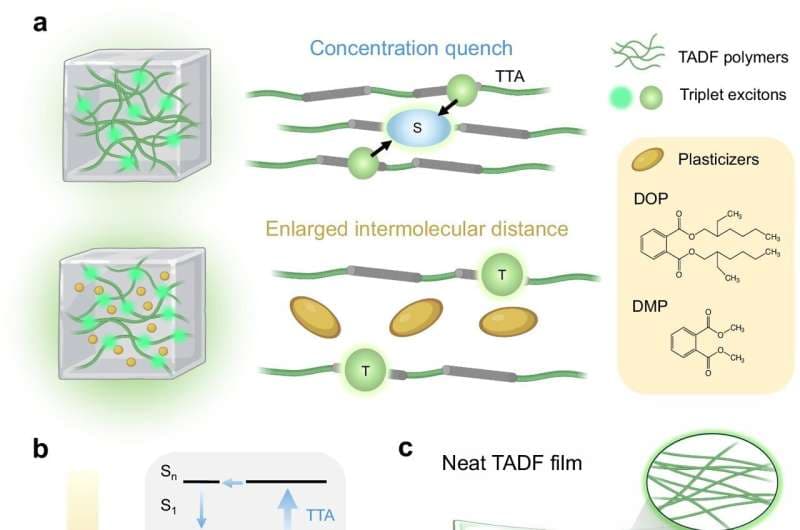
Image: TechXplore
A common plasticizer used to soften everyday plastics may offer a simple fix for one of the hardest problems in stretchable OLED design: making light-emitting films flexible without sacrificing brightness.
Researchers at the University of Chicago Pritzker School of Molecular Engineering found that mixing dioctyl phthalate (DOP) into light-emitting polymer films made them both brighter and more stretchable. The study was led by Glingna Wang, a UChicago PME undergraduate in the class of 2025, and published in Nature Communications.
As senior author Sihong Wang, associate professor of molecular engineering at UChicago PME, put it:
“In the past, we’d been trying to come up with all kinds of complicated, new chemical structures for stretchable emitters. But this method is really simple; you just mix two things together, and one of them is a commercially available additive that people have used for decades to soften everyday plastics.”
The team focused on TADF polymers—short for thermally activated delayed fluorescence—which are more efficient than conventional emitters. But when packed tightly in a film, nearby polymer units can interfere with one another, causing concentration quenching before light is emitted.
Recommended reading
Silicon photonics gets a cleaner path to mixed materials
Adding DOP created more physical space between polymer chains. According to the researchers, that reduced quenching while also letting the chains slide more easily under strain.
The results were striking:
- Fluorescence efficiency rose from 60% to nearly 100%
- Crack-onset strain improved from 5% to more than 110%
- In working OLED devices, efficiency increased by 35% compared with devices made without DOP
The effect also carried across four other TADF polymers with different chemical structures, suggesting the method could be broadly useful rather than tailored to a single material.
“Other groups had demonstrated that plasticizers can add some stretchability, but no one had tested the use of plasticizers in light-emitting polymers before.”
Glingna Wang, now starting a Ph.D. at Northwestern University, said she did not expect to become first author when she joined the lab.
“I wasn’t expecting, as an undergrad, to lead an independent project. But with the great trust and guidance of Professor Wang, and the supportive environment in the Wang group, I gradually learned to tackle problems and face actual research issues on my own.”
The Wang lab is now integrating the new emitters into display arrays and exploring optical therapies and other light-based biomedical devices.
The paper is “Approaching-unity PLQY and high stretchability in polymer emitters via molecular spacers” by Glingna Wang et al, published in Nature Communications (2026). DOI: 10.1038/s41467-026-73223-9

Computing Editor
Tomas lives in the terminal. He covers chips, laptops, and operating systems with a focus on performance and efficiency. He reads kernel changelogs the way other people read fiction, and he's always on the hunt for the perfect mechanical keyboard switch. If it processes data, Tomas has an opinion on it.
via TechXplore