• 4 min read
PsiQuantum bets on light for a 100-cabinet quantum computer
PsiQuantum says photonics and existing chip fabs can deliver a useful quantum computer, with hardware-ready systems planned in Australia by 2027.
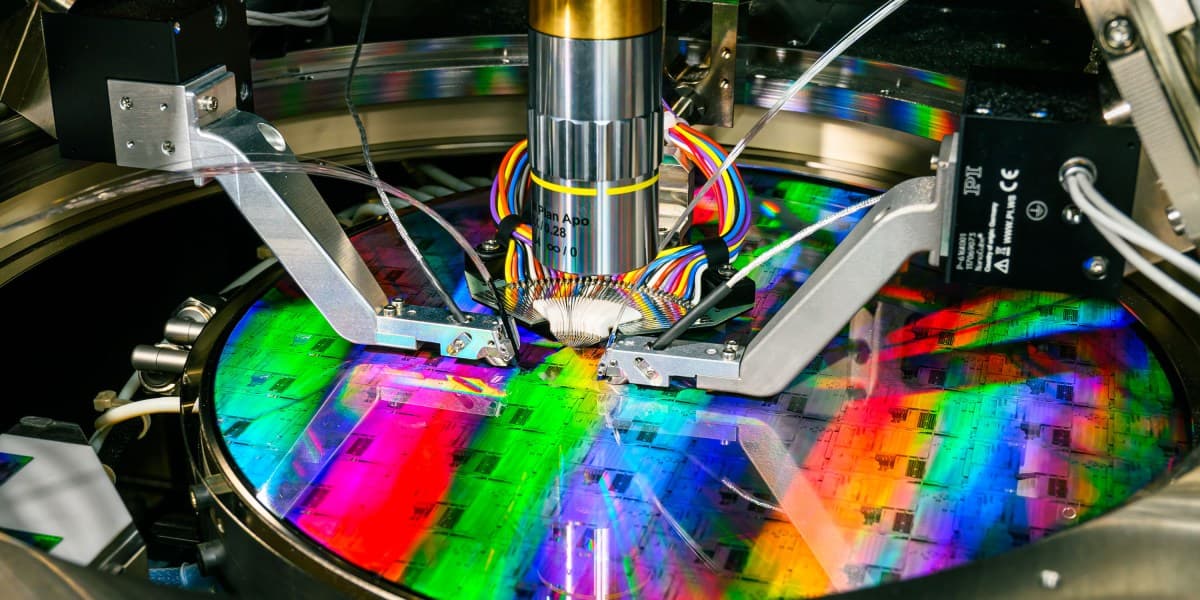
Image: MIT Technology Review
PsiQuantum is trying to build one of the most ambitious machines in tech: a quantum computer made from photons and spread across roughly 100 cryogenic cabinets. The company says that scale could finally make quantum computing commercially useful, tackling problems that conventional computers may take millions of years to solve.
Founded in 2016 by four physicists from UK universities, PsiQuantum has stood out in a crowded field for two reasons. It is aiming directly at a large, useful system rather than smaller interim machines, and it is working with GlobalFoundries to build its hardware in existing semiconductor fabs. That pitch has already drawn major backing: the company raised $1 billion last year, broke ground in Chicago with local government partners, and is building a second site in Australia that it says will be operational, meaning hardware-ready, in 2027. It is also one of just two companies, alongside Microsoft, to reach the third stage of a government evaluation program for quantum firms.
For PsiQuantum, the promise is practical. Philipp Ernst, the company’s vice president of quantum applications, says modeling the effects of cytochrome P450 enzymes on a specific drug can take over 10 years today, but “we aim to get it down to four minutes.”
The company’s chips will sit inside large cabinets, and a commercially useful quantum computer is expected to need about 100 of them linked together.

Recommended reading
Lenovo’s $680 Lecoo Pro14 packs 32GB and OCuLink
Why PsiQuantum is using photons
Quantum computers use qubits, which can exist in multiple states at once rather than just 1 or 0. In theory, that makes them well suited to simulating chemistry and physics far more directly than today’s machines can. In practice, current prototypes remain too small and too error-prone to be useful.
PsiQuantum’s approach is to use light particles as qubits. As cofounder Terry Rudolph argues, photons can preserve quantum states for a long time. The catch is that they move fast, scatter easily, and usually pass through one another instead of interacting, which makes computation difficult.
A key breakthrough came in 2001, when researchers at Los Alamos National Laboratory and the University of Queensland showed that networks of beam splitters and detectors could effectively mimic photon interactions. PsiQuantum was founded to turn that idea into hardware.
“I don’t think it’s a coincidence that the Industrial Revolution coincided with our ability to calculate and simulate the laws of Newtonian mechanics, the laws of thermodynamics,…the laws of classical electromagnetism. Whenever we have more power to calculate and simulate and understand things, we build incredible machines that come from it.”
WINNI WINTERMEYER
WINNI WINTERMEYER
PsiQuantum cofounder and chief scientific officer Pete Shadbolt at left, and machinery the company built to manufacture its own barium titanate at right.
Cooling systems, custom materials, and existing fabs
The engineering burden is immense. PsiQuantum’s cabinets currently run at 2 K, or -456 °F, with a target of -452 °F. Unlike many other quantum approaches, the whole machine does not need to be cooled that far down; only the single-photon detectors do. In May, the company said part of its planned $100 million in CHIPS Act funding will go toward those detectors.
A large share of PsiQuantum’s funding is going into custom cooling machinery that uses liquid helium. Shown here is part of the company’s cooling system in Milpitas, California.
Those helium systems are among the biggest capital costs in quantum computing, and PsiQuantum is spending heavily elsewhere too. One example is barium titanate, a crystal the company uses to route photons with very little electrical input. Because the material was not available at scale, PsiQuantum chose to manufacture it in-house. At the time MIT Technology Review visited, each wafer disc took about 12 hours to make; the company now says it produces several each day. The discs are then sent to GlobalFoundries in Malta, New York, where the chips are made.
WINNI WINTERMEYER
WINNI WINTERMEYER
PsiQuantum has spent heavily to make its own barium titanate, a material with a delicate crystal structure that is difficult to manufacture.
That is the heart of PsiQuantum’s bet: that this complicated supply chain can still scale better than rival approaches because it resembles an advanced version of the existing silicon photonics industry already used in data centers. The test of that claim may come soon. As the source notes, after years of closed-door work and hundreds of millions in investment, signs of whether PsiQuantum can deliver could start to emerge as soon as next year.

Computing Editor
Tomas lives in the terminal. He covers chips, laptops, and operating systems with a focus on performance and efficiency. He reads kernel changelogs the way other people read fiction, and he's always on the hunt for the perfect mechanical keyboard switch. If it processes data, Tomas has an opinion on it.