• 2 min read
AMD Zen 6 laptop chip tops Geekbench single-core
An AMD Zen 6 Medusa Point engineering sample posted 3,329 single-core points in Geekbench, beating current mobile x86 chips by a wide margin.
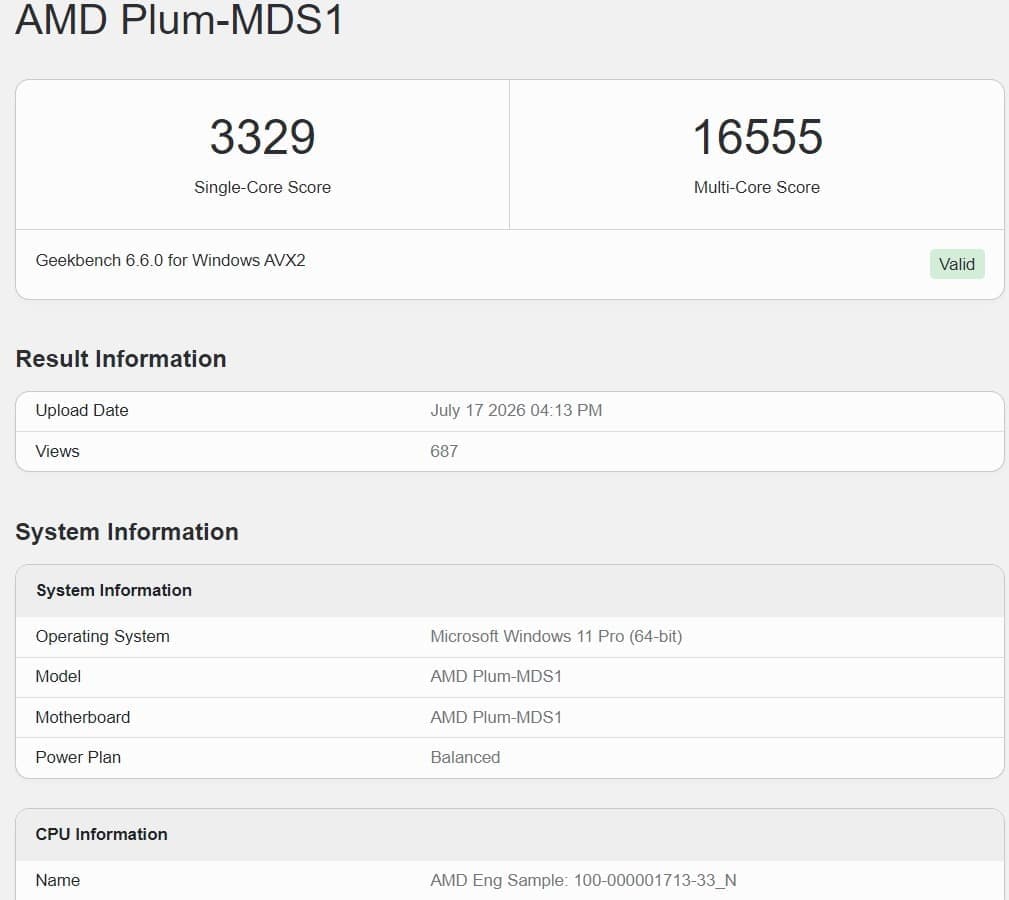
Image: iXBT
An AMD Zen 6 mobile engineering sample has posted the highest Geekbench single-core result yet seen from an x86 laptop chip. The processor, believed to be the upcoming Ryzen AI 9 565 from the Medusa Point family, scored 3,329 in single-core and 16,555 in multi-core.
The chip, listed as 100-000001713-33_N, was tested on AMD’s Plum-MDS1 reference platform. This is not Medusa Point’s first appearance in leaks, and compared with an earlier result, this engineering sample appears to be roughly 5% faster in single-core and nearly 10% faster in multi-core. That could reflect further firmware and platform tuning.
According to Geekbench, the 10-core chip runs at a 2 GHz base clock and boosts up to 5.37 GHz. Its cache configuration includes 10 MB of L2 and 32 MB of L3.
In single-core, the processor trails only the Qualcomm Snapdragon X2 Elite, while outperforming every currently available mobile x86 processor. iXBT says the result even approaches some desktop AMD parts, including the Ryzen 9 9900X and Ryzen 7 9800X3D.
Recommended reading
XElectron’s $70 projector packs Netflix and Wi-Fi 6
Multi-core performance also looks strong. The Medusa Point sample comes close to the higher-end mobile Ryzen AI Max+ 390, despite targeting the mainstream laptop segment rather than larger performance-focused systems. Compared with the current Ryzen AI 9 365, the new chip delivers about 33% higher Geekbench performance.
Medusa Point is expected to form the basis of the Ryzen AI 500 family, replacing the current Ryzen AI 400 lineup. AMD’s new chips are expected to compete with Intel Panther Lake, while more powerful Zen 6 laptops should arrive under a separate Gator Range family. As always with pre-release silicon, final specifications may change before launch as AMD adjusts clocks, power, and memory behavior.

Computing Editor
Tomas lives in the terminal. He covers chips, laptops, and operating systems with a focus on performance and efficiency. He reads kernel changelogs the way other people read fiction, and he's always on the hunt for the perfect mechanical keyboard switch. If it processes data, Tomas has an opinion on it.
via iXBT