• 4 min read
Vertu’s $6,880 AI phone feels premium, but Hermes falls short
Vertu’s Alphafold wraps luxury materials around a ZTE/Nubia-based foldable, but its Hermes AI agent was inconsistent in real executive-style tests.
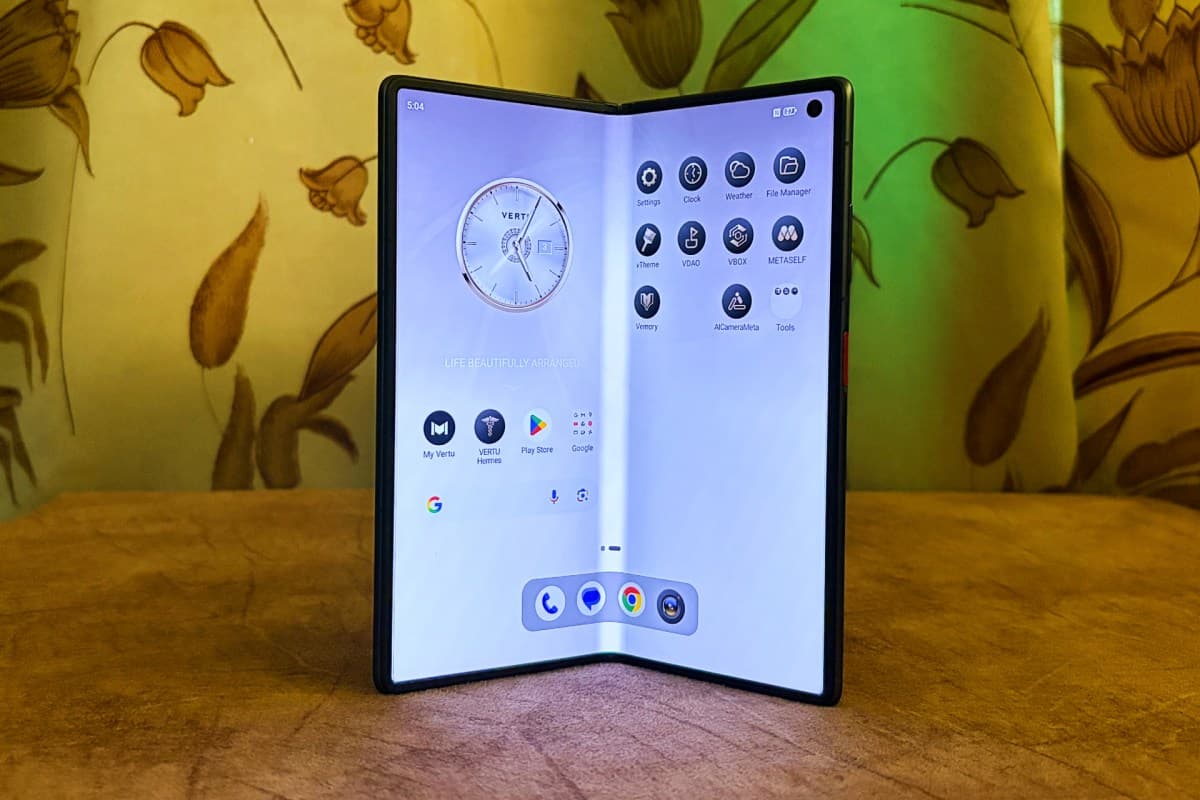
Image: TechCrunch
Vertu is trying to sell executives something very different from a typical foldable: not just a premium phone, but a $6,880 AI-equipped status symbol built around an assistant called Hermes Agent. After several days of testing, that pitch looks intriguing but unfinished.
Rather than chasing mainstream smartphone buyers, the UK-founded luxury phone maker is aiming at affluent customers — especially chief executives — with the Alphafold. The device combines calfskin leather, titanium accents, and bundled extras with an AI agent Vertu says can analyze files, automate tasks across apps, remember conversations, and escalate requests to a human concierge.
Physically, the phone looks the part. The 264-gram Alphafold feels heavier than the 215-gram Samsung Galaxy Z Fold 7, though its curved frame makes it easier to unfold. Samsung’s foldable still feels sleeker and easier to use one-handed when closed.
The packaging leans hard into luxury, more jewelry case than smartphone box, with drawers for accessories including a leather sleeve and charging cables.
Recommended reading
Infinix Note 60 Pro adds two metallic finishes
Underneath, though, the hardware appears far less exclusive. TechCrunch found strong similarities between the Alphafold and the $1,100 ZTE Nubia Fold, including the hinge, dimensions, and hardware layout. System information also showed ZTE identifiers in parts of the software. Vertu confirmed the phone was developed through a supply-chain partnership involving ZTE/Nubia’s hardware platform, component integration, and production engineering, while saying it handled the luxury materials, software experience, quality control, and after-sales service. ZTE did not respond to a request for comment.
How Hermes Agent performed
The real question is whether Hermes justifies the price. TechCrunch tested it against Google Gemini on the Galaxy Z Fold 7 using executive-style tasks: trip planning, contract and spreadsheet analysis, scheduling, and cross-app automation.
Hermes often acted more like a true agent than Gemini, taking more initiative and trying to complete multi-step tasks on its own. But that autonomy also led to mistakes.
In one test, TechCrunch asked Hermes to message a contact that the user was running 20 minutes late, navigate to the airport, switch on Do Not Disturb, and set a reminder to call the hotel in 15 minutes. Hermes sent the message, enabled Do Not Disturb, and opened Google Maps, but did not start navigation automatically. It also created the reminder for 9:08 p.m. instead of 15 minutes after the 2:32 a.m. request.
Gemini took a slower but more accurate route, asking follow-up questions about which airport to use and where to create the reminder before completing the task correctly.
Trip planning showed a similar pattern. Asked to organize a business trip from Mumbai to Pune with a morning flight, hotel recommendation, and calendar entry, Hermes said no direct morning flights were available and offered to escalate the request to Vertu’s concierge. It also created a calendar entry for 7 July instead of 18–19 July.
Gemini, by contrast, kept going and suggested alternative travel options instead of handing the task off.
Document analysis was mixed as well. Hermes initially handled an uploaded sales spreadsheet and correctly summarized Q2 figures. But days later, it no longer recognized the same file in the conversation history and asked for it to be uploaded again.
Gemini also needed the file uploaded at first, but retained the conversation context and later answered follow-up questions correctly, including identifying the North region as producing the highest sales.
TechCrunch notes that early software builds had problems with file uploads, image analysis, and concierge connectivity. After those issues were reported, Vertu pushed server-side fixes during the review period.
Security claims and the bottom line
Vertu says Hermes conversations are encrypted and not used to train public AI models. The company also says customers can choose where data is processed, including private infrastructure for enterprise deployments, and points to a dedicated “A5” security chip for hardware-level protection. TechCrunch says those claims could not be independently verified.
Away from AI, battery life lasted more than a day in testing. One notable omission at this price: no wireless charging, even as Samsung’s Galaxy Z Fold 7 supports Qi.
The broader verdict is straightforward. The Alphafold is a polished luxury product with an ambitious AI layer, but the hardware is hard to distinguish from much cheaper foldables, and Hermes Agent still behaves like an evolving platform rather than a reason on its own to spend thousands more.

Gadgets Editor
Eli is obsessed with the tangible future. He reviews phones, wearables, and everything with a battery. Known for his rigorous testing protocols and unabashed teardowns, Eli has broken more review units than he cares to admit, all in the name of discovering the truth about durability and repairability.
via TechCrunch