• 2 min read
16,000 satellites already crowd orbit—and 100,000 may follow
Earth orbit holds about 16,000 satellites today, and estimates suggest more than 100,000 could arrive this decade. Researchers say predictive AI may help keep them operating safely.
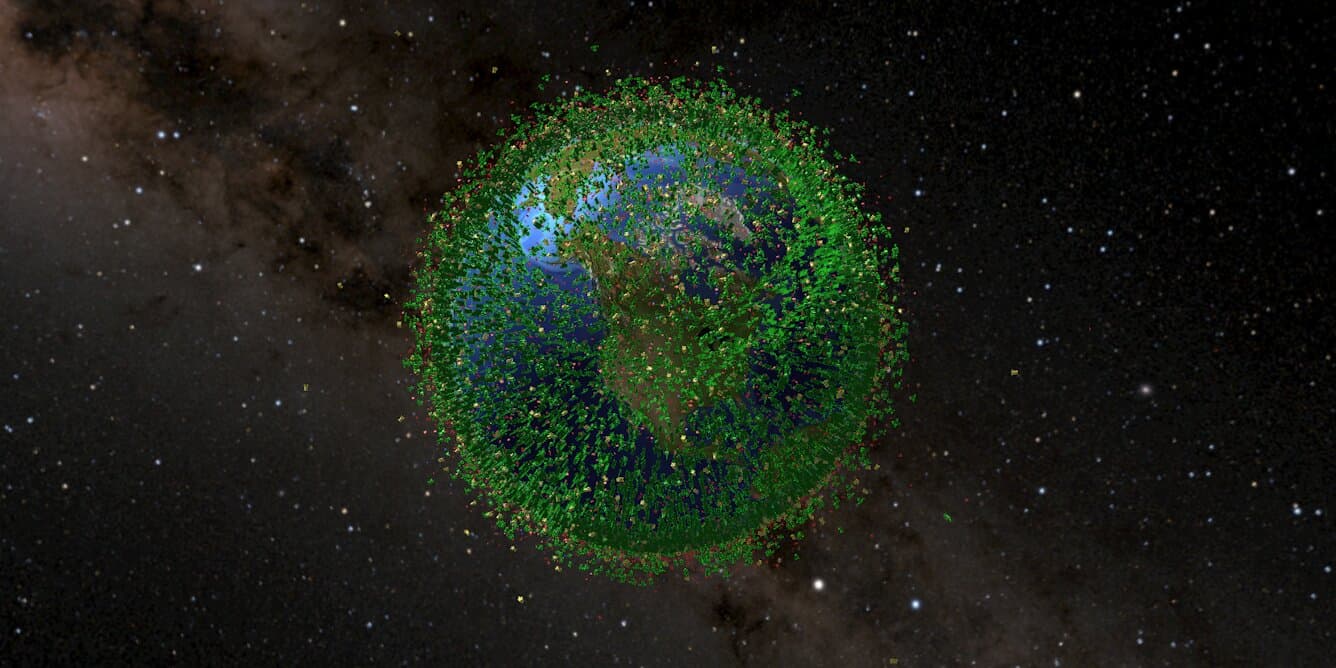
Image: TechXplore
Earth’s orbit is already crowded, with about 16,000 satellites circling the planet and supporting GPS navigation, weather forecasting, banking, emergency services, and internet communications. New launches happen every few weeks, and some estimates suggest the total could pass 100,000 within this decade. Even the more conservative projection—up to 60,000 satellites by 2030—would dramatically increase traffic overhead.
That growth brings familiar risks at much larger scale: more light pollution for astronomy, more chances of collisions, and more space debris. In the worst case, debris could trigger Kessler syndrome, a chain reaction that would fill orbit with fragments and make it unusable for future satellite launches and other missions.
The issue is not just launching satellites, but keeping them working safely for years. Satellites age like any other machine: batteries degrade, electronics wear down, and radiation and temperature swings take a toll. A reminder came in March this year, when a large NASA satellite made an uncontrolled re-entry over the eastern Pacific Ocean, drawing global attention as experts tracked where debris might fall.
Today, operators mostly monitor satellite health from the ground using telemetry on battery performance, temperatures, power consumption, and onboard systems. That model has worked for decades, but it becomes harder when constellations scale from dozens of spacecraft to hundreds or thousands.
Researchers say artificial intelligence could help by spotting early signs of failure before they become mission-ending problems. One focus is battery degradation. In recent research using publicly available NASA satellite battery data, scientists tested whether machine learning could detect patterns linked to battery aging and predict future performance. If problems are caught early, operators could send new instructions—such as reducing power-hungry tasks, changing when data are processed or transmitted, or putting nonessential systems into standby—to extend a satellite’s life.

Recommended reading
Earth model suggests AI isn’t humanity’s only endgame
The work also explores federated learning, which would let individual satellites learn from their own data and share insights with other satellites or ground systems without constantly transmitting raw data back to Earth. That could reduce demands on time, bandwidth, and energy while helping large fleets monitor themselves.
The authors caution that AI will not solve orbital congestion or eliminate debris on its own. Any predictive system would still need extensive testing against historical satellite data, simulated faults, and laboratory battery experiments, and autonomous decisions would need human oversight. Their paper is Amr Adel et al, _Federated predictive maintenance with NASA BP930 satellite battery in industry 5.0_, published in the Journal of Intelligent Manufacturing (2026), DOI: 10.1007/s10845-026-02839-x.

Frontier Editor
Dan is our resident futurist, covering electric mobility, space exploration, and the smart home. He's interested in atoms just as much as bits. Whether it's a new battery chemistry, a reusable rocket, or a protocol that finally makes IoT devices talk to each other, Dan breaks down the engineering that pushes humanity forward.
via TechXplore