• 2 min read
Concrete floors use up to half less material at TU Wien
TU Wien says topology-optimized concrete slabs can cut material use by up to 50% without reducing load-bearing capacity.
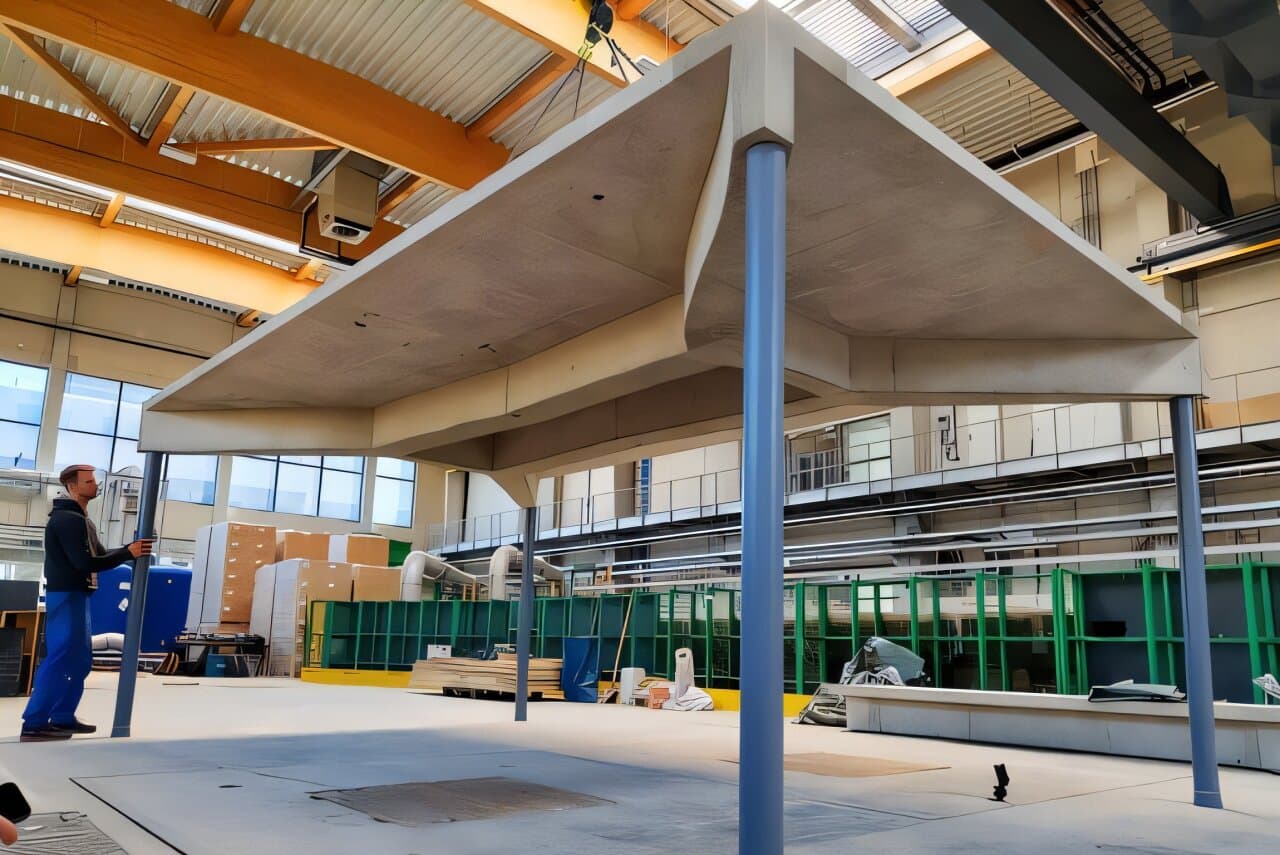
Image: TechXplore
TU Wien researchers say they have shown a way to build reinforced concrete floor slabs with up to 50% less material while maintaining the same load-bearing capacity. The work targets one of the biggest material sinks in buildings: floors can account for up to 60% of a building’s total concrete volume, and cement production is responsible for around 8% of global CO₂ emissions.
The project, called TOPS—short for Topology-Optimized Reinforced Concrete Slabs with Digital Formwork and Reinforcement—combines mathematical topology optimization with a digital manufacturing workflow. Instead of casting conventional solid flat slabs, the system calculates where concrete is structurally necessary and removes it elsewhere, producing ribbed, force-following shapes.
“Concrete is an excellent building material, but we need to use it in a much more efficient way. Our goal is to use material only where it is structurally needed.”
Material-saving systems such as waffle slabs are already known, but the team says their more complex geometries would be too expensive to make with standard construction methods. The key change is a “file-to-factory” process in which design data flows directly into production for both formwork and reinforcement. According to Huber, that makes it possible to update manufacturing data immediately when the model changes, reducing time and errors.
To validate the approach, the team built two large-scale demonstrators. DataB GmbH produced the formwork using CNC technology, while Mesh AG robotically welded the reinforcement. The slabs then underwent load testing against conventional floor systems, including checks for load-bearing capacity and deflection. TU Wien says the tests confirmed the material savings without weakening structural performance.
The researchers see the strongest near-term use in multistory buildings with longer spans, including office buildings and shopping centers, where repeated use of identical formwork elements can help offset the added geometric complexity.

Recommended reading
Sponge-inspired metamaterials cut vibrations and boost strength

Frontier Editor
Dan is our resident futurist, covering electric mobility, space exploration, and the smart home. He's interested in atoms just as much as bits. Whether it's a new battery chemistry, a reusable rocket, or a protocol that finally makes IoT devices talk to each other, Dan breaks down the engineering that pushes humanity forward.
via TechXplore