• 5 min read
AI GPUs Are Driving a Local Pollution Fight
The chips behind generative AI now sit at the center of a widening backlash over power, water, air pollution, and what communities get in return.
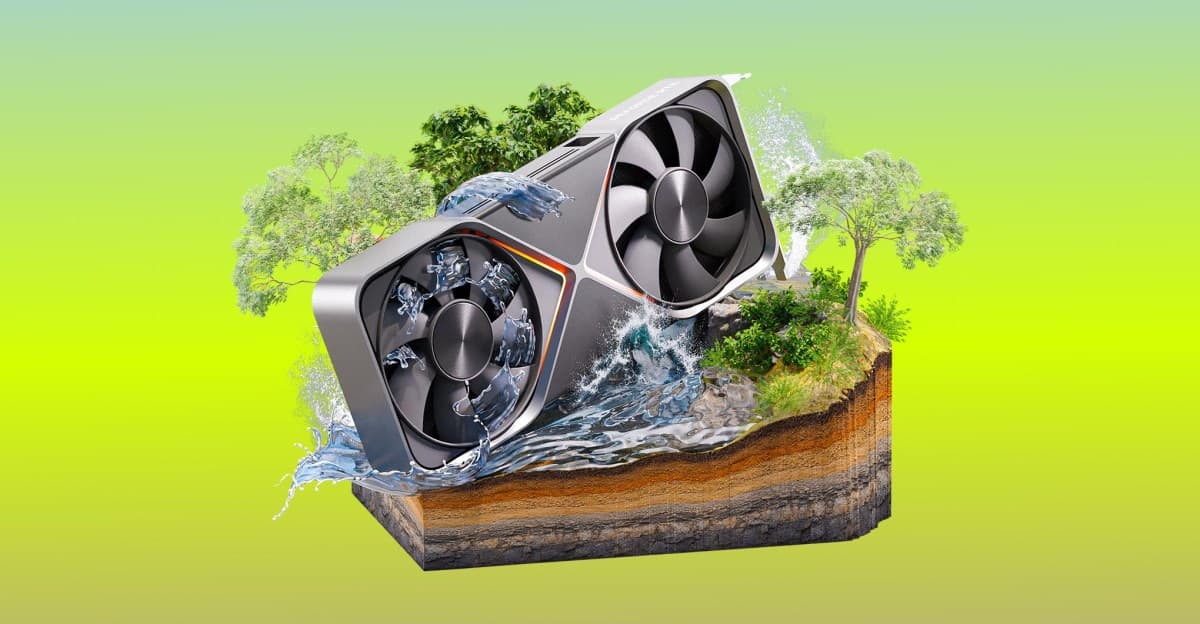
Image: The Verge
GPUs have moved from gaming hardware to the core machinery of the AI boom — and with that shift, they’ve become harder to ignore. Hundreds of thousands of them are being packed into data centers worldwide, even as the same class of chips remains embedded in smartphones, cars, and gaming PCs.
That scale-up has turned a once-niche component into a flashpoint over energy use, water demand, air pollution, and e-waste. As Nvidia has grown from a specialist chipmaker into the world’s most valuable company, debate over the environmental cost of AI has followed close behind.
“There are massive hardware developments that start because of games.”
Flick argues that GPUs have long sat at the center of bigger ethical questions, first in gaming and now in AI. Manufacturing them can involve raw material extraction and toxic chemicals, while running them in data centers burns through electricity and water. At the end of a GPU’s life, there is also the problem of electronic waste.
The tension, as the piece lays it out, is value. Consumers often tolerate environmental harm from products they find useful or cheap, whether that means fast fashion or consumer electronics. But Catherine Flick and Ashley Striblet, who works in product strategy and consumer AI, both say many people still do not see enough day-to-day benefit from AI to justify its costs.
US data centers are making the impact harder to ignore
The US already has more data centers than any other country and plans for many more. As companies expand hyperscale AI data centers, communities are increasingly confronting the local effects: higher utility bills, industrial noise, pressure on water systems, and more pollution.

Recommended reading
UK data centre boom hits a water reality check
That is no longer an abstract supply-chain issue happening overseas. In the US, residents are seeing large server facilities proposed or built near where they live, including in places where lower-income communities and communities of color have long shouldered disproportionate environmental burdens. The story cites the NAACP’s lawsuit against xAI, now doing business as SpaceXAI, over air pollution from gas generators installed to power its data centers.
“Isn’t it nice to have the environment as a scapegoat?”
The numbers behind AI power, air pollution, and water use
Shaolei Ren, an associate professor of electrical and computer engineering at the University of California, Riverside, studies how data centers affect nearby communities, especially through air quality and water scarcity. He argues that the real costs of AI often remain invisible to users.
A 2024 preprint study by Ren and colleagues at UCR and Caltech estimated that training a model as large as Meta’s Llama 3.1 could cause as much air pollution as 10,000 round trips by car between Los Angeles and New York City — roughly 93 years of driving. The same study found that public health costs tied to growing AI adoption could top $20 billion by 2028 and contribute to 1,300 premature deaths annually by 2030 from air pollution.
On electricity, the growth has been steep:
- Gaming used roughly 34 terawatt-hours per year in the US, according to a 2019 study, producing emissions comparable to about 5 million cars or roughly 24 million tons of CO2.
- GPU-accelerated AI servers in US data centers grew from 2TWh in 2017 to more than 40TWh in 2023, according to a 2024 Lawrence Berkeley National Laboratory study.
- By 2028, AI servers' annual power consumption could reach 165 to 326TWh.
- The lower estimate, 165TWh, would be about the yearly energy use of more than 8.7 million US homes.
According to Alex de Vries-Gao, a PhD candidate at the Vrije Universiteit Amsterdam Institute for Environmental Studies, AI likely exceeded the power consumption of Bitcoin mining in 2025 and accounted for nearly half of all electricity used by data centers globally. He estimates the resulting carbon emissions reached between 32.6 million and 79.7 million tons annually. For comparison, New York City produces around 50 million tons of CO2 annually.
Water use may be even more difficult for local communities. De Vries-Gao estimates AI may have used between 312.5 billion and 764.6 billion liters of water in 2025, roughly in the range of global bottled water consumption each year. Ren’s earlier 2023 study estimated water demand could reach as high as 600 billion liters in 2027.
What matters most locally, Ren says, is not just the annual total but the peak. Data centers can sharply increase water use during hot periods when communities may already face drought stress. During peak demand, a home might use 1.5 to 2.5 times its usual water volume; a data center might use 6 to 10 times as much, and some very large projects could need 30 times more water.
If current trends continue, US data centers could require up to 1,451 million gallons per day of new peak water capacity through 2030, according to a recent preprint Ren coauthored. Building enough capacity could cost up to $10 billion — a daunting bill for small, underfunded local water systems.
Ren says companies' promises around recycling or replenishing water are not enough on their own. What communities need, he argues, is transparency around peak demand and a real role in planning the infrastructure upgrades these facilities require.
“When we use AI we tend to forget that this has an impact on the real world around us. This goes beyond carbon [emissions], and it’s kind of out of sight, out of mind.”

Enterprise Editor
Marcus follows the money. He covers enterprise software, cloud architecture, and the tectonic shifts in Big Tech strategy. He translates dense earnings calls and complex M&A activity into actionable insights about where the industry is actually heading. If a tech giant makes a silent pivot, Marcus is usually the first to notice.
via The Verge