• 2 min read
AI predicts subway door risks before passengers arrive
Researchers from SKKU, KAIST, and Texas Tech built a CCTV-based system that flags subway door entrapment risks before riders reach the platform edge.
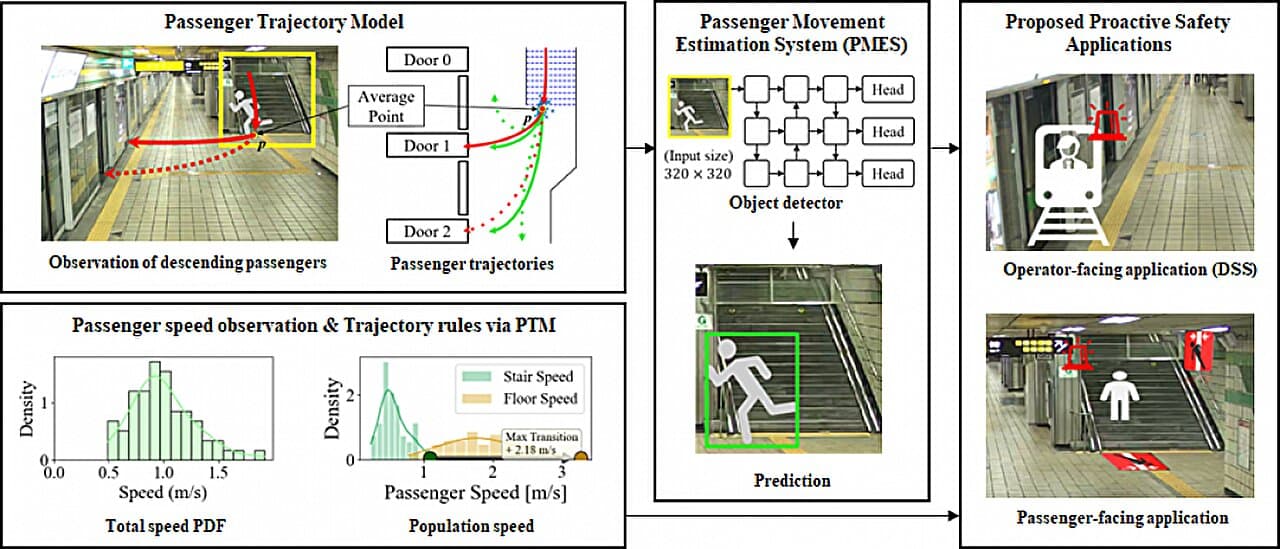
Image: TechXplore
A research team led by Professor Jo Woon Chong at Sungkyunkwan University (SKKU), working with researchers from KAIST and Texas Tech University, has developed a CCTV-based system designed to prevent subway door entrapment accidents before they happen.
The system, called Passenger Movement Estimation System (PMES), uses video footage to predict how passengers are moving near train doors. Unlike conventional safety systems that react only after someone enters a danger zone, PMES is intended to identify risk earlier—before a passenger reaches the boarding area. The work was published in IEEE Transactions on Intelligent Transportation Systems.
The researchers also validated a Passenger Trajectory Model (PTM) showing that when a train is at or approaching the platform, 97.85% of passengers coming down the stairs head directly toward the train doors.
“Based on these behavioral patterns, we built a system that captures passenger movements using a single video frame, allowing us to detect risks before passengers reach the train doors.”
In experiments, the team grouped stairway movement into three classes: ascending, descending, and passing. Using an object-detection model, they reported 97.58% real-time classification accuracy.
To make the approach practical for deployment, the researchers built SD Net (Subway Door Network), an ultra-lightweight model designed to run in constrained computing environments. They also developed a Decision Support System (DSS) to help train operators choose the best time to close doors and determine when passenger warning alarms should sound.

Recommended reading
Einride spends $38M to add charging software
The project brought together expertise from multiple fields, including civil and environmental engineering through Professor Lisa Lim at KAIST and electrical and computer engineering through Yifan Li at Texas Tech University. According to the team, the findings suggest transit systems could move beyond passive CCTV monitoring toward proactive safety responses while also reducing train delays.
The paper is: Hee Jo et al, “Passenger Trajectory Model and Passenger Movement Estimation System for Preventing Passenger Subway Door Accidents,” IEEE Transactions on Intelligent Transportation Systems (2026). DOI: 10.1109/tits.2026.3702710

Frontier Editor
Dan is our resident futurist, covering electric mobility, space exploration, and the smart home. He's interested in atoms just as much as bits. Whether it's a new battery chemistry, a reusable rocket, or a protocol that finally makes IoT devices talk to each other, Dan breaks down the engineering that pushes humanity forward.
via TechXplore