• 2 min read
AR glasses get clearer views without dulling the real world
Researchers built an AR display method that preserves real-world brightness while keeping virtual objects convincing under different lighting.
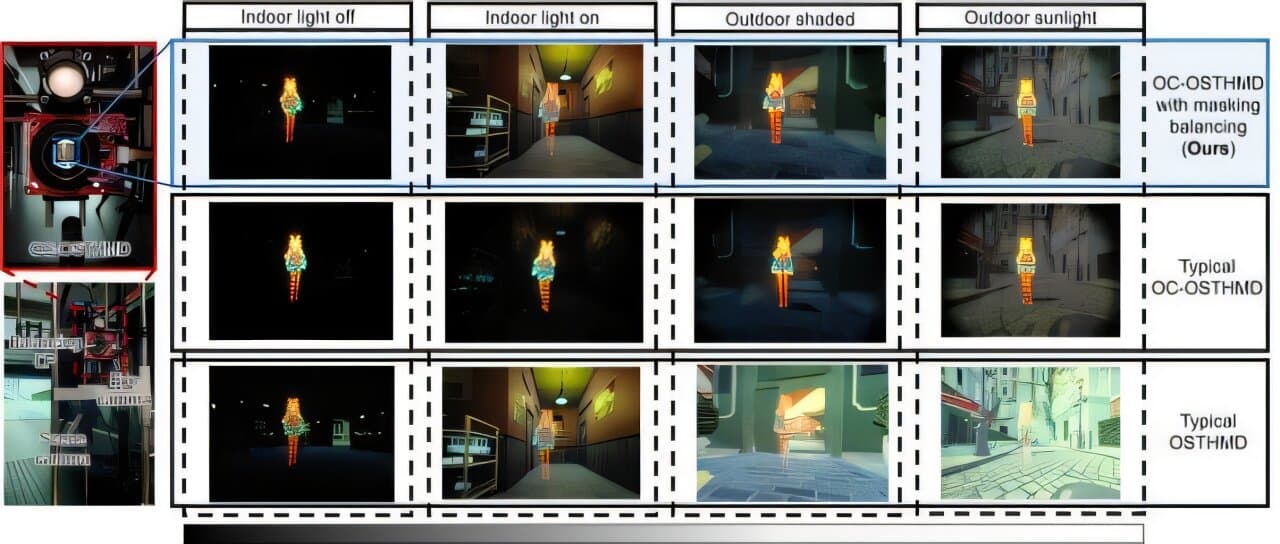
Image: TechXplore
A research team spanning Japan and China says it has tackled a long-standing AR glasses problem: making virtual objects look realistic without dimming the real world around the wearer.
In a paper published in IEEE Transactions on Visualization and Computer Graphics, the group describes a perception-driven display strategy for optical see-through augmented reality headsets. Existing occlusion systems improve the realism of virtual objects by physically blocking some incoming light, but that also reduces the brightness of the real environment and can make everyday tasks harder.
The new approach, developed by Xiaodan Hu of Shibaura Institute of Technology, Dr. Yan Zhang and Professor Xubo Yang of Shanghai Jiao Tong University, and Professor Kiyoshi Kiyokawa of the Nara Institute of Science and Technology, shifts the focus from pure hardware optimization to what users can actually see.
How mask balancing works
The system combines one polarized component for pixel-level occlusion with another that bypasses the optical path to preserve the natural brightness of the real world. By changing the cross-angle between a polarizing beam splitter and a linear polarizer, the display blends those two views in real time.
It also uses eye tracking and scene analysis to estimate how visible both the real scene and virtual objects are, then continuously adjusts the balance.
Recommended reading
Oura Ring 5 stays ahead with sharper software
To set perceptual thresholds, the researchers ran multiple user studies:
- 12 participants helped measure how much contrast was needed to recognize textures in virtual objects
- 24 participants were tested on the perception of lighting effects
- A final study with 12 participants evaluated the full prototype
According to the team, that final test showed improved real-world visibility while maintaining a convincing appearance for virtual content across different lighting conditions.
“Our research demonstrates that human visual perception can be used to dynamically balance the visibility of the real world and virtual content. By adapting the display according to what users can actually perceive, our method improves real-world visibility while preserving the appearance of virtual objects under different lighting conditions.”
Hu said the work builds on the team’s earlier study, “Perception-driven soft-edge occlusion for optical see-through head-mounted displays,” which found that human perception of AR displays can differ significantly from predictions based only on optical measurements.
Potential uses for future optical see-through AR systems include industrial maintenance, medical assistance, education, navigation, and remote collaboration—settings where users need to watch the real world and digital overlays at the same time.
The paper is titled “Mask Balancing: Perception-Driven Dynamic Visibility Enhancement for Occlusion-Capable Optical See-Through Head-Mounted Displays” by Yan Zhang et al., with DOI: 10.1109/tvcg.2026.3679903.

Gadgets Editor
Eli is obsessed with the tangible future. He reviews phones, wearables, and everything with a battery. Known for his rigorous testing protocols and unabashed teardowns, Eli has broken more review units than he cares to admit, all in the name of discovering the truth about durability and repairability.
via TechXplore