• 2 min read
Artemis III needs three rockets where Apollo used one
NASA says Artemis III will require launches from SLS, Blue Origin, and SpaceX, underscoring how much development still remains.
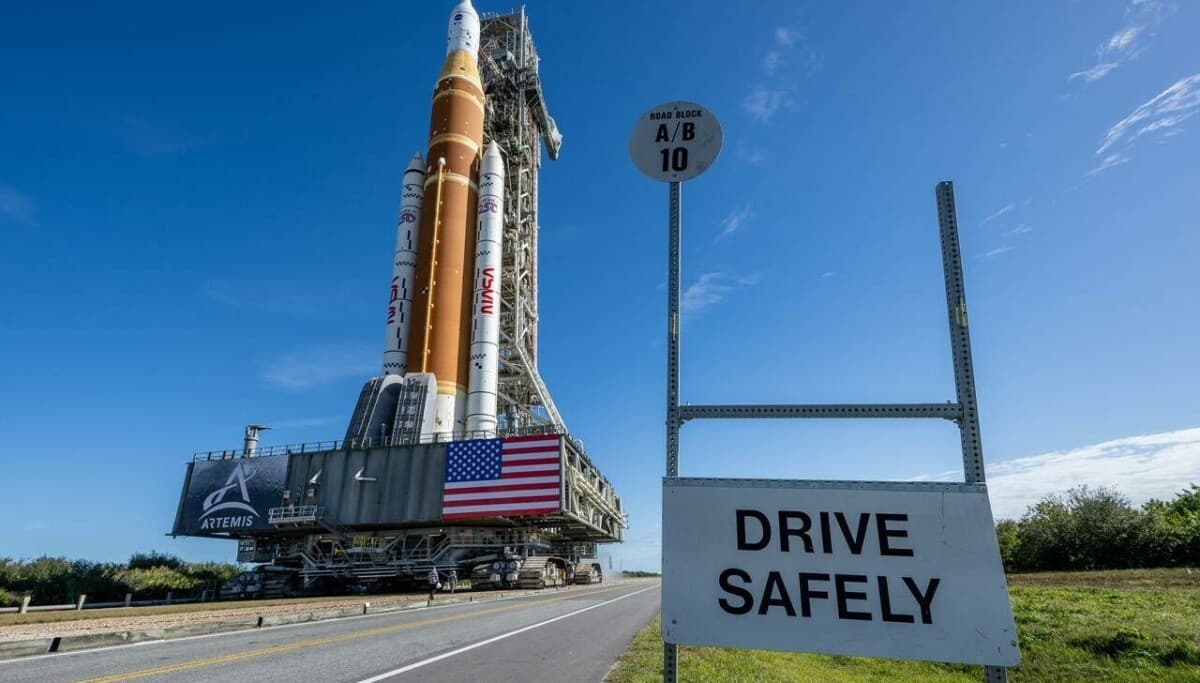
Image: The Register
NASA has laid out a strikingly complicated plan for Artemis III: the mission will need three separate rockets to accomplish what Apollo 9 did with one Saturn V.
In its latest update, the agency kept an optimistic 2028 lunar landing target for Artemis IV, but the briefing also highlighted how much work is still ahead for Blue Origin and SpaceX before Artemis III can fly as planned.
Artemis III has often been compared to Apollo 9, which tested the Apollo Lunar Module in Earth orbit. But neither commercial partner is yet flying anything close to a finished lunar lander. Blue Origin’s test vehicle will be based on its current Mark 2 crew lander architecture and include major avionics, flight software, life support, and the crew cabin. Orion, launched on NASA’s SLS, will dock to the side of the Blue Origin spacecraft for crew transfer. Two astronauts, wearing orange Orion survival suits, will board the test lander, while Orion’s software controls the stack. An instrumented lunar surface spacesuit mass simulator, similar to the “Moonikin” flown on Artemis I, will also be carried aboard the Blue Origin lander.

Recommended reading
Satellite startups pull $8.1B in half a year
SpaceX’s role is simpler: a docking system mounted on the nose of a Starship test article. But that still depends on Starship first reaching orbit, which is why NASA will be watching Flight Test 13 closely. According to the plan described, Starship V3 is still flying suborbital until SpaceX proves it can reliably relight an engine for controlled re-entry.
Artemis III launch sequence
The current mission profile starts with Blue Origin launching its lander into orbit, where it can loiter for up to 30 days. After checkout, the crew launches aboard Orion to rendezvous and dock. Only then would SpaceX launch its Starship test article, which would rendezvous and dock with Orion as well. The crew would not board Starship; they would only verify communications and interoperability. At that point, SpaceX’s vehicle would control the docked stack.
NASA noted that SpaceX’s docking capability was qualified in 2023, while Blue Origin tested its pressurized docking system only earlier this year.
“Artemis III will be a highly choreographed dance with a demanding launch sequence across multiple launch pads and equally demanding mission operations for our ground and flight crews, making it one of the most complex and ambitious missions NASA has ever undertaken.”
That complexity extends to the launch hardware itself. SLS has flown twice, including one lunar flyby. Starship still has not reached orbit, and Blue Origin is still rebuilding its launch pad after May’s explosion. If NASA, SpaceX, and Blue Origin can make the choreography work, Artemis III will be a major technical achievement on its own.

Frontier Editor
Dan is our resident futurist, covering electric mobility, space exploration, and the smart home. He's interested in atoms just as much as bits. Whether it's a new battery chemistry, a reusable rocket, or a protocol that finally makes IoT devices talk to each other, Dan breaks down the engineering that pushes humanity forward.
via The Register