• 3 min read
Chrome extension title tweaks can swing rankings fast
A dataset of 997 Chrome Web Store title changes suggests renaming an extension makes rankings about 4x more likely to move within two weeks.
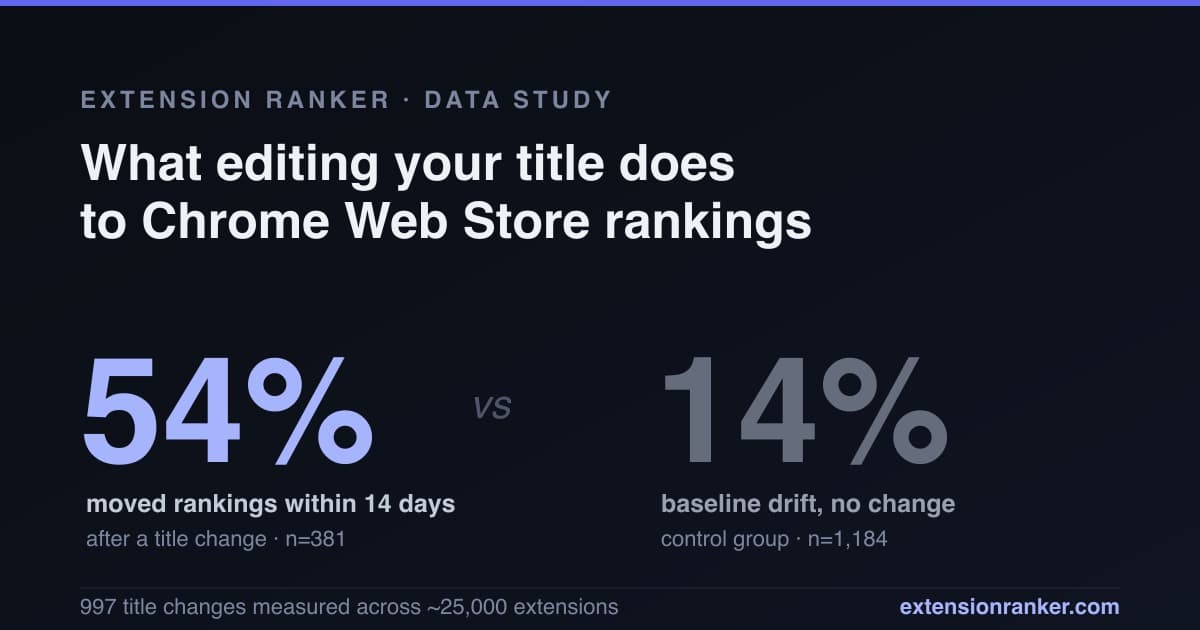
Image: Hacker News
Changing a Chrome Web Store title appears to be one of the fastest ways to shake up search rankings — for better or worse.
According to data published by Extension Ranker, 997 of roughly 25,000 tracked extensions changed their titles since early March, or about 50 title experiments a week. For 381 of those extensions, the author says there was enough ranking data before and after the change to measure the effect. A control group of 1,184 extensions that did not change titles served as a baseline.
The gap was stark:
- 54% of title changers saw at least one keyword move 3+ positions within 14 days
- Just 14% of non-changers saw the same level of movement
- 6% of title changers moved in both directions at once, versus 0.2% in the baseline group
Within the changed-title group, the split was almost even: 30% gained 3+ positions on at least one keyword, and 30% lost 3+ positions on at least one. The author’s takeaway is blunt: editing a title makes rankings about 4x more likely to move within two weeks, with roughly equal odds of going up or down.

Recommended reading
Deezer says 50% of new uploads are AI music
One example stood out. On June 18, Mailmeteor — listed at around 60K users at the time — changed its title from “Gmail AI Email Assistant” to “Mail Merge for Gmail.” The author says there was no version update around that date and ratings stayed steady, making it a relatively clean case.
Across 22 tracked keywords, the shift was dramatic. Terms tied to mail merge improved from around #8 to roughly #2, while broader terms such as “email assistant” fell from #1.0 to #11.0. Two weeks later, Mailmeteor’s displayed user count dropped from the 60K bucket to 50K.
The broader argument is that exact phrasing still matters, especially for smaller extensions. The author says only 44% of the #1 positions in the dataset have every word of the query in the title. The other 56% appear to be driven by factors such as user base, ratings, or partial matches.
A niche example: four variations on YouTube transcription queries — including “YouTube Video Transcript” and “YouTube Transcript Generator” — are led by four different extensions whose titles match those phrases word for word. Some have only about 20K users, while larger extensions in the 400K to 1M user range do not crack the top 10 for those terms.
The author is careful not to overclaim. The 3-position threshold and 14-day window were chosen by the researcher, and possible confounding factors such as version updates or rating changes were not ruled out across all 381 cases. So the data shows that rankings moved after title changes, not that title edits alone caused every shift.
Still, for smaller developers, the message is clear: title edits are not cosmetic. In the Chrome Web Store, each word can anchor specific rankings — and swapping those words means trading one set of searches for another.

Computing Editor
Tomas lives in the terminal. He covers chips, laptops, and operating systems with a focus on performance and efficiency. He reads kernel changelogs the way other people read fiction, and he's always on the hunt for the perfect mechanical keyboard switch. If it processes data, Tomas has an opinion on it.
via Hacker News