• 3 min read
Georgia Tech wants pulp mills making batteries and lubricants
Georgia Tech is testing membranes that turn kraft pulp mill waste into lignin, organic acids, battery materials, and industrial lubricants.
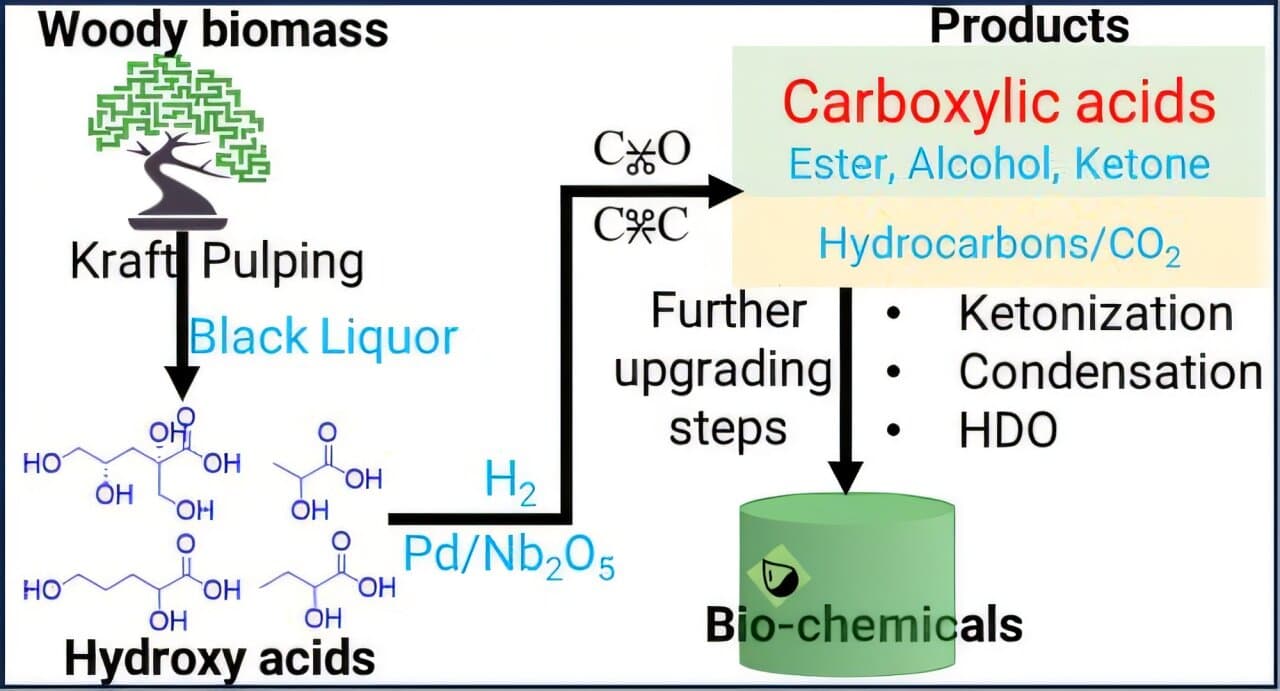
Image: TechXplore
Georgia’s $41 billion forest products industry is under pressure, and a Georgia Tech team says the path forward may be to turn kraft pulp mills into modular biorefineries that make more than paper pulp.
For nearly a decade, Sankar Nair, a professor in the School of Chemical and Biomolecular Engineering and a longtime researcher with the Renewable Bioproducts Institute (RBI), has led work aimed at rethinking how mills handle black liquor, the dark byproduct left after pulp is separated from wood chips. Traditional mills use an energy-hungry chemical recovery loop with multistage evaporators and large recovery boilers to remove water, burn organics for steam and electricity, and recycle chemicals.
Nair said the project began as an energy-saving effort: using membranes to dewater black liquor instead of evaporating it, with the potential to cut that energy use in half. The team then found the membranes could also fractionate black liquor into streams rich in lignin and organic acids, opening the door to higher-value products.
Recommended reading
Magnesium oxide could shield fragile solid-state batteries
From lignin-rich fractions, the researchers have already demonstrated carbon materials for battery anodes and porous adsorbents used in remediation and separations. On the organic-acid side, Nair and Christopher Jones have converted those acids into heavier molecules that could become industrial lubricants and additives. According to Nair, these products have large demand and could command significantly higher prices than conventional pulp outputs.
Field testing at a Georgia mill
A major challenge is making the membranes cheaply and at industrial scale. Tequila Harris, a professor in the George W. Woodruff School of Mechanical Engineering, is leading a shift from small batch production to a continuous roll-to-roll process for reduced graphene oxide membranes. Harris said the system is designed to produce long sheets at speeds above 60 meters per minute, while avoiding volatile organic solvents commonly used in membrane production.
The technology is now moving toward field trials. The team is preparing membrane modules for a test skid that will run on real kraft black liquor at a Rayonier Advanced Materials (RYAM) mill near Savannah. The goal is to gather long-term performance and reliability data under real operating conditions.
That work comes as the sector faces steep losses. Since the 1990s, Georgia’s forestry industry has been hit by paper mill closures tied to digitization and changing demand, including three major mill closures in 2025. The Georgia Forestry Commission estimates those closures erased the market for 8.3 million tons of timber, while reduced lumber usage, import tariffs, and labor shortages worsened the downturn, according to the 2026 Georgia AG Forecast.
Lignin as a battery material
Georgia Tech researchers also see a route from pulp mills into the U.S. battery supply chain. Matthew McDowell, co-director of the Georgia Tech Advanced Battery Center, said lignin-derived carbon could replace graphite in lithium-ion batteries, a material not widely produced in the U.S.
Valerie Thomas, Anderson Interface Chair of Natural Systems, said her team’s life-cycle and economic analysis found that lignin-based graphite can deliver 84% lower energy use and 92% lower greenhouse gas emissions than petroleum-derived synthetic graphite, while also cutting other pollutant emissions.
The battery effort could eventually connect to a new Advanced Battery Center facility scheduled to open at the end of 2027, where companies and academic researchers will be able to build and test full-scale battery cells for translational R&D.
Nair’s broader pitch is incremental rather than all-at-once: mills would not need to spend billions on entirely new plants, but could add membrane fractionation and upgrading systems over time. If that works, kraft mills could shift from commodity pulp production toward advanced biomanufacturing—while keeping jobs tied to facilities like RYAM’s Jesup, Georgia site, which employs more than 800 people.

Frontier Editor
Dan is our resident futurist, covering electric mobility, space exploration, and the smart home. He's interested in atoms just as much as bits. Whether it's a new battery chemistry, a reusable rocket, or a protocol that finally makes IoT devices talk to each other, Dan breaks down the engineering that pushes humanity forward.
via TechXplore